
c. 577 – 681·Feast January 10
St. Agatho
Elderly pope who healed the Monothelite schism
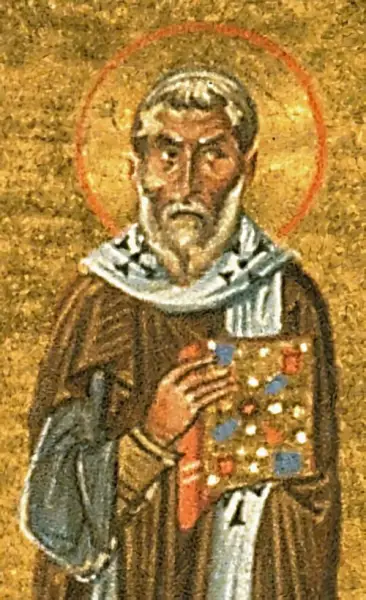
Overview
Agatho governed the church of Rome from 27 June 678 until 10 January 681, the day he died, presiding over the see in extreme old age. Born around 577, probably at Palermo in Sicily and of Greek origin, he lost his parents while young and is said to have entered the monastery of San Giovanni degli Eremiti in his native city. When raids by the Rashidun Caliphate struck Sicily from 652 onward, a wave of Sicilian clergy escaped to Rome, and Agatho was perhaps one of them. For several years he served the Roman church as its treasurer, was created a cardinal by Pope Adeodatus II, and succeeded Pope Donus in 678. His pontificate settled the appeal of Wilfrid of York and, above all, produced the Sixth Ecumenical Council, which condemned Monothelitism and proclaimed the two wills of Christ. He also negotiated with Emperor Constantine IV over imperial interference in papal elections. Church records describe him as the longest-lived pope, dying between 103 and 104 years of age. Anastasius records that his miracles earned him the title Thaumaturgus.
The Complete Life
An Orphan of Palermo
Almost nothing certain survives about Agatho's early years, wrapped as they are in the haze that surrounds most figures of the seventh century. What tradition preserves is this: he was born around 577, probably in Palermo, and was of Greek origin. His parents died while he was still young, leaving him an orphan in a city that stood on the front line of a changing Mediterranean. After their death, it is said, he joined the monastery of San Giovanni degli Eremiti in Palermo, trading an inheritance he scarcely remembered for the stability of monastic life. That peace proved fragile. From 652 onward the Rashidun Caliphate raided Sicily from the sea, and the island's clergy began to abandon their sees for the safety of Rome. Agatho may well have been among these refugees, carrying north with him the memory of his Sicilian monastery and the Greek tongue of his family. If the tradition is true, his path ran from orphanhood in Palermo, to the cloister, to exile, and finally to the service of the Roman church — a formation that left him, unusually for a pope, a man of both the Greek East and the Latin West.
§ Early life
Treasurer, Cardinal, Pope
In Rome Agatho found his life's work in the administration of the church rather than in the cloister. For several years he held the office of treasurer of the Roman church, administering the patrimony that sustained its charities and its clergy, and the office brought him to the attention of successive popes. On 5 March 676, Pope Adeodatus II created him a cardinal, and he served as a cardinal-deacon through the following year. When Pope Donus died in 678, Agatho was chosen to succeed him, ascending to the papal throne on 27 June 678, which fell on a Sunday. By the church's own records he was already a centenarian at his election — a remarkable age at which to take up the heaviest office in Christendom. Later scholars have wondered whether two men have been folded into one: a monk called Agathon and the pope called Agatho may originally have been distinct figures whose stories merged. Whatever the truth, the man elected in 678 brought to the papacy decades of administrative experience, a Greek upbringing that would soon prove indispensable, and the vigor of one whom age had somehow not wearied.
§ Early life
One Council, Two Wills
Two matters defined Agatho's pontificate. The first arrived on his doorstep soon after his election: Bishop Wilfrid of York arrived in Rome to appeal to the authority of the Holy See, having been driven from his see by Archbishop Theodore of Canterbury, who had broken up Wilfrid's diocese and set three bishops over its new divisions. Agatho convoked a synod at the Lateran to investigate. Its judgment was measured — the division of the diocese should stand, but Wilfrid himself should choose the bishops who would govern its parts. The second matter was far graver. Emperor Constantine IV, wanting to heal the schism that Monothelitism had opened between the churches, wrote to Pope Donus proposing a conference; Donus was dead when the letter arrived, but Agatho seized the offered olive branch at once. He commanded that councils meet across the West so that legates might carry the shared position of the Latin church, then sent a numerous delegation east. There, in the imperial palace at Constantinople, on 7 November 680, his letter was read aloud, teaching that Christ possesses two wills, divine and human. Patriarch George of Constantinople accepted it, as did most of the bishops. The council proclaimed the doctrine, condemned Monothelitism, and even included Pope Honorius I in its condemnation. Agatho also negotiated with the emperor over the court's interference in papal elections, winning a promise to abolish or reduce the tax levied on papal consecrations.
§ Papacy
The Wonderworker
Both the Catholic Church and the Eastern Orthodox Church number Agatho among their saints, witnesses to a pontificate that belonged to the whole of Christendom. Anastasius tells us that his miracles were so many that they won him the name of Thaumaturgus, the wonderworker — an uncommon honor for a pope and one that speaks to the devotion his memory inspired in both East and West. He died in January 681, having held the pontificate for about two and a half years, and so did not live to receive the decrees of the council whose success he had made possible; they were sent to Rome after his death, to be received by his successor Leo II. His feast in Western Christianity falls on 10 January, the day of his death, which the Roman calendar keeps as his memorial. The churches of the East — the Eastern Orthodox, and the Eastern Catholic Churches as well — keep him on 20 February in addition. In both traditions he is remembered as the aged pontiff whose letter guided an ecumenical council, the healer of a schism that had divided the church of his day, and the wonderworker whose prayers his contemporaries credited with signs and marvels.
§ Veneration
What His Papacy Left Behind
The work of Agatho outlasted his brief reign in several enduring ways. The Sixth Ecumenical Council, which his letter had guided and his legates had attended, not only ended Monothelitism but healed the schism between the sees of Rome and Constantinople — the central diplomatic and theological achievement of his age. His ruling in the affair of Wilfrid of York left its own trace on English church history, establishing that while a diocese might be divided for the good of souls, the deposed bishop retained a voice in naming his successors. His negotiation with Constantine IV curtailed, at least by promise, the imperial treasury's exaction from newly consecrated popes, an early step in the long wrestling of the Roman see with Constantinople's control. Church records long preserved his distinction as the longest-lived pope, said to have died between 103 and 104 years of age, though recent research has questioned the figure, suggesting that the pope and a monk named Agathon may have been confused with each other. In art he is shown holding a long cross, notably in the Menologion of Basil II around the year 1000, and the city of Palermo, which may have given him birth, honors him as its patron.
§ Papacy
Timeline
- 577
Born, probably at Palermo in Sicily, of Greek descent
§ Early life
- 652
Rashidun raids on Sicily began; he may have fled to Rome with other Sicilian clergy
§ Early life
- 5 Mar 676
Created a cardinal by Pope Adeodatus II
§ Early life
- 27 Jun 678
Ascended to the papacy on a Sunday, succeeding Pope Donus
§ Early life
- 7 Nov 680
Council opened in the imperial palace at Constantinople, where his letter on the two wills was read
§ Papacy
- 10 Jan 681
Died in Rome, aged about 103 or 104, after a reign of roughly two and a half years
§ Veneration
- Sep 681
Council ended after his death and sent its decrees to Rome
§ Papacy
The Record
- Major works
- Letter to the Sixth Ecumenical Council advocating that Christ possesses two wills, divine and human
- Patron of
- Patron of Palermo
- Symbols
- Holding a long cross
- Canonization
- Pre-congregation; venerated as a saint by the Catholic and Eastern Orthodox churches
Prayer
Bibliography
Show 5 sources
- Kelly, J. N. D.; Walsh, Michael (2015). Dictionary of Popes. Oxford University Press. ISBN 9780191044793.
- Ott, Michael. "Pope St. Agatho." The Catholic Encyclopedia. Vol. 1. New York: Robert Appleton Company, 1907.
- Brusher, Joseph S.J. Popes Through the Ages.
- Richards, Jeffrey (2014). The Popes and the Papacy in the Early Middle Ages: 476–752. Routledge. ISBN 9781317678175.
- Palermo, Gaspare (1816). Guida istruttiva per potersi conoscere tutte le magnificenze della Città di Palermo. Vol. 3. Palermo: Reale Stamperia. ISBN 9781017268133.
Profile text adapted from the Wikipedia article, licensed CC BY-SA 4.0.
Pray with this saint every day
Save St. Agatho to your favorites, read the full profile, and get feast-day reminders in the Saints app.
Get the Saints AppFree on the App Store for iPhone and iPad