
c. 15 – c. 92·Feast April 26
St. Anacletus
Second-century pope and martyr of Rome
Overview
Anacletus, also known as Cletus, was bishop of Rome in the generation immediately following the apostles, serving between about 80 and his death about 92, after Peter and Linus and before Clement I. A Roman by birth, born around the year 15, he was consecrated by the apostle Peter according to tradition. His pontificate belongs to the shadowed first decades of the Roman church, and little is known of it in detail, but the records that survive credit him with ordaining a number of priests and, by tradition, with dividing the city of Rome into twenty-five parishes — an act of organization that shaped the pastoral life of the capital for centuries. He is said to have died a martyr, perhaps about the year 91, though the precise dates of his life and reign remain uncertain. A tomb ascribed to him lies near St. Peter's tomb in the Vatican Necropolis beneath St. Peter's Basilica. His name, under the form Cletus, is spoken in the Roman Canon of the Mass to this day, and his feast is kept on 26 April.
The Complete Life
A Roman of the Apostolic Age
Anacletus was a Roman, born around the year 15, in the decades when the memory of Christ was still fresh and some who had seen him still lived. The names by which history knows him carry meanings the early church pondered: Cletus, from the Greek, means one who has been called, while Anacletus means one who has been called back, and a third form, Anencletus, means unimpeachable or blameless. Tradition holds that he was consecrated bishop by the apostle Peter himself, placing him in the closest circle of the church's founding generation. The ancient sources are inconsistent in their use of these names, and the Liberian Catalogue even lists Cletus and Anacletus as two different popes; yet Eusebius, Irenaeus, Augustine of Hippo, and Optatus all judge the two names to belong to a single individual, and the order used by Irenaeus — in which he succeeded Linus and preceded Clement — is the one generally followed today. The Roman Martyrology mentions the pope under the name Cletus, and the Annuario Pontificio gives both forms, preserving in its pages the memory of a man the earliest Christians knew by two names and honored with one devotion.
§ Name and etymology
Shepherding the Church of the Capital
Like most popes of the church's first centuries, Anacletus leaves a shadowy record: tradition places between about 80 and 92 and reckons at twelve years. The 2012 Annuario Pontificio says so itself: through the first two hundred years, when a pontificate began and ended cannot be fixed with certainty, and while it places Anacletus from 80 to 92 — the years given by Eusebius and Jerome — the years 76 to 88 are also frequently cited. What the surviving records do say is enough to mark him as a builder of the Roman church's daily life. One record notes that he ordained priests, though how many cannot now be said, supplying the young community with the clergy it needed to celebrate the sacraments and teach the faith in a city where Christianity had no legal standing. Tradition goes further and credits him with dividing Rome into twenty-five parishes, a work of pastoral organization that would have gathered the scattered faithful of an enormous capital into stable communities for worship and charity. Whether the detail is exactly remembered or devotionally embellished, it reflects the church's memory of a pope whose concern was the ordinary machinery of shepherding: priests ordained, flocks assembled, the faith carried into every quarter of the city.
§ Papacy
Martyrdom and Burial Near Peter
Anacletus is said to have died a martyr, perhaps about the year 91, his blood sealing a pontificate spent in the shadow of imperial suspicion. The day of his death is unknown, a silence that the passage of nineteen centuries has made irreparable. Yet the church of Rome never lost the sense of where he lay. In field P of the Vatican Necropolis, close beside the grave of St. Peter, lies a tomb ascribed to Anacletus, underneath St. Peter's Basilica, surrounded by the tombs likewise attributed to Linus, Evaristus, Telesphorus, Hyginus, Pius I, and Anicetus — with Victor I among them — an entire line of early bishops of Rome gathered around the grave of the apostle. Specialists observe that hardly any inscriptional proof backs assigning these tombs to the popes of those first centuries, and the caution is fair; but the tradition itself testifies to how the ancient church remembered him, as one of the first shepherds who ruled the Roman flock at the price of his life and was laid to rest beside the chief of the apostles. In the centuries since, pilgrims walking the scavi beneath the basilica pass the place where the church's memory has honored him from the beginning.
§ Papacy
One Saint, Two Feasts
The church has honored Anacletus from the beginning as one of its earliest martyrs, and his name is inseparable from its central prayer: under the form Cletus his name stands within the Roman Canon of the Mass, voiced by priests at every solemn celebration in the list of the apostles and early pontiffs. The calendar of his feast tells its own story of the pope's double name. The Tridentine calendar reserved 26 April as the feast of Saint Cletus, honored jointly with Pope Marcellinus, and 13 July for Saint Anacletus alone — one saint, as it seemed, receiving two observances. In 1960 John XXIII retained the 26 April observance — the one that names the saint as the Canon of the Mass names him — but struck 13 July from the calendar. The following year the Congregation for Rites decreed that the observance of Saint Anacletus, whatever its basis or rank, be moved to 26 April and given its proper title of Saint Cletus. Clergy who follow the General Roman Calendar of 1954 still keep the July feastday, and the Eastern Orthodox Church venerates him alongside the Catholic West, a martyr of the undivided early church.
§ Veneration
From the Roman Canon to Dante's Heaven
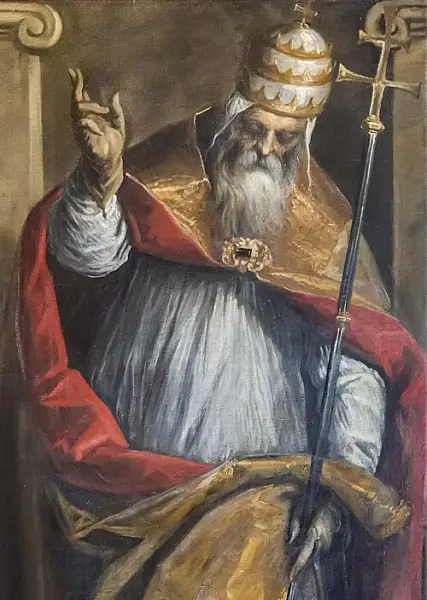
Few figures of the apostolic age have left so faint a documentary trace and so firm a place in the church's memory. The lists of the bishops of Rome, from Eusebius and Jerome onward, place him second or third in the succession that runs from Peter, and the church's liturgy keeps his name in the canon of the Mass, where the faithful have invoked Cletus with Linus and Clement for well over a millennium. Dante gave the old pope a poet's immortality: in the Divine Comedy he places Anacletus in the Heaven of the Fixed Stars, among the triumphant spirits of the Paradiso, so that the bishop whose earthly deeds are barely recorded stands ranked among the brightest of heaven's citizens. Art has shown him in the vestments of a later age, crowned with the anachronistic papal tiara in a sixteenth-century painting by Palma il Giovane in the I Gesuiti in Venice, and a Roman church, San Cleto, keeps his statue. The very uncertainty of the records — the disputed dates, the doubled names, the tombs without inscriptions — has become part of his legacy, reminding every generation that the church's foundations were laid by men whose greatest monument is not what was written about them but what was handed on through them.
§ In literature
Timeline
- 15
Born in Rome, in the reign of Tiberius
§ Papacy
- 80
Began his pontificate as bishop of Rome, succeeding Linus
§ Papacy
- 91
Died a martyr, perhaps about this year, ending his pontificate
§ Papacy
- 1960
Pope John XXIII kept the 26 April feast of Saint Cletus but removed 13 July as a separate feast of Saint Anacletus
§ Veneration
- 1961
The Congregation for Rites decreed that the feast of Saint Anacletus be transferred to 26 April under the name Saint Cletus
§ Veneration
The Record
- Major works
- Traditionally credited with dividing the city of Rome into twenty-five parishes
- Symbols
- Papal tiara, as shown in the painting by Palma il Giovane in the I Gesuiti, Venice
- Canonization
- Pre-congregation; venerated as a martyr-saint from the earliest centuries of the Roman church
Prayer
Bibliography
Show 5 sources
- Campbell, Thomas (1907). "Pope St. Anacletus." Catholic Encyclopedia. Vol. 1. New York: Robert Appleton Company.
- Attwater, Donald; John, Catherine Rachel (1993). The Penguin Dictionary of Saints. 3rd edition. New York: Penguin Books. ISBN 0-14-051312-4.
- Loomis, Louise Ropes. The Book of Popes (Liber Pontificalis). Merchantville, New Jersey: Evolution Publishing. ISBN 1-889758-86-8.
- McBrien, Richard P. (2000). Lives of the Popes. Harper. ISBN 0-06-065304-3.
- Reardon, Wendy J. (2004). The Deaths of the Popes: Comprehensive Accounts, Including Funerals, Burial Places and Epitaphs. Jefferson, N.C.: McFarland & Co. pp. 23–26. ISBN 978-0-7864-1527-4.
Profile text adapted from the Wikipedia article, licensed CC BY-SA 4.0.
Pray with this saint every day
Save St. Anacletus to your favorites, read the full profile, and get feast-day reminders in the Saints app.
Get the Saints AppFree on the App Store for iPhone and iPad