
died 19 December 401·Feast December 19
St. Anastasius I
Pope who condemned Origen's writings
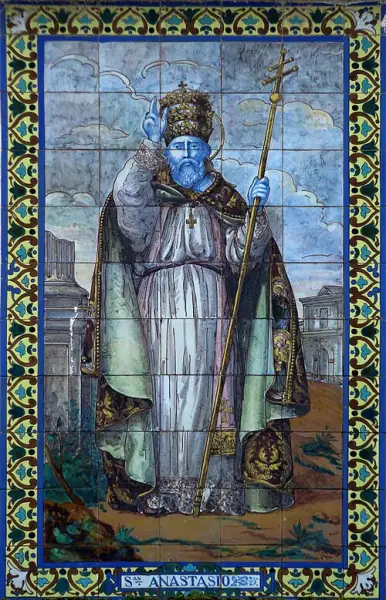
Overview
Anastasius I was bishop of Rome from 27 November 399 until his death on 19 December 401, a short pontificate at the turning of the fourth century. A native of Rome and a son of Maximus, he took the papal throne after Siricius. His brief reign was marked by a decisive stand in the theological controversies of the age: shortly after the writings of the Alexandrian theologian Origen were translated into Latin, Anastasius condemned them, called a Roman council in 400 to weigh the question, and battled Origenist teaching for the whole of his reign — the assembly concurring that Origen had forsaken the church's faith. He lent encouragement to the Christians of North Africa in their struggle against Donatism and issued a lasting liturgical instruction, directing priests to stand and bow their heads as they read from the gospels. Augustine, Jerome, and Paulinus all stood among his friends; Jerome called him a man of great holiness, rich in his poverty. He died in Rome and found burial in the Catacomb of Pontian beside his immediate successor, Innocent I.
The Complete Life
A Roman Son on the Chair of Peter
Anastasius was born in Rome, the son of a man named Maximus, and he belonged to that generation of Roman clergy who led the church as the age of persecution passed into the age of Christian emperors. When Pope Siricius died, Anastasius was chosen to succeed him and began his pontificate on 27 November 399, taking up the government of a church that stood at the center of the Christian world's oldest and most storied community. The Rome of his day was still, in its streets and senate, largely pagan, while barbarian pressure gathered beyond the frontiers; within the church, the great doctrinal battles of the fourth century had left questions unsettled that now demanded answers from the apostolic see. Anastasius held the office for barely two years, dying on 19 December 401, yet within that span he set the tone of a whole era of papal teaching. He surrounded himself with the finest Christian minds of the age — Augustine, Jerome, and Paulinus were among his friends — and the esteem in which they held him says as much about his character as any decree: Jerome, seldom free with praise, called him a man of great holiness, rich in his poverty.
§ Introduction
Against Origen, For the Gospel
The defining work of Anastasius's pontificate was his stand against the writings of Origen. When the works of the brilliant but speculative Alexandrian theologian began circulating in Latin translation, their diffusion alarmed the guardians of the church's faith, and Anastasius condemned them shortly after the translation appeared. He did not let the matter rest with a single pronouncement: he battled Origenist teaching for the whole of his reign, and in 400 he assembled a Roman council to weigh the question. The assembly deliberated and concluded that Origen had forsaken the church's faith, giving papal authority the weight of a Roman synod. In a letter to Simplicianus, the pope left no doubt of his mind, declaring that any further writings of Origen and their author were alike condemned by him. His concern for the faith reached beyond Italy. During his reign he encouraged the Christians of North Africa in their struggle against Donatism, the schism that was tearing the African church apart, offering the support of Rome to those who worked for unity. And he left the liturgy a permanent mark: Anastasius instructed priests to stand and bow their heads as they read from the gospels, a bodily reverence before the word of God that passed into the church's practice and endures in its worship.
§ Introduction
Rich in His Poverty
Anastasius died in Rome on 19 December 401, after a pontificate of little more than two years, and the church that honored him in death had already learned to honor him in life. Jerome said of him that he was a man of great holiness, rich in his poverty — words that capture the paradox of a pope presiding over the wealthiest see in Christendom while his own life advertised the treasure that was not in silver or gold. The same Jerome referred to Anastasius as the father of his successor, Innocent I; scholars have argued that the word expressed a hierarchical and spiritual relationship rather than a biological one, but either way it bound the two popes closely in the memory of the Roman church. That bond was honored in burial: Anastasius was laid to rest in the Catacomb of Pontian, and there, alongside him, his immediate successor Innocent I would eventually be buried as well — two pontiffs of the turn of the century resting in the same underground gallery among the tombs of the martyrs. His feast is kept on 19 December, the anniversary of his death, and his name has stood in the calendar of the Roman church since antiquity.
§ Introduction
Timeline
- 27 Nov 399
Became bishop of Rome, succeeding Pope Siricius
§ Introduction
- 400
Assembled a Roman council to weigh the writings of Origen; the judges declared him unfaithful to the church
§ Introduction
- 19 Dec 401
Died in Rome after a pontificate of barely two years
§ Introduction
In Their Own Words
If Origen has put forth any other writings, you are to know that they and their author are alike condemned by me. The Lord have you in safe keeping, my lord and brother deservedly held in honour.
The Record
- Major works
- Letters against the writings of Origen, including one to Simplicianus
- Canonization
- Pre-congregation; feast kept on 19 December since antiquity
Prayer
Bibliography
Show 5 sources
- Campbell, Thomas (1907). "Pope St. Anastasius I". In Herbermann, Charles (ed.). Catholic Encyclopedia. Vol. 1. New York: Robert Appleton Company.
- Dunn, Geoffrey (2007). "Anastasius I and Innocent I: Reconsidering the Evidence of Jerome". Vigiliae Christianae. 61 (1): 30–41. doi:10.1163/004260307x164476. ISSN 0042-6032.
- "Pope Anastasius I". The Ecole Glossary.
- "Saint of the Day, December 19". SaintPatrickDC.org.
- The Editors of Encyclopædia Britannica. "Saint Anastasius I". Encyclopædia Britannica.
Profile text adapted from the Wikipedia article, licensed CC BY-SA 4.0.
Pray with this saint every day
Save St. Anastasius I to your favorites, read the full profile, and get feast-day reminders in the Saints app.
Get the Saints AppFree on the App Store for iPhone and iPad