
c. 61 – 86·Feast April 25
St. Anianus of Alexandria
Second Patriarch of Alexandria and first convert of St. Mark
Overview
Anianus stands at the head of the Alexandrian church's line of shepherds, remembered as the second Patriarch of Alexandria and as the first person St. Mark the Evangelist won to the faith in Egypt. He was a cobbler working in Rakotis, a suburb of Alexandria, when Mark, newly arrived from Cyrene and the Pentapolis, sought him out to mend a sandal. An awl slipped and pierced his hand, and his cry of faith in the one God opened a conversation that ended in healing and baptism. Mark taught the Gospel to Anianus and his household, and soon many of the local people had embraced the new faith. When Mark judged it prudent to leave the city for a time, he ordained Anianus bishop in his absence, together with three presbyters and seven deacons. After Mark's martyrdom, Anianus assumed leadership of the Alexandrian church and guided it for more than seventeen and a half years, ordaining clergy for a community that grew steadily despite pagan hostility. He died peacefully in bed, was buried beside St. Mark at the church in Baucalis, and is honored as a saint in both East and West. In modern times a Coptic church in Monroe Township, New Jersey, became the first in the world dedicated in his name.
The Complete Life
A Cobbler of Rakotis
Before he was a bishop, Anianus was a craftsman, a cobbler working in Rakotis, a suburb of Alexandria, in the years when the gospel first reached Egypt. How this tradesman came to be a worshipper of the one God in a city of many gods has never been settled with certainty. One conjecture makes him a Jew, a man of that city's rich and long-settled Israelite population. Others propose that he was a pagan native who had fallen under the influence of that community and absorbed his monotheistic convictions from it. Still others have wished to see in him a man of noble rank, though the surviving documents do not really support such an elevation. Whatever his origins, the sources agree on the essentials: he practiced his trade in the western approaches of Alexandria, he believed in one God, and he was at his work when an itinerant evangelist arrived from Cyrene by way of the Pentapolis and turned into his shop with a broken sandal strap. It was an ordinary workshop encounter of the kind on which the history of the church so often turns, and it made the cobbler of Rakotis the firstfruits of Christianity in Egypt.
§ Connection with Saint Mark
The Healed Hand and the One God
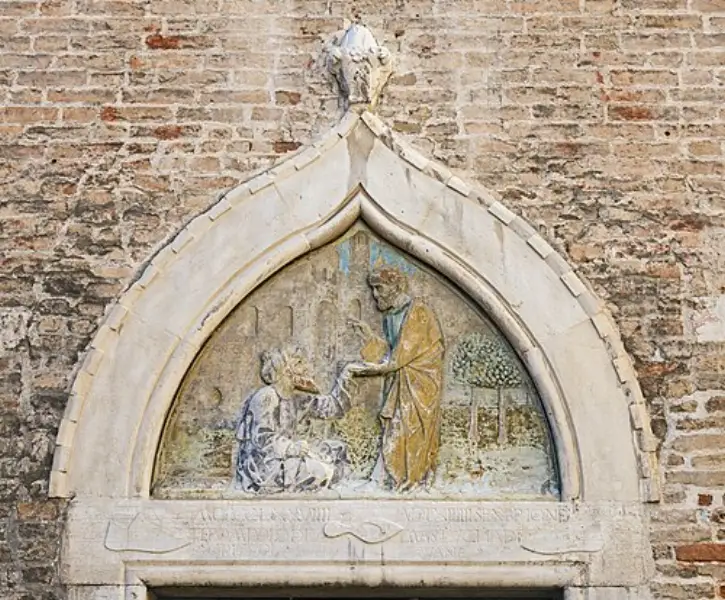
St. Mark, arriving in Rakotis at the end of his travels through Cyrene and the Pentapolis, found the strap of his sandal snapped, and looked about for a mender. The cobbler he found was Anianus. While the craftsman worked on the sandal, the awl slipped in his hand and pierced it. In the shock of the wound Anianus cried out in Greek, "Heis ho Theos" — "God is one" — a confession of faith in the single God that rose from a Christian before he had ever heard the Christian preaching. Mark took the cry as his opening and proclaimed the Gospel of Christ to the wounded man, and at the same moment, it is related, he healed Anianus of his injury by a miracle. The cobbler's house became a church in miniature: Mark was invited in, taught the Gospel to Anianus and his whole family, and baptized them all. From that household the faith spread with remarkable speed, and a large number of the local population were soon converted by Mark and his followers. Those who did not convert felt compelled to defend their ancestral gods against the new teaching, and the presence of the Gospel in Alexandria began to be felt as a public matter, no longer a private conversion in a cobbler's shop.
§ Connection with Saint Mark
Bishop in Mark's Absence, Patriarch in His Wake
When hostility toward the new faith grew, Mark, an outsider in the city, decided it would be best to withdraw for a time. As he departed he consecrated Anianus bishop to govern in his absence, ordaining at one and the same time three presbyters and seven deacons, and laid on the whole company the charge of the church until his return. Mark remained away for two years, preaching in Rome, Aquileia, and the Pentapolis, winning converts and performing miracles along the way. When he returned to Alexandria he found the church flourishing: the believers had grown numerous enough to raise a church building of their own at Bucolia, on the shore of the city's eastern harbor, the Portus Magnus of the Ptolemaic kings. Once Mark had been put to death on Baramudah 30, Anianus assumed the patriarchal office in fact as well as in commission, and he bore it for more than seventeen and a half years. In his hands the Christian population multiplied, and new priests and deacons were ordained for its service. How far the evangelization of the surrounding region extended is unknown, but it has been thought that much of it proceeded covertly, carried on under the eyes of a pagan population whose hostility to the faith never ceased.
§ Ordination of Anianus
A Peaceful Death Beside the Evangelist
Anianus led the church of Alexandria through its first generation after the apostolic founder, and unlike the martyr whose mantle he had inherited, he came to the end of his labors in peace. The tradition records simply that he died in bed, an unremarkable ending that deserves its own notice: the man who had kept a persecuted community alive through seventeen and a half years of quiet, and at times covert, expansion, finished his course without violence. His death came on the 20th day of Hathor in the Coptic reckoning, in the year 86. The Christians of Alexandria laid him beside the Evangelist himself, in the church at Baucalis where Mark's remains rested, and there the second patriarch of the city kept his place beside the first. The communities he had served remembered him as a shepherd who had been faithful with what another had planted, ordaining clergy, steadying believers against a hostile surrounding culture, and handing on the church not diminished but multiplied. His grave at Baucalis joined his name permanently to that of St. Mark, and the two were honored together at Alexandria as the founders, in blood and in labor, of its ancient see.
§ Ordination of Anianus
Venerated in East and West
Anianus has been honored as a saint from the earliest memory of the churches, without any formal process of canonization, and his cult embraces both East and West. The Coptic Orthodox Church keeps his feast on the 20th day of Hathor, the anniversary of his death, while the Catholic Church and the Eastern Orthodox Church commemorate him on the 25th of April. Devotion to him crossed the ocean with the Coptic diaspora: the church of St. Anianus in Monroe Township, New Jersey, is the first Coptic Orthodox church in the world to be dedicated under his name, a testimony to the endurance of a memory nearly two thousand years old. His ancient office has also been the subject of an old disagreement among the churches. The Catholic Church and some others have reckoned Anianus the first patriarch of Alexandria, while the Coptic Orthodox Church counts St. Mark himself as the first pope of the see and therefore honors Anianus as the second. The dispute concerns a title rather than the substance of his life, which all traditions agree in honoring: the first Egyptian convert of the Evangelist, the first bishop ordained for Alexandria, and a craftsman whose cry of faith in the one God made him the beginning of the church of Egypt.
§ Veneration
First or Second: A Question of Precedence
Among the questions that gather around the earliest years of the Alexandrian church, few have been argued longer than the precise rank of Anianus. It remains a matter of some dispute whether he was the first or the second Patriarch of Alexandria. The Catholic Church, together with some others, holds that Anianus stood first in the line of the Alexandrian patriarchs. The Coptic Orthodox Church of Alexandria, by contrast, regards the Evangelist Mark himself as the first patriarch of the see, since he founded and led the community before his martyrdom, and it therefore counts Anianus as the second. The disagreement reflects a deeper difference in how the churches weigh origins: whether the founder's brief apostolic presidency or the resident bishop's sustained episcopate marks the true beginning of a patriarchate. What no side disputes is the substance of the man — that he was Mark's first convert in the region, that he was ordained by the Evangelist's own hands to govern the church in his absence, and that he led the Alexandrian Christians for more than seventeen years after the martyrdom. On the succession that followed him, the traditions are again at one: from his place beside Mark at Baucalis the line of Alexandrian patriarchs continued unbroken, through Avilius his successor, down to the present day.
§ Dispute
Timeline
- 61
Traditionally counted as the year he took up leadership of the church of Alexandria under St. Mark
§ Pope Anianus of Alexandria
- 62
Ordained bishop of Alexandria by St. Mark the Evangelist, with three presbyters and seven deacons, during Mark's absence
§ Ordination of Anianus
- 86
Died in Alexandria on 20 Hathor after more than seventeen and a half years as patriarch, and was buried next to St. Mark at Baucalis
§ Ordination of Anianus
In Their Own Words
Heis ho Theos
The Record
- Patron of
- patron of cobblers
- Canonization
- Pre-congregation canonization; venerated from antiquity in both Eastern and Western Christianity
Prayer
Bibliography
Show 4 sources
- "Hator 20: Lives of Saints: Synaxarium - CopticChurch.net"
- Holweck, F. G., A Biographical Dictionary of the Saints. St. Louis, MO: B. Herder Book Co., 1924.
- Atiya, Aziz S. The Coptic Encyclopedia. New York: Macmillan Publishing Company, 1991. ISBN 0-02-897025-X.
- Meinardus, Otto F.A. (2002). Two Thousand Years of Coptic Christianity. American University in Cairo Press. ISBN 978-977-424-757-6.
Profile text adapted from the Wikipedia article, licensed CC BY-SA 4.0.
Pray with this saint every day
Save St. Anianus of Alexandria to your favorites, read the full profile, and get feast-day reminders in the Saints app.
Get the Saints AppFree on the App Store for iPhone and iPad