
died April 168·Feast April 20
St. Anicetus
Bishop of Rome who welcomed Polycarp amid the Easter controversy
Overview
Anicetus governed the church of Rome as its bishop from about 157 until his death in April 168, though the Annuario Pontificio allows that his pontificate may have begun as early as 153. According to the Liber Pontificalis he was a Syrian, born in the late first century at Emesa, the modern Homs, and he stands among the earliest popes whose eastern origin is recorded. His pontificate is remembered chiefly for two visits. The aged Polycarp of Smyrna, a disciple of John the Evangelist, came to Rome to discuss with Anicetus the disputed date of Easter; the two did not agree, but the bishop of Rome conceded to Polycarp's church the right to keep its accustomed day, an early instance of divergent practice held together in communion. The Christian historian Hegesippus also reached Rome during these years, a visit often cited as evidence of the growing importance of the Roman see. Anicetus actively opposed the Gnostics and Marcionism, and the Liber Pontificalis credits him with a decree barring priests from wearing long hair, perhaps because the Gnostics did. Church tradition reckons him a martyr under Emperor Lucius Verus, though historians find the claim groundless. The cemetery of Callistus received his body, and the West keeps his feast on April 20.
The Complete Life
A Syrian at the Head of the Roman Church
Anicetus was born in the late first century in Emesa, a city of Roman Syria that the modern world knows as Homs. The chief source for his origins is the Liber Pontificalis, the ancient book of the pontiffs, which records that he was a Syrian from that city. His rise to the episcopal throne of Rome illustrates how far the gospel had already traveled within a hundred years of the apostles: a man from the Semitic East became, in due course, the bishop of the church of the imperial capital. Nothing else in the record describes his family, his trade, or his formation, and the silence of the sources means that his early life must be left where the Liber Pontificalis leaves it. What can be said is that by the middle of the second century he stood within the clergy of the Roman church and was recognized as fit to lead it. He succeeded Pius I in the pontificate, inheriting at a formative moment a community that was beginning to define itself against rival versions of Christianity and to receive visitors from the great churches of the East, two circumstances that would determine the character of his years in office.
§ Biography
Called to the See of Rome
Anicetus became bishop of Rome around the year 157, though the Annuario Pontificio, the Vatican's own yearbook, allows that the beginning of his papacy may have fallen as early as 153, a reminder of how slender the chronological threads of the second century are. He was the eleventh or twelfth in the succession from the apostles, leading a church that was not yet the seat of any imperial power but was already a point of reference for Christians throughout the Mediterranean world. His vocation to that office placed him at a crossroads of the early church. During his pontificate Rome received the aged Polycarp of Smyrna, one of the last living links to the apostolic age, and Hegesippus, the first Christian historian whose journey was recorded as a pilgrimage through the principal churches. The arrival of such men at Rome while Anicetus held the see is regularly taken to show how much weight Rome already carried. To preside over that church in that generation required both firmness in doctrine and hospitality of spirit, and the brief record of Anicetus's pontificate shows him exercising both: receiving the eastern visitors with honor, and confronting the teachers whose doctrines he judged destructive of the faith.
§ Biography
Polycarp at Rome: The Easter Controversy
The defining episode of Anicetus's pontificate was his encounter with Polycarp of Smyrna over the celebration of Easter. According to Irenaeus, the aged bishop, a disciple of John the Evangelist, came to Rome to discuss the question face to face. Polycarp's church of Smyrna observed the crucifixion on Nisan 14, the Passover date itself, regardless of the weekday on which it came; the Roman church celebrated Easter on the Sunday, the day of the resurrection. The two bishops did not reach a common date, and the disagreement was to grow heated in the centuries that followed. Yet the meeting ended not in rupture but in communion: Anicetus yielded to Polycarp's community the privilege of keeping its inherited observance, and bishop and visitor then shared the Eucharist as one. In the same years Anicetus acted against the teachers he judged enemies of the faith, actively opposing the Gnostics and Marcionism. The Liber Pontificalis also records that he decreed priests were not allowed to wear long hair, perhaps precisely because the Gnostics were known to do so. His reign thus joined two things the early church always held together: firm boundaries against doctrine held to be false, and a wide charity toward divergent practice within the communion of the churches.
§ Biography
Death in Rome and the Doubtful Crown of Martyrdom
Anicetus died in Rome in April of the year 168, closing a pontificate of roughly a decade. From early times the church has numbered him among the martyr popes: tradition holds that he suffered martyrdom during the reign of the emperor Lucius Verus, who ruled alongside Marcus Aurelius in the years just before the bishop's death. Modern historians, however, find no historical grounds for the account, and the martyrdom must remain a pious tradition rather than an established fact. Even the precise day of his death was uncertain in antiquity: the sixteenth, seventeenth, and twentieth of April are all cited as the date, a scatter of witnesses that reflects how little was securely remembered two generations after his pontificate. Of the circumstances of his final years the sources say nothing further, neither of illness nor of persecution endured. What the record does preserve is where he was laid: the Liber Pontificalis records his grave as lying in the cemetery of Callistus, the burial ground on the Appian Way that became the resting place of the Roman bishops. There his memory remained fixed while the controversy he had handled with such gentleness, the quarrel over the date of Easter, continued to trouble the church for two more centuries.
§ Biography
A Saint of the Undivided Early Church
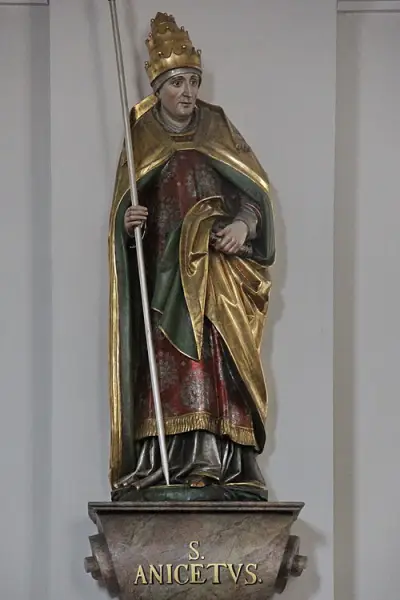
Anicetus belongs to the company of bishops of Rome honored as saints from the first centuries, long before any formal process of canonization existed; his sanctity rests on the uninterrupted veneration of the church rather than on a decree. In the West his feast is kept on April 20, the date the reformed Roman calendar established, and the Martyrologium Romanum records his name on that day. Before the liturgical reform that took effect in 1970, the Roman church had kept his feast on April 17, one of the several dates proposed for his death. The Christian East commemorates him on April 17 as the hieromartyr Anicetus, pope of Rome, and preserves the title of martyr that the Latin church retains in tradition even while acknowledging the weakness of its historical foundation. He is represented in sacred art with the papal tiara and the palm branch, the former marking his office as bishop of Rome, the latter his martyr's crown. His name is joined in the calendar to that of his successor Soter, and both are remembered as shepherds who guided the Roman church through the middle years of the second century, when it was learning to hold together truth, charity, and the breadth of the catholic communion.
§ Pope Anicetus
Communion Across Difference
The legacy of Anicetus was fixed in a single meeting that Irenaeus recorded and the church never forgot. When Polycarp could not persuade the Roman bishop to adopt the Asian reckoning of Easter, and Anicetus could not persuade the aged martyr to abandon the custom of John, the two nonetheless shared the Eucharist and parted in peace, each church free to keep its own day. Within a lifetime their compromise had collapsed into the Quartodeciman controversy, which grew heated in the following centuries and saw bishops exchange anathemas over the very question these two had settled by forbearance. Later ages would look back on the meeting of Anicetus and Polycarp as a model of how the early church handled divergence before the age of councils and canons, and Irenaeus himself cited it to rebuke a later bishop of Rome for threatening excommunication over a lesser dispute. Anicetus's reign also marked a stage in the growth of the Roman see: the journey of Hegesippus to the city while Anicetus governed it is regularly read as evidence of the rank Rome already enjoyed among the churches. Against the Gnostics and Marcion he helped fix the boundaries of the faith, and his decree about the tonsure of priests shows a bishop attending to the visible discipline of his clergy. He left no writings, but he left the church an example.
§ Biography
Timeline
- 153
The Annuario Pontificio gives this as a possible alternative date for the beginning of his papacy
§ Pope Anicetus
- 157
Became bishop of Rome about this year, succeeding Pius I
§ Biography
- Apr 168
Died in Rome; April 16, 17, and 20 are each proposed by different sources as the day of his death
§ Biography
- 1970
Under the reformed Roman calendar his feast was kept on 20 April, replacing the date of 17 April used before 1970
§ Biography
The Record
- Symbols
- papal tiara·palm branch
- Canonization
- Pre-congregation canonization; traditionally accounted a martyr, though the historical grounds for this are doubtful
Prayer
Bibliography
Show 6 sources
- Campbell, Thomas (1907). "Pope St. Anicetus" in The Catholic Encyclopedia. Vol. 1. New York: Robert Appleton Company.
- Raymond Davis (2000). Book of the Pontiffs (Liber Pontificalis) (Liverpool University Press - Translated Texts for Historians). Liverpool University Press. p. 5. ISBN 9780853235453.
- Irenaeus, cited in Eusebius, Historia Ecclesiastica, 5.24; translated by G.A. Williamson, Eusebius: History of the Church (Harmondsworth: Penguin, 1965), pp. 232f.
- Butler, Alban. "St. Anicetus, Pope and Martyr", The Lives of the Saints, Vol. IV: April. 1866.
- Martyrologium Romanum (Libreria Editrice Vaticana 2001). ISBN 88-209-7210-7.
- Calendarium Romanum (Libreria Editrice Vaticana 1969), p. 120.
Profile text adapted from the Wikipedia article, licensed CC BY-SA 4.0.
Pray with this saint every day
Save St. Anicetus to your favorites, read the full profile, and get feast-day reminders in the Saints app.
Get the Saints AppFree on the App Store for iPhone and iPad