
died 3 January 236·Feast January 3
St. Anterus
Bishop of Rome for a brief winter pontificate of persecution
Overview
Anterus held the Roman episcopate from 21 November 235 to 3 January 236 — among the shortest reigns in the history of the see, and one that fell entirely within the persecution of the emperor Maximinus the Thracian. He was the son of Romulus and was born at Petilia Policastro in Calabria; many judge him Greek by stock, and his very name has led some scholars to suspect that he had first been a slave and afterwards a freedman. He took the place of Pontian, whom the authorities had shipped into Sardinian exile along with the antipope Hippolytus. In his few weeks of office Anterus created a single bishop, for the city of Fondi. Some scholars believe he was martyred, arguing that his insistence on greater strictness in collecting the acts of the martyrs, as recorded by the notaries appointed under Pope Clement I, provoked his death; others doubt this and hold that he more likely died in ordinary circumstances during the persecution. His remains were laid in the papal crypt of the Catacomb of Callixtus along the Appian Way, where de Rossi located the grave in 1854. His feast is kept on 3 January in the Catholic Church and 18 August in the Russian Orthodox Church.
The Complete Life
A Son of Calabria of Greek Blood
Anterus was born at Petilia Policastro in Calabria, in the mountainous toe of the Italian peninsula, and he was the son of a man named Romulus. Beyond his father's name the sources preserve nothing of his family, but two details have invited centuries of commentary. Most scholars take him for a Greek by descent, which need not surprise anyone in a region so heavily colonized by Greek settlers that it was known as Magna Graecia; his native Calabria long retained the Greek language in its liturgy and its daily speech. And his very name has prompted speculation: some scholars have suggested that the name Anterus may indicate that he had been a freed slave, since names of this kind were commonly borne by freedmen in the Roman world. If so, he would stand among the popes whose origins lay in the lowest ranks of society, a living witness to the social reach of the Christian communities of the third century, among which slaves, freedmen, and the freeborn shared one table. Nothing is recorded of his education or of his service in the Roman clergy before his election. He emerges into history in the autumn of 235, when the see of Rome had been left vacant by violence and deportation, and the choice fell upon this son of Calabria.
§ Life
Elected in the Wake of Deportation
Anterus succeeded Pope Pontian, whose pontificate had ended not in death but in arrest: in 235 the emperor Maximinus the Thracian had moved against the leaders of the Christian community in Rome, and Pontian was deported to the salt mines of Sardinia together with Hippolytus, the antipope whose quarrel with the church he had himself once shepherded. To succeed a living pope exiled for his faith was a task of unusual delicacy, and the church of Rome, gathered in the shadow of an active persecution, chose the Calabrian Anterus to undertake it. His consecration as bishop of Rome took place on 21 November 235. He thereby became the head of a community under threat, its previous bishop condemned to forced labor on a distant island, its gatherings watched by the authorities. The date of his election is fixed with a precision rare for the period, a reminder that the church of the third century, however persecuted, kept careful records of its own succession. Into an office defined by hardship he brought whatever formation his Calabrian youth and his Roman ministry had given him, and the record of his weeks in power, thin as it is, shows a bishop attending to order, to the memory of the martyrs, and to the needs of the flock committed to him.
§ Life
Guarding the Acts of the Martyrs
The record of Anterus's pontificate is brief, but two actions of his five weeks in office have been preserved. He consecrated a single new bishop, stationing him at Fondi, and so extended the episcopal structure of the Italian church at a point south of Rome. And, according to the tradition that later ages judged most revealing, he ordered greater strictness in the collection of the acts of the martyrs, the trial records of the confessors put to death in the persecutions, which had been gathered exactly by the notaries originally appointed for that work under Pope Clement I. The act may appear administrative, but in the year 235 it was charged with meaning: the emperor Maximinus had renewed persecution, new confessors were being condemned and executed, and the bishop of Rome directed that their sufferings be recorded with precision rather than let the memory of their witness decay into legend. Some scholars have gone further and argued that this very fidelity cost Anterus his life, provoking the authorities against a bishop who was, in effect, archiving the evidence of their cruelty. Others dispute any causal link and judge an unremarkable death in the course of the persecution more plausible. Whichever reading is right, his weeks in office tied his name permanently to the church's memory of her martyrs.
§ Life
Six Weeks and the Crypt of Callixtus
Anterus died in Rome on 3 January 236, little more than six weeks after his consecration, and the question of how he died has never been settled. The scholarly tradition is divided: some believe he was martyred, whether for his care in collecting the acts of the martyrs or simply in the general persecution of Maximinus the Thracian; others doubt this and consider a death in ordinary circumstances during the persecution more probable. The sources do not describe a trial or an execution, and the brevity of his reign left little time for the kind of events that later ages could have recorded. What is certain is where he was buried. His remains were deposited in the papal crypt at Callixtus beside the Appian Way, the chamber reserved the designated resting place of the bishops of Rome. There, in 1854, the archaeologist Giovanni Battista de Rossi discovered the site of his sepulchre, recovering fragments of a Greek inscription that had been cut into the slim rectangular tablet covering the grave; of the inscription, only the Greek term for bishop remained legible. A Greek epitaph for a pope of possible Greek birth from Calabria closed the circle of a life that had joined the Greek East and the Latin West.
§ Life
Honored East and West
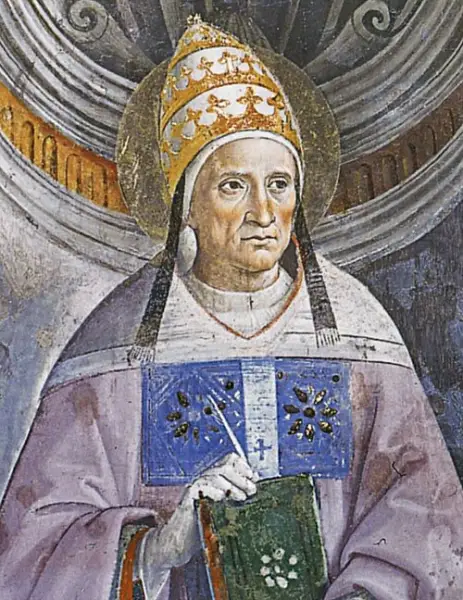
Anterus has been venerated as a saint since the earliest centuries of the Roman church, numbered among the martyr popes even while historians debate the manner of his death. His cult required no formal decree: the church of the first ages recognized as saints those who had borne witness to Christ in life or in death, and the bishop whose mortal remains rested in the papal crypt beside his predecessors was honored in their company. The Catholic Church keeps his memory on 3 January, the anniversary of his death in 236. The Russian Orthodox Church commemorates him on 18 August, retaining an independent tradition about the date of his feast. In art he is remembered through a fifteenth-century mural by Pietro Perugino in the Sistine Chapel, where the young Raphael's master placed the third-century bishop among the company of the church's glorified pontiffs, a testimony to how early and how widely his name was numbered among the saints. The title of martyr that tradition gives him, though modern scholarship treats it with caution, expresses the judgment of the church that a bishop who governed the Roman see in the midst of persecution, honoring the confessors and dying in their season, had himself offered the witness that the crown presupposes.
§ Pope Anterus
The Tomb That Was Found Twice
The afterlife of Anterus's burial became one of the more curious stories in the archaeology of the Roman church. The bishop's body had gone into the papal crypt at Callixtus by the Appian Way, covered by a slim rectangular tablet cut with a Greek epitaph. At some later date his ashes were removed from the catacombs and translated to the Church of Saint Sylvester in the Campus Martius, one of the many translations by which the relics of the early popes were brought within the walls of the city for safer and more honored keeping. There they lay forgotten until 17 November 1595, when Pope Clement VIII rebuilt the church and the remains were rediscovered. Four centuries later the original tomb was found in its turn: in 1854 Giovanni Battista de Rossi, the pioneer of Christian archaeology, located the site of the sepulchre in the Catacomb of Callixtus and recovered the broken fragments of the epitaph slab, on which only the Greek word for bishop could still be read. The discovery gave the briefest of pontiffs an unusual distinction, a physical monument to his existence, and it confirmed the care with which the third-century church had marked the graves of its bishops. Anterus's legacy is thus carved in stone: a name, an office, and a testimony that outlasted the empire that had persecuted him.
§ Life
Timeline
- 21 Nov 235
Began his pontificate as bishop of Rome, succeeding Pontian, who had been deported to Sardinia
§ Life
- 3 Jan 236
Died in Rome after barely six weeks in office; his body was laid to rest in the papal crypt at Callixtus
§ Life
- 17 Nov 1595
His ashes, removed to the Church of Saint Sylvester in the Campus Martius, were discovered there when Pope Clement VIII rebuilt the church
§ Life
- 1854
Giovanni Battista de Rossi discovered the site of his sepulchre in the Catacomb of Callixtus, with broken remnants of a Greek epitaph
§ Life
The Record
- Canonization
- Pre-congregation canonization; traditionally honored as a martyr, though some scholars doubt he died a martyr's death
Prayer
Bibliography
Show 5 sources
- Shahan, Thomas (1907). "Pope St. Anterus" in The Catholic Encyclopedia. Vol. 1. New York: Robert Appleton Company.
- de Montor, Artaud (1911). The Lives and Times of the Popes: Including the Complete Gallery of Portraits of the Pontiffs Reproduced from Effigies Pontificum Romanorum Dominici Basae. New York: The Catholic Publication Society of America. pp. 49–50. OCLC 7533337.
- Levillain, Philippe; O'Malley, John W. (2002). The Papacy: An Encyclopedia. London: Routledge. pp. 63, 557. ISBN 978-0-415-92230-2.
- Marucchi, Orazio (2003). Manual of Christian Archeology 1935. Translated by Hubert Vecchierello. Kessinger Publishing. p. 48. ISBN 978-0-7661-4247-3.
- Herbermann, Charles, ed. (1913). "Pope St. Anterus". Catholic Encyclopedia. New York: Robert Appleton Company.
Profile text adapted from the Wikipedia article, licensed CC BY-SA 4.0.
Pray with this saint every day
Save St. Anterus to your favorites, read the full profile, and get feast-day reminders in the Saints app.
Get the Saints AppFree on the App Store for iPhone and iPad