
died 4 September 422·Feast October 25
St. Boniface I
Pope who won a disputed election and disciplined the Church
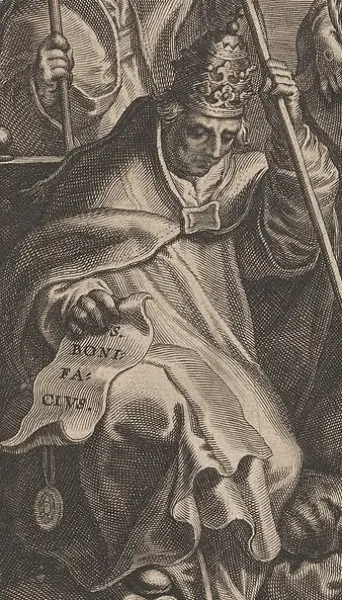
Overview
Boniface I was bishop of Rome from the final days of 418 until his death on 4 September 422, and his accession remains one of the most contested in the early history of the papacy. When Pope Zosimus died, two parties in Rome elected rival bishops on the same day: the deacon Eulalius at the Lateran, and Boniface, a former councilor of Pope Innocent I, at the church of Saint Marcellus. Emperor Honorius first favored Eulalius, and Boniface was even seized and detained outside the walls, but when Eulalius defied an imperial order and entered Rome before Easter, the emperor recognized Boniface as lawful pope on 3 April 419. In office Boniface proved a disciplined administrator. He gave the Gloria in excelsis its place at the Maundy Thursday liturgy, reined in the overreach of the see of Arles in Gaul, restored the metropolitan rights of Narbonne and Vienne, and persuaded Theodosius II to return Illyricum to Western jurisdiction. He supported Augustine of Hippo against the Pelagians, and Augustine dedicated his four books against the two Pelagian letters to him. He died in Rome and is commemorated on 25 October.
The Complete Life
A Roman of the Presbyter's Family
The records say almost nothing of Boniface before he reached the papal throne, and his birth year is unknown. The Liber Pontificalis describes him as a Roman and the son of a presbyter named Iocundus, also written Jocundus, so church service was in his household's blood. He had been a married man, and his wife had died before the events that brought him to the see of Peter, leaving him free for higher orders. Ancient tradition holds that he was ordained by Pope Damasus I, whose long pontificate spanned the years from 366 to 384, an apprenticeship in the Roman church that would have covered his youth and early manhood. By about 405 he had risen high enough in the confidence of Pope Innocent I to be sent as that pope's representative to Constantinople, an early example of Roman diplomacy toward the imperial court in the East. When Innocent's successor Zosimus died in December 418, Boniface stood among the senior clergy of the city, known as a councilor of the late pope and respected enough that a majority of the priests chose him on the very day a rival faction chose another.
§ Early life
Election amid Strife
The death of Pope Zosimus split the Roman church in two. On the day of his funeral at San Lorenzo fuori le Mura, partisans of the deacon Eulalius took possession of the Lateran, and before the day was out Eulalius stood among a throng of deacons, laity, and a handful of priests who chose him bishop; his supporters waited until Sunday, 29 December, for the customary formal ordination. On the Saturday following the funeral, however, the greater number of the city's priests had chosen Boniface; he received his own consecration there on 29 December, in the Campus Martius church of Saint Marcellus. Aurelius Anicius Symmachus, prefect of the city, admonished both parties to keep the peace and reported to Emperor Honorius his judgment that Eulalius, chosen first and in due order, appeared to be in the right. On 3 January 419 the emperor answered by recognizing Eulalius. Violence followed: officers of the prefect laid hold of Boniface and kept him under watch in a lodging beyond the walls. His partisans petitioned the emperor alleging irregularities, and Honorius summoned both men to a hearing on 8 February before himself and certain Italian bishops, ordering each to stay away from Rome while the bishop of Spoleto celebrated the approaching Easter rites in the city.
§ Election
The Judgment of Honorius
At the imperial court the empress Galla Placidia and her husband Constantius III both favored Eulalius, who had been elected first, and for a time Boniface's cause seemed hopeless. The hearing on 8 February deferred the decision to a synod summoned for Spoleto on 13 June; but the deadlock broke through the rashness of his rival rather than any fresh argument. Although Easter Sunday that year fell on 30 March, Eulalius defied the emperor's command and entered Rome on 18 March, losing the support of the authorities at a stroke. Symmachus dispatched officers to take over the Lateran, driving Eulalius from the basilica and confining him to a dwelling beyond the city walls; the Mass in the Lateran was then celebrated by Bishop Achilleus of Spoleto. The proposed Council of Spoleto was canceled altogether, and on 3 April 419 Honorius formally recognized Boniface as the rightful pope. The whole affair illustrated how indefinite the rules of papal succession still were in the fifth century, and how the authority of the state had become the arbiter when the church's own machinery failed to produce a single undisputed bishop for the city of Rome.
§ Election
Discipline, Liturgy, and the Defense of Grace
Once seated, Boniface governed as a reformer of order rather than a ruler by decree. He gave the angels' hymn, Gloria in excelsis Deo, a settled place in the Maundy Thursday liturgy, of the Roman church. He reversed several of his predecessor's administrative policies and reduced the vicariate authority that had given Patroclus, bishop of Arles, jurisdiction over the other Gallic sees, giving back instead the metropolitan authority of the leading bishops of each province and freeing Narbonne and Vienne from subjection to Arles. When Patroclus tried to install his own candidate in the vacant see of Lodève, Boniface backed Hilary, archbishop of Narbonne, in his choice. In the case of Maximus, bishop of Valence, he insisted that the accusations against Maximus be weighed not by a single primate but by a provincial council of the Gallic episcopate, whose verdict he pledged to uphold — a procedural fairness notable for its time. Doctrinally he stood with Augustine of Hippo in the struggle against Pelagianism, forwarding to the bishop two Pelagian letters that slandered him; in gratitude Augustine dedicated to Boniface his rejoinder in the four books Against the Two Letters of the Pelagians.
§ Pontificate
Illyricum and the Close of the Pontificate
In the last years of his reign Boniface turned his attention to the boundary between the Eastern and Western halves of the church. He persuaded Emperor Theodosius II to return Illyricum to Western jurisdiction, a diplomatic achievement that secured for the Roman see an ancient sphere of pastoral care, and he defended the rights of the Holy See against encroachment from every quarter. The dispute over his election had consumed the first months of his pontificate, and the settlement of Gaul took much of the rest; yet the brief reign left the Roman church's discipline firmer than he found it. He died in the city of his birth on 4 September 422 and was succeeded by Celestine I. His death closed a pontificate of barely three and a half years, but within it fell the recognition of his lawful election, the reordering of Gallic jurisdiction, the recovery of Illyricum, and the encouragement of Augustine's great defense of grace against the Pelagians — a record out of all proportion to its length.
§ Pontificate
Saint of the Undivided Church
Boniface I was numbered among the saints of the church long before formal processes of canonization existed, in the age when the confession of a bishop's life and the uninterrupted prayer of the faithful sufficed to enroll him in the calendar. His feast is kept on 25 October. Veneration of him grew within the church of his own city and spread with the whole ancient cult of the Roman pontiffs to the Christian East, so that he is honored today not only by the Catholic Church but also by the Eastern Orthodox Church and the Oriental Orthodox churches — a testimony that his defense of discipline and of the faith belonged to the entire undivided church of the fifth century rather than to one communion alone. Medieval and modern catalogues of the popes list him without hesitation among the canonized bishops of Rome, and his cult has never been interrupted since antiquity, resting on the same continuous recognition that sanctified the apostle's earliest successors in the see he briefly and lawfully occupied.
§ Pontificate
A Contested Throne, an Enduring Office
The immediate legacy of Boniface's troubled election was a precedent: when the Roman clergy could not produce a single bishop, the imperial government would decide, and Eulalius's fall showed that the emperor's order, once given, bound even an installed claimant. The historian Stewart Oost judged that papal elections of that era were still quite indefinite, and that both parties could rightly claim proper election and consecration — a reminder that Boniface's victory was as much political as canonical. His settlement with Gaul endured as a statement of principle: metropolitans, not an ambitious vicar at Arles, should govern their provinces, and bishops accused of crimes deserved judgment by their peers in synod. His success over Illyricum preserved the Western reach of the Roman see in the Balkans. Most lastingly, his alliance with Augustine gave the church's decisive answer to Pelagianism one of its great literary monuments, dedicated in his honor. He stands in the papal catalogue between Zosimus and Celestine I, remembered less for length of reign than for the firmness with which an unchallenged pastor emerged from the most disputed election of his age.
§ Pontificate
Timeline
- 405
Served as representative of Pope Innocent I at Constantinople.
§ Early life
- 29 Dec 418
Consecrated bishop of Rome at the Church of Saint Marcellus in the Campus Martius in rivalry with Eulalius.
§ Election
- 3 Jan 419
Emperor Honorius answered the urban prefect's report by recognizing Eulalius as rightful bishop of Rome.
§ Election
- 8 Feb 419
Both claimants appeared for judgment before Honorius and Italian bishops, who deferred the case to a synod at Spoleto.
§ Election
- 18 Mar 419
Eulalius defied the imperial order and entered Rome before Easter, forfeiting the support of the authorities.
§ Election
- 3 Apr 419
Emperor Honorius recognized Boniface as the rightful pope; the proposed Council of Spoleto was canceled.
§ Election
- 4 Sep 422
Died in Rome after a pontificate of nearly four years.
§ Pontificate
In Their Own Words
still quite indefinite and both parties could thus with right claim proper election and consecration.
The Record
- Major works
- Order that the Gloria in excelsis be sung on Maundy Thursday·Letters regulating church discipline and the jurisdiction of the Gallic sees
- Canonization
- Pre-congregation; recognized as a saint by ancient custom and venerated in the Catholic, Eastern Orthodox, and Oriental Orthodox churches
Prayer
Bibliography
Show 4 sources
- Peterson, John Bertram (1907). "Pope St. Boniface I". In Herbermann, Charles (ed.). Catholic Encyclopedia. Vol. 2. New York: Robert Appleton Company.
- Oost, Stewart. Galla Placidia Augusta: A Biographical Essay. Chicago: University of Chicago Press, 1968, pp. 156-160.
- Butler, Alban. Lives of the Fathers, Martyrs, and Principal Saints, 1866. CatholicSaints.Info, 26 October 2013.
- "St. Boniface I", Archdiocese of Baltimore.
Profile text adapted from the Wikipedia article, licensed CC BY-SA 4.0.
Pray with this saint every day
Save St. Boniface I to your favorites, read the full profile, and get feast-day reminders in the Saints app.
Get the Saints AppFree on the App Store for iPhone and iPad