
550 – 615·Feast May 8
St. Boniface IV
Pope who consecrated the Pantheon to Mary and all Martyrs
Overview
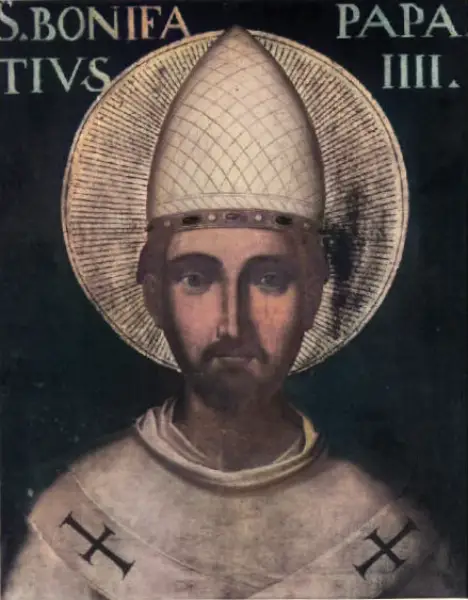
Boniface IV was bishop of Rome from 608 until his death on 8 May 615, a pope of Benedictine formation who carried the monastic spirit of his mentor Gregory the Great into the government of the church. Born in Valeria around 550 to a physician named John, of Marsi stock according to the Liber Pontificalis, he served Gregory as a deacon and as dispensator, the first official in the administration of the Roman patrimonies, and like Gregory he ran the Lateran Palace as a monastery. His election to the papacy was delayed over nine months by the wait for imperial confirmation from Constantinople. The great act of his reign came on 13 May 609, when, with the leave of Emperor Phocas, he consecrated the Pantheon — the temple Agrippa had raised to pagan gods — under the title of the Virgin Mary and every martyr, the first transformation of a Roman pagan temple into a Christian church. In 610 he received Bishop Mellitus of London and sent letters of counsel to the young English Church. Encouraging monasticism throughout his pontificate, he finally converted his own house into a monastery, retired there, and died on 8 May 615. He is buried in the portico of Saint Peter's Basilica.
The Complete Life
A Son of the Marsi
Boniface came into the world around 550 in Valeria, in the upland country of the Abruzzo that now forms the Province of L'Aquila. The Liber Pontificalis records that his family belonged to the Marsi, an ancient people of central Italy, and that his father John practiced medicine — a household of some standing and learning in a rugged region far from Rome. The bust later set up in his honor at San Benedetto dei Marsi styles him a man of Marsi nation and of the Valerian community, and his memory has never lost its hold on that corner of Italy: to this day the people of Luco dei Marsi keep his feast among their patrons on a weekend in August. Of his boyhood and education the sources are silent, but the career that followed presupposes both learning and administrative gifts. He made his way to Rome, joined the ranks of its clergy, and came in time to the notice of Pope Gregory the Great, whose own chosen discipline of life — the monastic rule carried into the government of the church — would shape everything Boniface afterward did.
§ Family and early career
Deacon and Steward of Gregory the Great
During the pontificate of Gregory the Great, Boniface served the Roman Church as a deacon and acted as its dispensator — first official in charge of administering the patrimonies, the estates whose revenues sustained the church's charities and works. He belonged to the Benedictine order, and his formation was monastic rather than courtly: he learned from Gregory, his mentor, to govern as a monk serves, with order, austerity, and concern for the poor. So faithfully did he imitate his master that he ran the Lateran Palace itself as a monastery, converting the papal residence's routine into something akin to religious life. This double service, managerial and spiritual, made him a natural candidate for the highest office when the vacancy came. Yet when Boniface III died, the see of Rome stood empty for more than nine months, for no bishop could be consecrated without imperial confirmation from distant Constantinople — a delay that measured how deeply the Byzantine emperors' authority over the Roman church ran even at the turn of the seventh century. Only when that consent arrived was Boniface consecrated, in 608, with the Vatican reckoning the official beginning of his papacy from 25 September.
§ Pontificate
The Pantheon and the English Church
The defining act of Boniface's reign required the consent of an unlikely ally. He obtained leave from Emperor Phocas to convert the Pantheon in Rome — the temple erected by Agrippa to Jupiter the Avenger, Venus, and Mars — for Christian worship, consecrating it on 13 May 609 under the title of the Virgin Mary and every Martyr. Ancient report says that twenty-eight cartloads of holy bones were brought up out of the Catacombs and set in a porphyry basin below the high altar, so that the dome once dedicated to the pagan gods sheltered the remains of the church's witnesses. It was the first time in Rome that a pagan temple was made a place of Christian worship. His gaze reached beyond Italy as well. In 610 Mellitus, first bishop of London, came to Rome to consult the pope on matters touching the newly established English Church; Boniface admitted him to the synod then sitting on questions of the monks' life and monastic peace, and when Mellitus departed sent him home with the council's decrees and letters addressed to Archbishop Laurence of Canterbury, to the whole clergy, to King Æthelberht of Kent, and to all the Anglo-Saxons. Near the end of his life, the Irish missionary Columbanus, living at Bobbio, addressed him a stern letter on the Three Chapters.
§ Pontificate
A Pope in the Monastic Spirit
Everything known of Boniface's inward life belongs to the tradition of Gregory the Great. As a Benedictine deacon he had administered the patrimonies of the church, and as pope he encouraged monasticism throughout Christendom, governing the Lateran Palace as a monastery in conscious imitation of his mentor. The letter that Columbanus sent him between 612 and 615, at the urging of King Agilulf of the Lombards, charged the pope with suspected heresy on account of his acceptance of the Fifth Ecumenical Council, urging him to call a council that would demonstrate his orthodoxy; no rejoinder from Boniface is on record, and the silence suits the man the sources otherwise show — one who preferred works of consecration to controversy. His final act of devotion was characteristic. He converted his own house into a monastery and withdrew into it, exchanging the government of the church for the common life of prayer in the last months before his death. The successor who followed him, Adeodatus I, reversed his policy of favoring monasticism, which makes clear how distinctive that orientation was. Boniface's pontificate thus presents the figure of a monk on the throne of Peter, ruling by the disciplines of the cloister rather than the methods of the court.
§ Pontificate
Retirement and Death
Boniface closed his life as he had ordered its interior: as a monk. Inspired by the example of Gregory the Great, he transformed his residence into a monastery, laid aside the burdens of office, and retired into the common life he had fostered. There he died on 8 May 615, at about sixty-four or sixty-five years of age. Most authorities give that day for his death, though the old scholar Jaffé preferred 25 May. Adeodatus I then took up the succession and reversed the policy of favoring monasticism. His body was laid to rest in the portico of Saint Peter's Basilica, and from that resting place his relics began a long journey through the history of the great basilica: they were removed three times — in the tenth or eleventh century, a second time late in the 1200s under Pope Boniface VIII, and at last on 21 October 1603, to the new Saint Peter's that was rising in his own day. The Roman Martyrology commemorates him on 8 May, the anniversary of his death, while Benedictines and Cistercians keep his memory on 28 May.
§ Death
Honored Among the Pontiff Saints
The Catholic Church numbers Boniface IV among its saints and keeps his feast universally on 8 May, and the tradition of the medieval church records his canonization under Pope Boniface VIII, the same pontiff under whose direction his relics received one of their translations at the end of the thirteenth century. His cult is among the oldest attached to the early medieval popes, rooted in the reverence the Romans felt for the man who had given their most famous building to the Mother of God and the martyrs. The calendar of his feast is unusually rich: the main commemoration falls on 8 May, the anniversary of his death; an older observance lingered on 25 May; the Benedictine and Cistercian orders, who claim him as one of their own, keep him on 28 May; the translation of his relics in 1603 is remembered on 21 October; and the third weekend of August belongs to him at Luco dei Marsi in the Abruzzo, where he is honored as one of the patrons. The Roman Martyrology enters his name each year on his dies natalis, and his shrine remains in Saint Peter's Basilica.
§ Feast Days
The Temple Given to the Martyrs
The act by which Boniface IV is remembered changed the face of Rome and, in time, the rhythm of the church's year. The consecration of the Pantheon on 13 May 609 was the first transformation of a pagan temple into a Christian place of worship in the city, a precedent both architectural and theological: the finest building of the old religion was not destroyed but baptized, and its dome, still crown of the Roman skyline, has sung the praise of Mary and the martyrs for fourteen centuries. Some writers trace the memory of that consecration in the later observance of All Saints. His correspondence with the English Church, carried home by Bishop Mellitus in 610, tied the infant mission of Augustine of Canterbury to the Apostolic See at a delicate moment, though the precise value of the surviving documents is debated — the extant decrees of his Roman synod are considered spurious, and scholars have divided over the letter to King Æthelberht, judged spurious by Hefele, questionable by Haddan and Stubbs, and genuine by Jaffé. Among his own people of the Marsi he remains a patron and protector, and in Saint Peter's Basilica his body lies where he placed the bones of the martyrs he loved.
§ Pontificate
Timeline
- 550
Born in Valeria, in what is now the Province of L'Aquila, son of the physician John, to a family of Marsi origins.
§ Family and early career
- 608
Consecrated bishop of Rome after a vacancy of more than nine months spent awaiting imperial confirmation from Constantinople.
§ Pontificate
- 13 May 609
With the permission of Emperor Phocas, consecrated the Pantheon as a church honoring the Virgin Mary and every martyr.
§ Pontificate
- 610
Received Bishop Mellitus of London in Rome and sent letters to Archbishop Laurence of Canterbury, King Æthelberht of Kent, and the Anglo-Saxons.
§ Pontificate
- 8 May 615
Retired to the monastery he had made of his own house and died; he was buried in the portico of Saint Peter's Basilica.
§ Death
- 21 Oct 1603
His remains were translated to the new Saint Peter's Basilica, the third removal of his relics.
§ Death
The Record
- Major works
- Consecration of the Pantheon as the church of Saint Mary and the Martyrs·Letters to the English Church, to Archbishop Laurence of Canterbury, and to King Æthelberht of Kent
- Patron of
- patron of Luco dei Marsi (Abruzzo)
- Symbols
- Papal vestments
- Canonization
- Canonized by Pope Boniface VIII; venerated in the Catholic Church with a universal feast on 8 May
Prayer
Bibliography
Show 6 sources
- "Bonifacio (?-615)", Cardinals of the Holy Roman Church.
- "St Boniface IV", Oxford Reference.
- Bertolini, Paolo (2000). "BONIFACIO IV, santo". Enciclopedia dei Papi (in Italian).
- Oestereich, Thomas (1907). "Pope St. Boniface IV". In Herbermann, Charles (ed.). Catholic Encyclopedia. Vol. 2. New York: Robert Appleton Company.
- Ekonomou, Andrew J. Byzantine Rome and the Greek Popes. Lexington Books, 2007.
- MacDonald, William L. (1976). The Pantheon: Design, Meaning, and Progeny. Cambridge, MA: Harvard University Press. ISBN 0-674-01019-1.
Profile text adapted from the Wikipedia article, licensed CC BY-SA 4.0.
Pray with this saint every day
Save St. Boniface IV to your favorites, read the full profile, and get feast-day reminders in the Saints app.
Get the Saints AppFree on the App Store for iPhone and iPad