
died 22 April 296·Feast April 22
St. Caius
Pope of the persecutions, confessor buried on the Appian Way
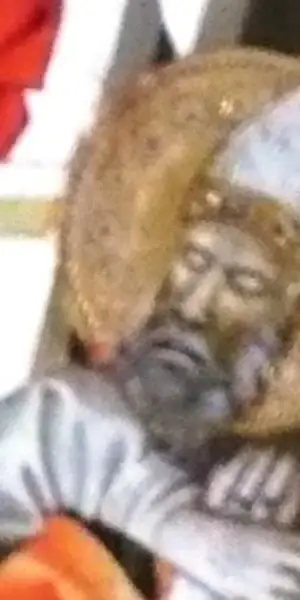
Overview
Caius, also called Gaius, was bishop of Rome from 17 December 283 until his death on 22 April 296. Tradition gives him Salona in Dalmatia as his native city and a father who bore the same name, and counts him a kinsman of the emperor Diocletian; nearly everything else recorded of him reaches us by way of the Liber Pontificalis and its retelling of the legend bound to Susanna of Rome's martyrdom. His pontificate fell in the last years before the great persecution, and tradition remembers him as a shepherd who prepared his church for trial: he decreed that no one could become a bishop without passing through the lower orders from porter to priest, and he organized the districts of Rome among the deacons. While anti-Christian measures multiplied, new churches rose and the cemeteries were enlarged. According to his legend he took refuge in the catacombs during the unrest and died a martyr, though historians note that the Diocletianic Persecution began only in 303, after his death. He was buried in the cemetery of Callixtus on the Via Appia, where his tomb and original epitaph, together with the ring he used to seal his letters, were discovered. The Roman Martyrology honors him on 22 April as a confessor of the faith.
The Complete Life
A Nobleman of Salona
Christian tradition makes Caius a native of Salona, the great Dalmatian port city on the Adriatic, and the son of a man who bore the same name, Caius or Gaius. His family is described as noble and as related to the emperor Diocletian himself, a connection that would give his later pontificate a poignant irony when Diocletian's name became a byword for persecution. The Dalmatian coast had ancient Christian communities, and the basilica ruins that still mark Salona testify to the faith he carried with him to Rome. Beyond these outlines the sources are silent: his birth year is unknown, and no ancient writer records his upbringing or his path to the Roman clergy. A curious thread ties his name to the beginnings of one of Rome's oldest shrines. Around 280 the site of Santa Susanna gained a house of Christian worship, gathering in a private domus ecclesiae which sixth-century acta ascribe to two brothers, Caius and Gabinus, Christians of standing in the city. Some sources have identified that Caius with the future pope, and since Gabinus was the father of Susanna, they make the pope the saint's uncle — a family woven into the martyrology of Rome itself.
§ Pontificate
Shepherd in the Shadow of the Palace
Caius was elected bishop of Rome on 17 December 283, succeeding Pope Eutychian, and led the church for twelve years and four months, from the close of one century's order to the brink of its greatest trial. The church he inherited was growing even as the empire's temper darkened: Diocletian had become emperor a decade earlier, and though he was not immediately hostile to Christianity, anti-Christian measures increased during Caius's pontificate. Tradition records the pope's response as one of preparation rather than panic. He decreed that no man could assume the office of bishop after serving through every lower degree of the clerical state — porter, lector, exorcist, acolyte, subdeacon, then deacon — binding the episcopate to a long apprenticeship of service and ensuring that those who would govern the church had learned it from the ground up. The city's districts, too, he parceled out among the deacons, a practical reorganization that strengthened the church's care of the city's poor and its burial places. Under his direction new churches were built even as the measures against Christians multiplied, and the cemeteries were expanded — quiet works of stone that would soon shelter the church in its passion.
§ Pontificate
Governing the Church before the Storm
The twelve years of Caius's pontificate stand in the histories as a season of quiet building between the persecutions of the third century and the final assault of the fourth. Nearly all that is known of his governance comes through the Liber Pontificalis, built as it is upon a legend telling of Susanna of Rome's martyrdom — a caution the reader does well to keep in view, though the outlines it preserves have been received by the church's memory. It tells of a pope who baptized the men and women converted by Tiburtius and Castulus, spreading the faith through the households of the Roman nobility even as the law frowned upon it. His ordering of the clerical ranks gave the Roman church a ministry formed by years of graded responsibility, and his distribution of the city among the deacons gave it an administrative spine. He is remembered in the fourth-century Depositio Episcoporum simply as a bishop of Rome: the ancient calendar notes his burial in the cemetery of Callixtus on the fifth day before the Kalends of May. Whatever embellishments legend added, this much the oldest records attest — a Dalmatian pope who kept his see intact and his dead honored through uncertain years.
§ Pontificate
Legend of a Martyr's Death
The legend that grew around Caius's last days is dramatic. It tells that the pope went into hiding because of the increasing persecution of the church, hidden away with Saints Polycarp, Sebastian, Tranquillinus, Tiburtius, Nicostratus, and Zoe under the roof of Castulus, a Christian officer serving in the Imperial Palace. Over the following years the entire group, one by one, was discovered by the Roman authorities and martyred. Caius, the story runs, was discovered at prayer beside Tiburtius soon after Tiburtius's children had been converted and baptized; the pair was dragged before the local prefect, a man named Fabian, who built a great bonfire and gave them a choice — throw frankincense into the flames to appease the Roman gods, or cast themselves into the fire. Tiburtius stepped into the fire, calling on the name of Christ, and came out unharmed; for this he was taken beyond the walls by the Via Labicana and beheaded. Of Caius himself the legend is less certain: his ultimate fate is often associated with beheading, but historians observe that the Diocletianic Persecution began only in 303, after his death, and that Diocletian was not at first hostile to Christianity. The ancient calendar, notably, lists him as a bishop, not a martyr.
§ Martyrdom
Confessor in the Roman Martyrology
Caius belongs to the earliest company of the church's saints, honored from antiquity without any formal process of canonization. His name appears in the fourth-century Depositio Episcoporum, the oldest Roman record of the bishops' burials, entered there as one who rested in the cemetery of Callixtus — and notably not recorded there as a martyr. His tomb was found in the catacomb of Callixtus with its original epitaph still in place, and within it the ring with which he had sealed his letters, a relic of the papal chancery of the third century. His feast is kept on 22 April, the same day as that of Pope Soter; Rome kept the two together from the Tridentine calendar through every revision of the General Roman Calendar until 1969, since which year their observance has been omitted, though both remain named under 22 April in the Roman Martyrology, the church's official list of recognized saints. That book describes him not with the crown of a martyr but with the quieter title his history supports: a pope who fled the persecution of Diocletian and died a confessor of the faith.
§ Legacy
Tombs, Churches, and a Florentine Name
The memory of Caius has left marks across Rome and far beyond it. His papal residence in the city was turned into a church in 1631, but the building came down in 1880, when the ground was needed for the Ministry of War on the Via XX Settembre; his relics were then carried to the Barberini family's chapel, where they remain. In art he is portrayed wearing the papal tiara beside Saint Nereus, and his veneration took deep root in Dalmatia, the land of his birth, and in Venice, the sea power that long looked to the Adriatic East. In Florence the faithful dedicated to him the church of San Gaggio, which stands on the via Senese, its name a corruption of Cajo; in 2003 plans were set in motion to convert the deconsecrated building into residential council housing. He is remembered by historians as one of the transitional bishops of Rome — a kinsman of Diocletian who prepared the church's discipline for the storm that his relative would one day unleash, and whose gravestone in the papal crypt of Callixtus still links the third-century church to its own beginnings.
§ Legacy
Timeline
- 280
A Christian meeting house took shape on the site of Santa Susanna in Rome, occupying a domus owned by brothers named Caius and Gabinus.
§ Pontificate
- 17 Dec 283
Began his pontificate as bishop of Rome, succeeding Pope Eutychian.
§ Pontificate
- 22 Apr 296
Died in Rome and was buried in the cemetery of Callixtus on the Via Appia.
§ Martyrdom
- 303
The Diocletianic Persecution of Christians began, years after Caius's death, leading historians to question the tradition of his martyrdom.
§ Martyrdom
In Their Own Words
At Rome, in the cemetery of Callistus on the Via Appia, the burial of Saint Caius, Pope, who, fleeing from the persecution of Diocletian, died as a confessor of the faith.
The Record
- Major works
- Decree requiring candidates for the episcopate to pass through porter, lector, exorcist, acolyte, subdeacon, deacon, and priest·Division of the districts of Rome among the deacons
- Patron of
- venerated in Dalmatia and Venice
- Symbols
- Papal tiara·Portrayed with Saint Nereus
- Canonization
- Pre-congregation; recognized as a saint from antiquity and entered in the Roman Martyrology under 22 April
Prayer
Bibliography
Show 6 sources
- Chapman, John (1908). "Caius and Soter, Saints and Popes". In Herbermann, Charles (ed.). Catholic Encyclopedia. Vol. 3. New York: Robert Appleton Company.
- Brusher, Joseph (1959). "St. Caius". Popes Through the Ages.
- Chisholm, Hugh, ed. (1911). "Caius". Encyclopædia Britannica. Vol. 4 (11th ed.). Cambridge University Press. p. 960.
- Martyrologium Romanum. Libreria Editrice Vaticana, 2001. ISBN 88-209-7210-7.
- Crawford, Alexander (1847). Sketches of the history of Christian art. London: J. Murray. p. 236.
- "Our Popes", The Church of Santa Susanna.
Profile text adapted from the Wikipedia article, licensed CC BY-SA 4.0.
Pray with this saint every day
Save St. Caius to your favorites, read the full profile, and get feast-day reminders in the Saints app.
Get the Saints AppFree on the App Store for iPhone and iPad