
died c. 222·Feast October 14
St. Callixtus I
Slave, mine convict, and pope who opened the church to sinners
Overview
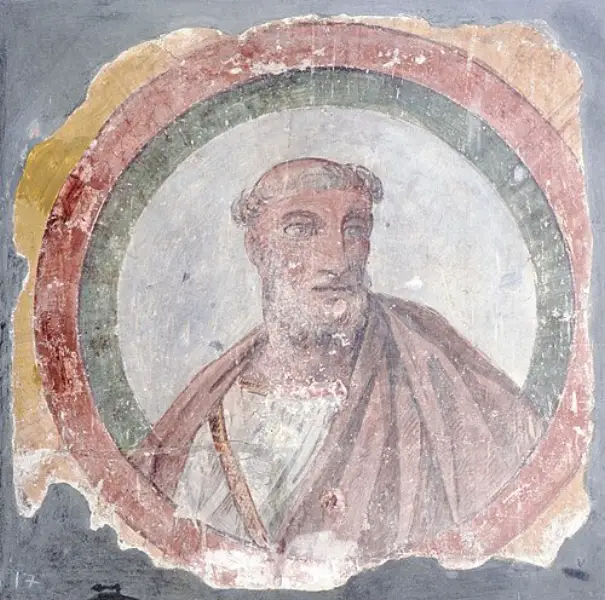
Callixtus I rose from slavery to the bishopric of Rome, serving from about 217 until his death around 222 or 223, in the reigns of the emperors Elagabalus and Alexander Severus. The hostile testimony of Tertullian and of Hippolytus preserves the story of his early life: as a young slave of his master Carpophorus he was entrusted with money collected for the care of widows and orphans, lost the funds, fled, was captured near Portus, and after further troubles was denounced as a Christian and condemned to the mines of Sardinia. Freed at the intercession of Marcia, the mistress of Emperor Commodus, he was pensioned by Pope Victor I while his health recovered at Antium. In 199 Pope Zephyrinus gave him the deaconate and set him over the Christian burial ground on the Appian Way, the ground still known as the Catacombs of Saint Callixtus, the first property the church owned and the burial place of popes. As bishop of Rome he admitted converts from the sects without demanding prior penance and established absolution even for adultery and murder — a mercy that scandalized the rigorist Hippolytus, who set himself up as the first antipope. Callixtus was killed for being a Christian, probably in a popular uprising, and perhaps by being thrown down a well; his grave lies in the cemetery of Calepodius along the Aurelian Way.
The Complete Life
The Slave of Carpophorus
The earliest account of Callixtus comes from his enemies. Tertullian and Hippolytus of Rome, the author of the Philosophumena, relate that he was a young slave in the household of his master Carpophorus in Rome, placed in charge of funds that other Christians had collected as alms for the care of widows and orphans. He lost the money and fled the city, but was caught near Portus at the mouth of the Tiber; according to the tale he even jumped overboard to avoid capture, only to be rescued and returned to his master. Released at the request of creditors who hoped he might recover some of the money, he was arrested once more after brawling in a synagogue while trying to raise money or press debts from its members. Then came the charge that changed everything: denounced as a Christian, he was sentenced to hard labor in the mines of Sardinia. He escaped death there only through an extraordinary intervention — Hyacinthus, a eunuch presbyter acting for Marcia, the favorite mistress of Emperor Commodus, obtained the release of Callixtus with the other Christians condemned to the mines. His health had suffered so much that fellow Christians sent him to Antium to recover his strength, and Pope Victor I allowed him a pension.
§ Life
Deacon and Keeper of the Christian Dead
Whatever his enemies made of his past, the church judged the man by what he had become. In 199 Pope Zephyrinus gave Callixtus the deaconate and set him over the Christian burial ground on the Appian Way — an office of far more weight than it may seem. That ground, called to this day the Catacombs of Saint Callixtus, received the bodies of many popes and stands as the first real property the church ever possessed; across the 200s nine bishops of Rome took their place among its dead, in the portion now known as the Capella dei Papi. The care of the Christian dead was itself a witness in pagan Rome. Emperor Julian the Apostate, writing to a pagan priest a century and a half later, conceded that the believers' charity toward strangers and their tending of Christian graves had done more than anything for the faith's reputation — the very office entrusted to Callixtus. Under Zephyrinus he became the pope's trusted assistant, and when Zephyrinus died in 217, Callixtus — according to Sextus Julius Africanus — succeeded him as bishop of Rome; Eusebius and the Liberian catalogue allot his episcopate five years, from 217 to 222.
§ Life
A Pope of Mercy and the First Antipope
Callixtus's pontificate opened with a policy that has echoed through the centuries. In 217 he opened the church's doors to converts from the sects and from schism without demanding penance of them first, and he fought the heretics with success. More startling still, he introduced the practice of granting absolution for every sin — adultery and murder not excepted — teaching that the church could forgive even sins for which many rigorists held there was no remedy. Hippolytus found his readiness to extend forgiveness to sexual transgressions shockingly lax, and denounced him as well for allowing believers to recognize as valid marriages their liaisons with their own slaves. The quarrel, fed by doctrinal differences as well as discipline, ended in schism: Hippolytus allowed himself to be elected a rival bishop of Rome, becoming the first antipope in the church's history. Callixtus was also a builder. He was patron of the titulus that became the Basilica di Santa Maria in Trastevere, where an oratory he raised stood on ground claimed by tavern keepers until Alexander Severus determined that any god was better worshiped there than wine. Close at hand, the Chiesa di San Callisto began as a shrine marking the place of his martyrdom.
§ Life
The Gospel of Forgiveness
The spirituality of Callixtus is written in the discipline he dared to change. A man who had himself lost money, fled justice, worked the mines as a condemned criminal, and been pardoned by the intercession of others, he seems to have drawn from his own fall the conviction that no sin places a human being beyond the reach of the church's absolution. Against the rigorism that would leave the adulterer and the murderer permanently outside, he asserted the power of the keys to bind and to loose, and made the church a house of return rather than a courtroom of permanent exclusion. The same charity marked his administration: as superintendent of the cemetery he embodied the Christian care for the dead that even a hostile emperor named as the secret of the church's appeal, and as pope he welcomed back those whom schism had carried away, asking of converts only the sincerity of their conversion. His mercy provoked the first antipope, and his memory has been contested ever since by readers of his enemies — a modern scholar has even asked, in the title of a study, whether he was a martyr or a confessor. But the church that canonized him saw in his reign the Gospel enacted: the last workers admitted to the vineyard at the same wage as the first.
§ Life
Martyrdom on the Tiber
Callixtus died for being a Christian, around the year 222 or 223, in the turbulent Rome of the last months of Elagabalus and the first of Alexander Severus. It is possible that he perished in a popular uprising against the church, and possible too that he was killed by being thrown down a well. The apocryphal Acts of Saint Callixtus preserve a story that grew around his death: Asterius, a priest of Rome, recovered the pope's body after it had been cast into the well and buried it under cover of night. For that act of piety Asterius was arrested by the prefect Alexander and put to death by being thrown from a bridge into the Tiber. As for Callixtus, burial came in the cemetery of Calepodius along the Aurelian Way, outside the walls of the city he had governed. The fourth-century Depositio Martirum and the martyrologies that followed it give his anniversary as 14 October, the day on which the Catholic Church still keeps his optional memorial. In the ninth century his relics were translated to Santa Maria in Trastevere, the titulus he had patronized, so that the pope who had kept the graves of others came to rest within the church he founded.
§ Death
Saint and Martyr of the Catacombs
The veneration of Callixtus reaches back to the church's own earliest records. The fourth-century Depositio Martirum entered his anniversary under 14 October, and every subsequent martyrology carried the date forward; the Catholic Church celebrates his memorial on that day to this hour, and honors him as a saint and martyr. Whether he shed his blood in a riot of the mob or died as a confessor under restraint has been debated by scholars — one recent study bears the title asking whether he was a martyr or a confessor — but the ancient church, which knew him by the testimony of the Depositio and the shrine near his martyrdom, numbered him among those who died for the name of Christ. His cult has always been bound to the place of his greatest work. The cemetery on the Appian Way that he superintended became the holiest burial ground of Roman Christianity, and after the catacombs were rediscovered by Giovanni Battista de Rossi in 1849, pilgrims once more walked the galleries where nine bishops of Rome of the third century sleep in the Capella dei Papi. He is invoked as the patron of cemetery workers, the trade in which he first served the church of God.
§ Death
The First Property of the Church
No act of Callixtus proved more consequential than his stewardship of the ground on the Appian Way. The cemetery he administered is the first land property the Christian church is known to have owned, the seed from which the great Roman catacombs grew, and the chosen resting place of the popes of the third century. Even an apostate emperor, Julian, admitted that the Christian care for the burial of their dead had done more for the faith's reputation than argument. The basilica he patronized in Trastevere endured through rebuildings and rededications: the fourth-century basilica of Ss Callixti et Iuliani received its present form in the 1100s from Pope Innocent II and given to the Blessed Virgin Mary, yet its apse mosaic and its name keep the trace of the slave-deacon who raised the first oratory there. His teaching on forgiveness entered the deep current of Catholic practice, establishing that the church can absolve every sin however grave — a principle on which the later penitential system rests. His enemy Hippolytus, first of antipopes, is honored beside him among the saints, a reconciliation of the church's memory; and Callixtus himself, once a slave and a convict, stands in the catalogue of the bishops of Rome as their fourteenth successor of Peter.
§ Death
Timeline
- 199
Made a deacon by Pope Zephyrinus and placed in charge of the Christian burial ground on the Appian Way.
§ Life
- 217
Succeeded Zephyrinus as Bishop of Rome and began admitting converts from sects and schisms into the Church without prior penance.
§ Life
- 222
Died a martyr's death, perhaps during a popular uprising and perhaps by being thrown down a well; burial followed in the cemetery of Calepodius along the Aurelian Way.
§ Death
- 1849
The Catacombs of Saint Callixtus, burial place of nine third-century bishops of Rome, were rediscovered by the archaeologist Giovanni Battista de Rossi.
§ Life
In Their Own Words
Christians have gained most popularity because of their charity to strangers and because of their care for the burial of their dead.
The Record
- Major works
- Superintendence of the cemetery on the Appian Way, later the Catacombs of Saint Callixtus·Establishment of the practice of absolution of all sins, including adultery and murder
- Patron of
- patron of cemetery workers
- Canonization
- Pre-congregation; venerated as a saint and martyr from antiquity, with an optional memorial on 14 October
Prayer
Bibliography
Show 8 sources
- The Editors of Encyclopædia Britannica. "Saint Calixtus I". Encyclopædia Britannica.
- Jones, Tery M. "Pope Saint Callistus I". Saints.SQPN.com. Star Quest Publication Network.
- Chapman, John (1908). "Pope Callistus I". In The Catholic Encyclopedia. Vol. 3. New York: Robert Appleton Company.
- Pirlo, Paolo O. (1997). "St. Callistus I". My First Book of Saints. Sons of Holy Mary Immaculate - Quality Catholic Publications. p. 240. ISBN 978-971-91595-4-4.
- Pagels, Elaine (1979). The Gnostic Gospels. Weidenfeld & Nicolson. p. 108.
- Baring-Gould, Sabine. The Lives of the Saints. Vol. 2. J. Hodges, 1877. p. 506.
- Handl, András (2014). "Bishop Callistus I. of Rome (217?-222?): A Martyr or a Confessor?" Zeitschrift für Antikes Christentum 18, pp. 390-419.
- Kelly, J. N. D. (2006). Oxford Dictionary of the Popes (2nd ed.). Oxford University Press. pp. 13-14. ISBN 978-0198614333.
Profile text adapted from the Wikipedia article, licensed CC BY-SA 4.0.
Pray with this saint every day
Save St. Callixtus I to your favorites, read the full profile, and get feast-day reminders in the Saints app.
Get the Saints AppFree on the App Store for iPhone and iPad