
c. 359 – 432·Feast July 27
St. Celestine I
Pope of Ephesus who sent the faith to Ireland
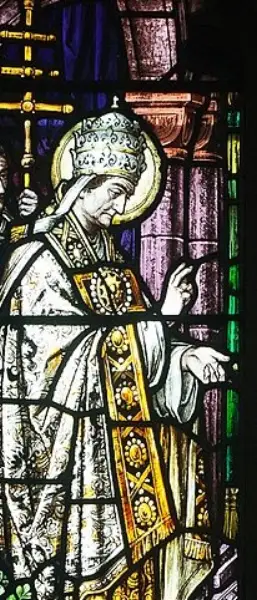
Overview
Celestine I was bishop of Rome from 10 September 422 until his death on 27 July 432, a pontificate spent almost entirely in the defense of the church's teaching. A Roman from Campania, son of a man named Priscus and said to be a relative of the emperor Valentinian, he had lived for a time at Milan with Saint Ambrose and appears first in a document of Pope Innocent I in 416 as "Celestine the Deacon." As pope he condemned Pelagianism, backing the initiative of the Gallic bishops who sent Germanus of Auxerre and Lupus of Troyes to Britain in 429, and in 431 he commissioned Palladius as bishop to the Scots of Ireland — the first recorded papal missionary to that island. When the teaching of Nestorius shook the East, Celestine held a Roman synod in 430 to condemn it, and when Cyril of Alexandria appealed to him for a decision, he entrusted to Cyril the task of executing the condemnation at the First Council of Ephesus. He opposed the Novatians in Rome, insisting that reconciliation should never be refused to a dying sinner, and rebuked his clergy for seeking distinction in dress rather than learning. He died in 432 and was buried in the cemetery of Saint Priscilla on the Via Salaria; his body now rests in the Basilica di Santa Prassede.
The Complete Life
A Roman of Campania
Celestine came of Roman stock from the region of Campania, born around the year 359 into a family of some standing; his father's name was Priscus, and according to the tradition recorded by John Gilmary Shea he was a relative of the emperor Valentinian. Beyond these bare lines the story of his youth is almost a blank — nothing is known of his early history beyond the company he kept. That company was illustrious: tradition has him dwelling for a while at Milan in the company of Saint Ambrose, within the household and under the influence of the greatest bishop of the Latin West, whose defense of the church against emperors and heretics alike must have marked him for life. The first document to cast light on him is a record of Pope Innocent I from the year 416, in which he is spoken of simply as "Celestine the Deacon" — already a man of mature standing in the Roman clergy, entrusted with the service of the see. When Innocent's successor Boniface I died in the summer of 422, after his own disputed election, the choice of the Roman church fell upon this deacon of Campanian origin, then in his sixties, tested by decades of service.
§ Early life and family
From the Deaconate to the Throne of Peter
The path by which Celestine reached the papacy ran through the schools and services of the Roman church rather than through intrigue. Formed in the tradition of Ambrose at Milan and of Innocent at Rome, he served the apostolic see as a deacon, and the first record of his life shows him holding that office in 416 under Pope Innocent I — the pope whose teaching on the primacy of the Roman see he would later carry forward. He was elected to succeed Boniface I in 422, entering upon the pontificate on 10 September by the reckoning of Tillemont and of the Vatican, though the Liber Pontificalis dates the beginning to 3 November. He inherited a church beset on every side: Pelagianism, condemned but not extinguished, still circulated in the West; the Novatians held their own congregations in Rome itself; and in the East the teaching of Nestorius, patriarch of Constantinople, threatened to divide the natures of Christ that the church confessed as united in one person. The deacon of the Roman church became the pope who would meet each of these dangers in turn — not by innovation but by a resolute adherence to the faith and discipline he had received.
§ Pontificate
Ephesus and the Fall of Nestorius
The great work of Celestine's pontificate was the condemnation of Nestorianism. In 430 he gathered a Roman synod that passed judgment on Nestorius's teaching; when Cyril of Alexandria then appealed to him to make a decision in the gathering quarrel, Celestine responded with decisive delegation: he entrusted to Cyril the job of executing the condemnation of Nestorius if the patriarch did not recant his teachings. The next year his delegates went to the First Council of Ephesus, convened over the same question, and the council's judgment against Nestorius stands in history as a triumph in which the Roman see had an instrumental part. Four letters from Celestine's hand belong to that moment, each bearing the date of 15 March 431, joined by further letters addressed to the African episcopate, to Illyria, to Thessalonica, and to Narbonne; these survive only in Greek re-translation, for the Latin originals have perished — a loss that measures how far his correspondence ranged across the Christian world. In the same years he acted against Pelagianism in the far West: he gave his backing to the Gallic episcopate's plan of dispatching Germanus of Auxerre and Lupus of Troyes to Britain in 429 against bishops said to favor Pelagius, and in 431 Palladius went out to Ireland at his command as bishop, carrying the papal mission to the edge of the known world.
§ Pontificate
Orthodoxy without Novelties, Mercy without Exception
Celestine's spiritual character combined two convictions that later ages have found hard to hold together: an unbending insistence on the faith once delivered, and a boundless readiness to forgive the repentant sinner. The least departure from the settled practice of his predecessors he would not brook. Vincent of Lerins, writing in 434, recounted how the pope's epistle to the Gallic priests arraigned them for connivance in error, their silence having betrayed the ancient faith and permitted profane novelties to spring up; to preachers of novelty he gave short order: rebuke them, and restrain their freedom to preach. The same pope, however, stood against the rigorism of the Novatians, who closed absolution to the lapsi; Celestine held that no penitent at the point of death, if sincerely seeking it, might ever be turned away from reconciliation, and he took strong measures against them in Rome, obliging their bishop Rusticulus to hold his meetings in private houses. His letter to the bishops of Gaul in 428 shows the same inward temper turned on his own clergy: they should be distinguished from the common people by learning, not clothes; by conduct, not dress; by cleanness of mind, not by care for the person.
§ Pontificate
Death and the Reckoning of Dates
Celestine died in 432, but even the day of his death has been argued over by scholars for fifteen centuries. Several interpretations exist: some manuscript traditions of the Liber Pontificalis put his death on 6 or 8 April 432, a reckoning favored by the Eastern Orthodox church, which fixed its feast day for the pope accordingly. Critical analysis of the alternative sources shows that the April date sits uneasily both with the known succession of Sixtus III and with the number of days Celestine sat on the papal throne. Counting the days from his election to his death, Tillemont calculated the date as 26 July 432; When Louis Duchesne produced the first full critical edition of the Liber Pontificalis in 1886, his like computation yielded 27 July 432 — the date the Western church now largely keeps and marked by the Roman church as his feast. He was buried in the cemetery of Saint Priscilla on the Via Salaria, among the martyrs and earliest Christians of the city he had governed; but his body was subsequently moved, and it now lies in the Basilica di Santa Prassede, where the pilgrim may still venerate the pope who sent the faith to Ireland.
§ Death and legacy
Saint of East and West
Celestine is recognized as a saint by the Oriental Orthodox, Eastern Orthodox, and Catholic Churches, his cult resting on the ancient veneration that gathered around the great bishops of the undivided church rather than on any formal process. The calendar of his feast tells the story of a memory cherished across three communions: the Catholic Church keeps 27 July, the date of his death established by the critical scholarship of Duchesne; the Eastern Orthodox Church celebrates him on 8 April, following the Liber Pontificalis tradition of an April death; and the Coptic church of Egypt — the church of Cyril, his great ally at Ephesus — remembers him on 3 Epip. In art he is portrayed as a pope attended by a dove, a dragon, and a flame, emblems that preachers have read as figures of the Holy Spirit's gentleness, the evil he confronted, and the zeal that burned in him. His name is entered in the catalogue of the canonized popes of Rome between Boniface I and Sixtus III, and his liturgical commemoration has never lapsed in East or West since the centuries immediately following his death.
§ Death and legacy
The Pope Who Sent Patrick's Predecessors
The decisions of Celestine's ten years shaped the church for a millennium. His synod of 430 and his delegation to Cyril set the course that ended at Ephesus, where the church confessed Mary as the Mother of God and the unity of Christ's person against the teaching of Nestorius; the four letters of March 431 survive as monuments of the Roman see's direction of the universal church. His missions redrew the religious map of the far West: Germanus of Auxerre's campaign in Britain broke the strength of Pelagianism there, and the sending of Palladius to Ireland in 431 stands at the head of the papal relationship with that island — remembered in art and legend alongside the mission of Saint Patrick, whom tradition links to the same pontificate. His insistence that the church must forgive the dying penitent struck a blow against the Novatian rigorism that had shadowed Christian charity for two centuries. His body, translated from the cemetery of Saint Priscilla, rests in Santa Prassede; his example — orthodoxy without cruelty, discipline without vanity — passed into the self-understanding of the Roman papacy, and his correspondence, preserved in Greek re-translation when the Latin originals perished, remains among the earliest extensive records of a pope governing the whole church.
§ Death and legacy
Timeline
- 359
Born around this year in Rome, a Roman of the region of Campania, son of a man named Priscus.
§ Early life and family
- 416
First appears in the historical record in a document of Pope Innocent I, spoken of as "Celestine the Deacon".
§ Early life and family
- 10 Sep 422
Began his pontificate as bishop of Rome, succeeding Boniface I; the Liber Pontificalis gives the start as 3 November.
§ Pontificate
- 428
Sent the bishops of Gaul a letter rebuking clergy who had begun wearing distinctive clerical dress.
§ Pontificate
- 429
Supported the Gallic bishops' mission sending Germanus of Auxerre and Lupus of Troyes to Britain against Pelagianism.
§ Pontificate
- 430
Convened a Roman synod that passed judgment against the teaching of Nestorius.
§ Pontificate
- 15 Mar 431
Wrote four letters, dated this day, to the bishops of Africa, Illyria, Thessalonica, and Narbonne.
§ Pontificate
- 431
Sent delegates to the First Council of Ephesus, having delegated to Cyril of Alexandria the condemnation of Nestorius.
§ Pontificate
- 431
Commissioned Palladius and dispatched him as bishop to the Scots dwelling in Ireland and northern Britain.
§ Pontificate
- 27 Jul 432
Died in Rome; Tillemont calculated 26 July, while the Liber Pontificalis offers dates of 6 or 8 April.
§ Death and legacy
In Their Own Words
We are deservedly to blame if we encourage error by silence. Therefore rebuke these people. Restrain their liberty of preaching.
We should be distinguished from the common people by our learning, not by our clothes; by our conduct, not by our dress; by cleanness of mind, not by the care we spend upon our person.
this Celestinus took away the churches from the Novatians at Rome also, and obliged Rusticulus their bishop to hold his meetings secretly in private houses.
The Record
- Major works
- Four letters of 15 March 431 to the African bishops, to those of Illyria, of Thessalonica, and of Narbonne·Letter to the bishops of Gaul (428) on clerical dress·Commission of Palladius as bishop to Ireland
- Symbols
- Dove·Dragon·Flame
- Canonization
- Pre-congregation; recognized as a saint by ancient custom and venerated in the Catholic, Eastern Orthodox, and Oriental Orthodox churches
Prayer
Bibliography
Show 7 sources
- Duchesne, Louis (1886). Liber Pontificalis, Texte, Introduction et Commentaire. p. 89.
- Loomis, Louise Ropes (1916). The Book of the Popes (Liber Pontificalis). New York: Columbia University Press. pp. 92f.
- Shea, John Gilmary. "Celestine I", Little Pictorial Lives of the Saints. Benziger Brothers: New York, 1894.
- Murphy, John Francis Xavier (1908). "Pope St. Celestine I". Catholic Encyclopedia. Vol. 3. New York: Robert Appleton Company.
- Tillemont, Louis Sébastien Le Nain de (1709). Memoires pour servir a l'histoire ecclesiastique des six premiers siecles. Paris: Charles Robustel. 14:148.
- Socrates Scholasticus. Ecclesiastical History 7:11.
- Vincent of Lerins. Commonitory 32.
Profile text adapted from the Wikipedia article, licensed CC BY-SA 4.0.
Pray with this saint every day
Save St. Celestine I to your favorites, read the full profile, and get feast-day reminders in the Saints app.
Get the Saints AppFree on the App Store for iPhone and iPad