
c. 1209 – 1296·Feast May 19
St. Celestine V
The Hermit Pope Who Resigned After Five Months
Overview
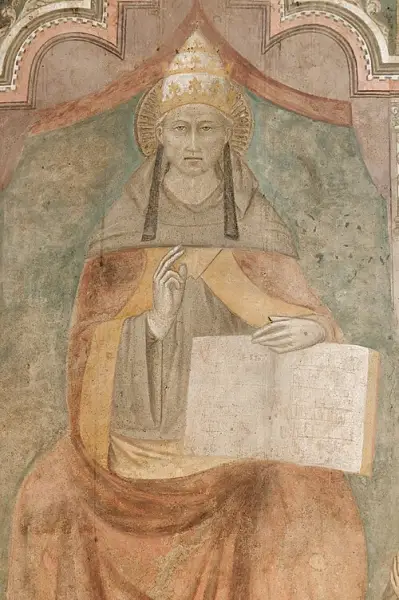
Pietro Angelerio, remembered as Peter of Morrone, spent most of his long life as a hermit in the mountains of Abruzzo before being raised, at about eighty years of age, to the papal throne. Born into a peasant family in Molise, he entered the Benedictines at seventeen and soon withdrew into solitude on the Montagne del Morrone, where his austerity drew disciples and a reputation for wonders. The community gathered around him received papal approval as the Celestines, a severely ascetical branch of the Benedictine family. When the cardinals, deadlocked for over two years after the death of Nicholas IV, chose him in July 1294, he accepted with reluctance and was crowned at Aquila. Lacking political experience and dominated by King Charles II of Naples, his five-month pontificate proved ineffectual, yet he enacted one decree of lasting consequence: the formal recognition of a pope's right to resign. He exercised that right on 13 December 1294, declaring his longing for humility and the tranquility of his former life. His successor Boniface VIII, fearing an antipapal movement, confined him in the castle of Fumone, where he died ten months later. Canonized in 1313 by Clement V, he is honored as a confessor, and no later pope has taken his name.
The Complete Life
A Peasant Son of Molise
Pietro Angelerio was born around 1209 to a peasant household in the rural Molise, then a region of the Kingdom of Sicily; his native village is placed at Sant'Angelo Limosano, near Campobasso. His parents, Angelo Angelerio and Maria Leone, raised a large family: twelve children were born to Maria, and Pietro was the second-youngest of the seven sons who survived infancy. His father died when the boy was five or six years old, leaving the household to its own slender resources. Maria cherished a particular affection for Pietro and imagined for him a future beyond the farming and shepherding that occupied his neighbors. She sold a portion of the family's property to engage a tutor, a sacrifice that stirred resentment among his brothers. The investment bore fruit quickly, for the boy took to learning with ease and soon mastered reading the psalter. When seventeen he received the Benedictine habit at Santa Maria di Faifoli, an abbey of the Benevento diocese. There his disposition toward austerity and solitude revealed itself with unusual force. In the early 1230s he withdrew to a solitary cavern on the Montagne del Morrone, the height that gave him his enduring name. Others began to seek him out, drawn by his eremitical example and by reports that he worked miracles. In 1244, after traveling to Rome for his ordination, he abandoned even that retreat and moved with two companions to a more remote cave on the Maiella, where he modeled his life on the austerity of John the Baptist.
§ Early life
Founder of the Celestines
The hermit of Morrone did not remain alone. While pursuing his ascetical discipline in 1244 he gathered a new religious community, the congregation that posterity would name the Celestines after him. In 1254 Pietro gave the brotherhood a written rule drawn from his own manner of life, its spirit shaped by the reforming writings of Peter Damian. Though fundamentally Benedictine, the group also stood close to the radical Franciscans, who grieved over the growing worldliness and political entanglement of the Church. A church rose at the foot of the Morrone in 1259 to serve the expanding community, and in June 1263 Pope Urban IV granted the institution formal approval. A graver test came a decade later. Hearing that Gregory X, then presiding over a council at Lyon, intended to suppress new orders founded since the Lateran Council had forbidden their multiplication, Pietro journeyed to Lyon in person. There in 1274 he won from the pope what suppression could not touch: recognition of his congregation as a branch of the Benedictines under the Rule of Saint Benedict, strengthened with additional severities, taken under papal protection, secured in its possessions, and exempted from the authority of local ordinaries. The order spread rapidly, and Pietro lived to govern it as superior-general over a family of thirty-six monasteries housing better than six hundred monks. At a general chapter held in 1293 judged the original house on the Maiella too desolate, and the Abbey of the Holy Spirit in the plain near Sulmona became the order's seat, remaining so until its extinction in the eighteenth century.
§ Founding of the Celestines
Chosen to End a Deadlock
When Nicholas IV died in April 1292 the cardinals gathered at Perugia, but more than two years passed without a consensus. Pietro, well known to them as a Benedictine hermit of blameless reputation, addressed to the deadlocked cardinals a letter in which he cautioned that heaven's vengeance would overtake them should they fail to give the Church a shepherd without delay. The aged and ailing Dean of the Sacred College, Latino Malabranca, thereupon proclaimed aloud that he elected brother Pietro da Morrone, and his colleagues ratified the choice at once. Summoned to receive the dignity, Pietro refused obstinately and, as Petrarch recounts, even sought to slip away, and yielded only when cardinals came for him together with the king of Naples and the claimant to Hungary's crown. His election fell on 5 July 1294, the last non-conclave papal election in the Church's history, and he was crowned at Santa Maria di Collemaggio in Aquila on 29 August under the name Celestine V. One of his first acts crowned the occasion with mercy: an indulgence of rare plenitude, bestowed by papal bull, for every pilgrim passing through the basilica's holy door on the anniversary of his coronation. That generosity survives in the Perdonanza Celestiniana, the festival still celebrated in L'Aquila each year on 28 and 29 August.
§ Election as pope
A Throne Weighed Against a Conscience
The pontificate of Celestine V laid bare the distance between the cloister and the court. Holding his office within the Kingdom of Naples, cut off from the Roman Curia and wholly subject to King Charles II, the aged hermit proved weak and ineffectual in governance. He lavished royal favorites on Church offices, at times appointing several men to the same post, and ordered clerical tonsure and minor orders for Louis of Toulouse, an instruction never carried out. Yet beneath the administrative confusion moved a conscience seeking God with the same directness that had driven him into the mountains. He renewed Gregory X's stringent rules for conclaves, a decree the Church has honored ever since. He appointed three cardinals to govern during Advent so that he might give himself to fasting. When he recognized his own inability to bear the office, he consulted Cardinal Benedetto Caetani, his eventual successor, on the possibility of laying it down, and then issued the decree that became his enduring monument: the declaration that a pope may resign. Five months and eight days into his reign, on 13 December 1294, he put that newly declared right into practice. In the formal instrument of renunciation he confessed his motives plainly: a yearning after humility, a cleaner life, and an unstained conscience; the frailty of his body; the limits of his learning; and homesickness for the quiet existence he had surrendered. Divested of every outward symbol of the papal dignity, he slipped away from Naples toward his old solitude.
§ Papacy
Prisoner of Fumone
The resigned pope, once more simply Pietro Angelerio, was not permitted to return to the hermit's life he craved. Because parties opposed to the resignation might have set him up as an antipope, Boniface VIII summoned him to Rome. The old man fled and took cover in the woods, hoping to make his way to Sulmona and resume monastic observance, but the plan proved impossible; an attempt to flee by sea to Dalmatia was defeated when a tempest drove his ship back to port. Captured, he was confined in the castle of Fumone near Ferentino in Lazio, attended by two monks of his own order. There, after ten months of captivity at about the age of eighty-one, he died on 19 May 1296. His partisans alleged that Boniface had treated him harshly and even put him to death, but history records no proof of such a crime. A 2013 examination of the small hole in his skull concluded that it was inflicted after death, when the remains were already skeletonized, most likely during a reburial. He was laid to rest at Ferentino, but his body was afterwards translated to the Basilica of Santa Maria di Collemaggio in L'Aquila, the church of his coronation, where it became the object of enduring pilgrimage.
§ Retirement, death, and canonization
Raised to the Altars
The cause of the humble pontiff found its champion in the secular prince who had most opposed his successor. Philip IV of France, having supported Celestine and quarreled bitterly with Boniface VIII, nominated the departed hermit for sainthood after the election of Clement V. On 13 May 1306 the new pope signed a decree of dispensation opening a formal investigation of the nomination. The deliberations that followed turned in part on the rivalries of Roman factions: in the consistory that decided the matter, the Colonna family, ancient rivals of Boniface's Caetani kin, outvoted the latter and carried the day. On 5 May 1313 Clement V canonized Pietro Angelerio at Avignon, enrolling among the saints the man who had held the highest office in Christendom for barely five months and surrendered it for love of a stricter life. The Martyrologium Romanum commemorates him on the day of his death, recalling how the celebrated hermit of Abruzzo, famed for holiness and for wonders, was raised to the Roman see in his old age under the name Celestine V, laid that burden down within the same year, and chose solitude once more. His feast is kept on 19 May, and he is venerated as a confessor rather than a martyr.
§ Retirement, death, and canonization
The Great Refusal and Its Afterlife
Modern attention to Celestine V has fixed above all on his resignation. Though often called the first pope to step down, he was preceded by Pontian, John XVIII, Benedict IX, and Gregory VI; his true innovation was formalizing the process itself, and his reinstatement of Gregory X's conclave system in the bull Ubi periculum has governed papal elections ever since. No successor took his name. Dante's Inferno seems to glimpse him among the neutrals outside Hell as the shade who made the great refusal through cowardice, an identification first advanced by the poet's son Jacopo and long debated by scholars; Petrarch sprang to his defense, declaring in his De vita solitaria that the refusal was a virtuous exemplar of the solitary life. In 1966 a visit by Paul VI to Ferentino, and the homage he paid there, stirred speculation that the pope himself contemplated retirement. In 2009 Celestine's remains survived the L'Aquila earthquake unharmed, a circumstance an Italian spokesman called another great miracle; Benedict XVI, visiting the damaged basilica that April, laid on the glass casket the pallium he had worn at his own inauguration. To mark the eight hundredth anniversary of the saint's birth, Benedict proclaimed a Celestine year from August 2009 to August 2010, and dramatists from Silone to Peter Barnes have returned to the paradox of the throne abandoned for the cave.
§ Legacy
Timeline
- 1209
Born at Sant'Angelo Limosano in Molise, son of Angelo Angelerio and Maria Leone.
§ Early life
- 1230
Sought out a lonely cavern high on the Montagne del Morrone, where he began living as a hermit in the early 1230s.
§ Early life
- 1244
Ordained during a visit to Rome, then withdrew with two companions to a remote cave on the Maiella.
§ Early life
- 1244
Founded the religious community that would later be called the Celestines.
§ Founding of the Celestines
- 1254
Formally issued a rule for his community, modeled on his own practices and influenced by Peter Damian.
§ Founding of the Celestines
- 1259
A church was completed at the foot of the Morrone for his growing brotherhood.
§ Founding of the Celestines
- Jun 1263
Pope Urban IV formally approved the new religious institution.
§ Founding of the Celestines
- 1274
Persuaded Gregory X at Lyon to approve the order as a Benedictine branch under papal protection.
§ Founding of the Celestines
- Apr 1292
Nicholas IV died and the cardinals assembled at Perugia, beginning an election lasting over two years.
§ Election as pope
- 1293
A general chapter designated the Abbey of the Holy Spirit near Sulmona as headquarters of the order.
§ Founding of the Celestines
- 5 Jul 1294
Elected pope at Perugia after Latino Malabranca named him, ending the long conclave impasse.
§ Election as pope
- 29 Aug 1294
Crowned at Santa Maria di Collemaggio in Aquila, having granted pilgrims there a plenary indulgence.
§ Papacy
- 10 Oct 1294
Consecrated the altar of Sulmona Cathedral, into which his relics were placed.
§ Legacy
- 13 Dec 1294
Resigned the papacy after five months and eight days, exercising the right of resignation he had decreed.
§ Papacy
- 19 May 1296
Died a prisoner in the castle of Fumone near Ferentino, attended by two monks of his order.
§ Retirement, death, and canonization
- 13 May 1306
Clement V signed a decree of dispensation authorizing investigation of his proposed canonization.
§ Retirement, death, and canonization
- 5 May 1313
Canonized by Clement V at Avignon after a consistory in which the Colonna family prevailed over the Caetani.
§ Retirement, death, and canonization
- 28 Apr 2009
Benedict XVI prayed at his remains in the earthquake-damaged basilica and left his pallium on the casket.
§ Legacy
In Their Own Words
The desire for humility, for a purer life, for a stainless conscience, the deficiencies of his own physical strength, his ignorance, the perverseness of the people, his longing for the tranquility of his former life.
I saw and recognized the shade of him who due to cowardice made the great refusal.
The Record
- Major works
- Rule of the Celestines (1254)·Opuscula omnia
- Patron of
- patron of bookbinders·patron of papal resignations·patron of Aquila·patron of Urbino·patron of Molise·patron of Sant'Angelo Limosano·patron of the Celestines
- Symbols
- papal vestments·papal tiara·Benedictine habit
- Canonization
- Canonized 5 May 1313 at Avignon by Pope Clement V
Prayer
Bibliography
Show 5 sources
- Ferzoco, George (2001). "Peter of the Morrone (Pope Celestine V), Autobiography". In Head, Thomas F. (ed.). Medieval Hagiography. New York: Routledge. pp. 729–732. ISBN 978-0-415-93753-5.
- Sweeney, Jon M. (2012). The Pope Who Quit. New York: Image Books. ISBN 978-0-385-53189-4.
- Loughlin, J. F. (1908). "Pope St. Celestine V". The Catholic Encyclopedia. Vol. 3. New York: Robert Appleton Company.
- Kelly, J. N. D.; Walsh, Michael J. (2010). The Oxford Dictionary of Popes (2nd ed.). New York, NY: Oxford University Press. pp. 206–208. ISBN 978-0-19-929581-4.
- Duffy, Eamon (2006). Saints & Sinners: A History of the Popes (3rd ed.). New Haven, Conn.: Yale University Press. p. 159. ISBN 978-0-300-11597-0.
Profile text adapted from the Wikipedia article, licensed CC BY-SA 4.0.
Pray with this saint every day
Save St. Celestine V to your favorites, read the full profile, and get feast-day reminders in the Saints app.
Get the Saints AppFree on the App Store for iPhone and iPad