
died June 253·Feast September 16
St. Cornelius
Bishop of Reconciliation in a Time of Persecution
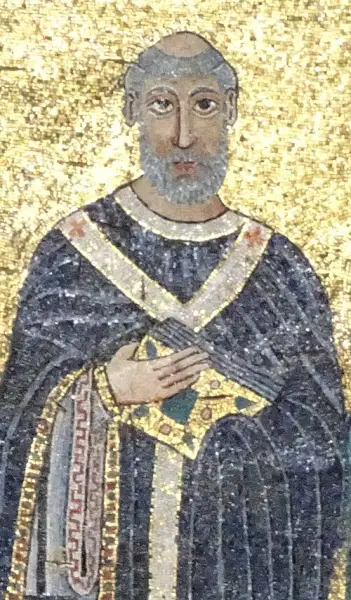
Overview
Cornelius led the church of Rome from March 251 until his death in exile three years later, guiding it through the aftermath of the Decian persecution and a bitter quarrel over mercy. When Emperor Decius required every citizen to offer sacrifice to the gods, many Christians fell away to save their lives, and the vacant Roman see could not be filled for fourteen months. When the clergy finally chose a bishop, Cornelius was elected reluctantly, over the rigorist priest Novatian. The rejected party had Novatian consecrated as a rival bishop, insisting that apostates could never be readmitted to communion, while Cornelius, in agreement with Cyprian of Carthage, taught that the lapsed could be restored after genuine repentance and a period of penance. A synod of sixty bishops confirmed his election, excommunicated Novatian, and settled the discipline of readmission, though the controversy rumbled on for years. His surviving letters, written in the plain Latin of ordinary speech, sketch the Roman church of his day in remarkable detail: more than 150 clergy, over 1,500 people fed daily, and a Christian population estimated at 50,000. When Trebonianus Gallus renewed the persecutions in 251, Cornelius was banished to Centum Cellae, where he died in June 253, a confessor whose hardships, and perhaps his beheading, the church counted as martyrdom.
The Complete Life
Elected in the Shadow of Persecution
The persecution of Decius, which had begun sporadically after his accession in 249, hardened in January 250 into an empire-wide command: every citizen was to perform religious sacrifice before commissioners or face death. Many Christians refused and died; Pope Fabian was martyred on 20 January 250; and many others offered the sacrifices to preserve their lives. With a pope dead and the machinery of the state turned against the church, no successor could be chosen, and for fourteen months the Roman community was governed by a group of priests, among them the learned Novatian. The leading candidate for the vacant see, Moses, died under the persecution itself. Only when Decius left the city to campaign against invading Goths did the Roman clergy dare to elect a bishop. Their choice fell in March 251 on Cornelius, a man of moderate temperament who accepted the office unwillingly, preferred over Novatian and other aspirants as the twenty-first occupant of the see. The election answered the Church's deepest need at that moment. Two parties had formed among the survivors of the persecution: rigorists who declared that the fallen could never return, and moderates who believed that repentance must be allowed to heal what terror had broken. Cornelius belonged unmistakably to the second.
§ Christian persecution
Mercy Over Rigorism
The rivalry that dogged Cornelius's brief pontificate crystallized at once. His opponents secured episcopal consecration for Novatian and withheld all recognition from Cornelius as Rome's bishop, and both parties dispatched letters across the Christian world in search of allies. Cyprian, Dionysius, and the great body of African and Eastern bishops stood with Cornelius; Novatian could count only a minority of Rome's clergy and laity among his adherents. Cornelius then convened a synod of sixty bishops, which acknowledged him as the rightful pope, excommunicated Novatian and his followers, and ruled that Christians who had abandoned the practice of the faith under Decius could be readmitted to the community after performing penance. Its verdict was communicated to bishops far and wide, most pointedly to the see of Antioch, whose bishop was a fierce Novatianist. The letters Cornelius sent in this struggle preserve a vivid portrait of the Roman church in the mid-third century: forty-six priests, seven deacons, seven subdeacons, forty-two acolytes, fifty-two ostiarii, more than fifteen hundred widows and persons in distress, a clerical staff exceeding one hundred and fifty, and over fifteen hundred souls fed daily, figures that suggest a Christian population of at least fifty thousand. One of these letters contains the earliest known mention of the office of exorcist in the church.
§ Papacy
Exile at Centum Cellae
In June 251 Decius perished in battle against the Goths, and under his successor Trebonianus Gallus the machinery of persecution turned upon the church once more. Cornelius was arrested and banished to Centum Cellae, the coastal town now called Civitavecchia, far from the community he governed. He did not cease to work from exile: the letters he sent during his banishment are among the chief witnesses to his pontificate, and their language tells its own quiet story about the man. He wrote not in the classical style cultivated by the educated, as the theologian Cyprian or the philosopher Novatian would have done, but in the colloquial Latin of everyday speech. This suggests that Cornelius came from a family of ordinary means and received the common education of a child of that station, a provincial of no great polish entrusted with the greatest see in Christendom. In June 253 he died at Centum Cellae. The Liberian catalogue ascribes his death to the rigors of banishment; later tradition maintains that he was beheaded. His body was laid in a catacomb close by the popes' chapel, covered by a Latin epitaph instead of the Greek used for his predecessor Fabian and his successor Lucius I, a simple tablet reading "Cornelius Martyr".
§ Death and letters
The Saint with the Horn
Veneration of Cornelius spread far beyond the catacomb where he was first laid. During the Middle Ages some of his relics crossed into Germany, and the skull passed into the keeping of Kornelimünster Abbey by Aachen, whose town honors him as its own patron. In the Rhineland he ranked among the Four Holy Marshals, venerated in the late Middle Ages alongside Quirinus of Neuss, Hubertus, and Anthony the Great, and he was honored there as a patron of lovers. A tender legend tells of a youthful painter hired to adorn the Corneliuskapelle in Neuss's Selikum district, whose heart was won by a local townsman's daughter; the father withheld his blessing unless the pope likewise consented, whereupon Cornelius's statue leaned out over the couple from its altar and blessed them, and the marriage went forward. Another legend, told at Carnac, says those famous standing stones were soldiers who chased the fleeing saint and were changed into rock at his word. The church keeps his feast on 16 September, sharing the day with his friend and ally Cyprian; Jerome records 14 September as the original date, marking the day both men suffered martyrdom. His name, meaning "battle horn", explains his emblem: a pope with a cow's horn, or a cow at his side, and his patronage extends against earache, epilepsy, fever, and twitching.
§ Veneration
Timeline
- Jan 250
Decius decreed that all citizens sacrifice to the gods before commissioners on pain of death.
§ Christian persecution
- 20 Jan 250
Pope Fabian was martyred, and the Roman see could not be filled during the persecution.
§ Christian persecution
- Mar 251
Elected Bishop of Rome on 6 or 13 March after a fourteen-month vacancy, chosen over Novatian.
§ Christian persecution
- 251
His rivals had Novatian consecrated a bishop, refusing to recognize Cornelius as rightful pope.
§ Papacy
- 251
Convened a synod of sixty bishops that confirmed his election, excommunicated Novatian, and set terms for restoring the lapsed.
§ Papacy
- Jun 251
Decius fell in battle against the Goths, and persecutions resumed under Trebonianus Gallus.
§ Death and letters
- Jun 253
Died in exile at Centum Cellae; the Liberian catalogue attributes his death to the hardships of banishment.
§ Death and letters
In Their Own Words
forty six priests, seven deacons, seven sub-deacons, forty two acolytes, fifty two ostiarii, and over one thousand five hundred widows and persons in distress.
The Record
- Major works
- Letters from exile, written in the colloquial Latin of his day
- Patron of
- against earache·against epilepsy·against fever·against twitching·patron of cattle and domestic animals·patron of earache sufferers·patron of epileptics·patron of lovers in the Rhineland·patron of Kornelimünster, Germany
- Symbols
- papal figure holding a cow's horn·cow standing nearby
- Canonization
- Pre-congregation canonization; venerated as a martyr from the earliest centuries
Prayer
Bibliography
Show 6 sources
- Chapman, John (1913). "Pope Cornelius". In Herbermann, Charles (ed.). Catholic Encyclopedia. New York: Robert Appleton Company.
- McBrien, Richard P. "Pope Cornelius, a reconciler, had a hard road." National Catholic Reporter 40.41 (September 24, 2004): 19(1).
- Moody Smith, D. "Review: The Rise of Christianity: A Review." Journal of the American Academy of Religion 54 (1986): 337–42.
- Schrembs, Joseph. "The Catholic Philosophy of History." The Catholic Historical Review 20 (1934): 1–22.
- Papandrea, James L., Novatian of Rome and the Culmination of Pre-Nicene Orthodoxy. Wipf and Stock Publishers, 2011. ISBN 9781606087800.
- Saints and Feast Days. New York: Loyola P, 1991.
Profile text adapted from the Wikipedia article, licensed CC BY-SA 4.0.
Pray with this saint every day
Save St. Cornelius to your favorites, read the full profile, and get feast-day reminders in the Saints app.
Get the Saints AppFree on the App Store for iPhone and iPad