
c. 1816 – 1861·Feast January 31
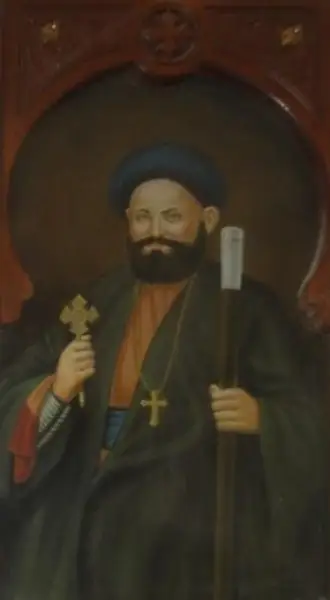
St. Cyril IV of Alexandria
Father of Reform of the Coptic Church
Overview
Cyril IV, born David (Daoud) around 1816 in Sawamaa near Girga, served as the 110th Pope of Alexandria and Patriarch of the See of St. Mark, and though his enthronement lasted barely seven years, the Coptic Orthodox Church honors him as the modern Father of Reform. A monk who became abbot of the Monastery of Saint Anthony, he first served the church as a diplomat: Peter VII sent him to Ethiopia to mediate between Abouna Salama and his opponents and to check the spread of Catholic missionary influence, and it was during this absence that the patriarch died, leaving Daoud, the majority choice as successor, barred from his seat for two years by the intrigues of the Ichege Gebre Mariam. Enthroned at last on 5 June 1854, he turned his energies to renewing his own church, above all by establishing a great printing house through which many Church books were issued for the first time. At the request of the viceroy Sa'id he returned to Ethiopia, making the first recorded journey to that country by the head of the Coptic church. There Emperor Tewodros II received him coldly, imprisoned him on suspicion of spying, and quarreled with his fellow churchman; Cyril lifted the resulting interdict and departed. He died in Egypt on 31 January 1861.
The Complete Life
From the Desert of Saint Anthony to the Throne of Mark
The man who would reign as Cyril IV began life as David, or Daoud, born around 1816 at Sawamaa in the district of the Upper Egyptian city of Girga. He embraced the monastic life and rose to become abbot of the Monastery of Saint Anthony, the ancient house whose founder gave the whole of Egyptian monasticism its pattern. His abilities brought him to the attention of Pope Peter VII, who dispatched the abbot to Ethiopia on a delicate double mission: to mediate between Abouna Salama and his opponents within the Ethiopian Church, and to prevent sympathies for Catholic missionaries and their teaching from gaining further ground. The mission kept him abroad at the very moment of Peter VII's death. Daoud was the majority choice to succeed the departed patriarch, but the former Ichege Gebre Mariam, then in Cairo to press Ethiopian claims to a convent in Jerusalem, seized the occasion to advance his own cause, and the elected candidate was kept from his seat for two full years. Only after this delay was Daoud enthroned as the 110th Pope of Alexandria, taking the name Cyril IV, on 5 June 1854, with his residence at Saint Mark's Coptic Orthodox Cathedral in Azbakeya.
§ Pope Cyril IV of Alexandria
Envoy Between Egypt and Ethiopia
Once enthroned, Cyril was called back across the Red Sea. Viceroy Sa'id of Egypt requested that the patriarch journey to Ethiopia, and Cyril complied, undertaking what is recorded as the first visit ever made to that country by the head of the Coptic church. The reception he met was chilling. Emperor Tewodros II — a ruler whom the historian Trimingham portrayed as finding it unthinkable that any Christian bishop would serve as messenger for a Muslim sovereign — gave Pope Cyril a cold reception in December 1856. Matters worsened when the patriarch, showing an interest in reviewing the Emperor's army, awakened the Emperor's suspicion that he was a spy; Tewodros confined him together with Abouna Salama in their house, and both men were freed only when the Ethiopian clergy intervened on their behalf. In November of the following year tempers flared between the Abouna and the Emperor, and Salama went so far as to excommunicate Tewodros II. Patriarch Cyril, judging the anathema a peril to the church itself, lifted the interdict against Salama's wishes, and departed Ethiopia not long afterward. The episode displayed the qualities that would mark his whole pontificate: a readiness to cross boundaries for the sake of peace, and a firmness of judgment under the pressure of rival authorities.
§ Pope Cyril IV of Alexandria
The Printing Press and the Renewal of a Church
Cyril's pontificate lasted from 5 June 1854 until his death on 31 January 1861, less than seven years, yet the Coptic Church remembers it as the beginning of its modern awakening. She ranks him as her Father of Reform in the modern age, a title earned chiefly by his embrace of the technologies of the printed word. He established a great printing house and through it printed many Church books, putting within reach of clergy and laity alike the liturgical, scriptural, and patristic texts that had previously survived only in costly manuscript copies. In a church whose ancient heritage had been preserved by scribes for a millennium and a half, the press promised that the tradition could now be renewed rather than merely guarded, and every later reforming patriarch built upon the foundation he laid. His death at the age of about forty-five cut short a program of renewal still in motion, and Demetrius II succeeded him upon the throne of St. Mark. His repose is recalled in the Coptic Orthodox Synaxarium, the Church's book of saints, where the departure of Pope Cyril IV, the 110th Pope of Alexandria, is commemorated among the departures of the faithful servants of the See of St. Mark.
§ Pope Cyril IV of Alexandria
Timeline
- 1816
Born David (Daoud) at Sawamaa in the district of Girga.
§ Pope Cyril IV of Alexandria
- 5 Jun 1854
Enthroned as 110th Pope of Alexandria and Patriarch of the See of St. Mark, after a two-year delay.
§ Pope Cyril IV of Alexandria
- Dec 1856
Received unfavorably by Emperor Tewodros II on his diplomatic journey to Ethiopia.
§ Pope Cyril IV of Alexandria
- 1856
Suspected of spying when he asked to review the imperial army, and confined with Abouna Salama to their house until the Ethiopian clergy secured release.
§ Pope Cyril IV of Alexandria
- Nov 1857
Lifted the interdict Abouna Salama had pronounced against Emperor Tewodros II, against Salama's wishes, and left Ethiopia soon afterward.
§ Pope Cyril IV of Alexandria
- 31 Jan 1861
Died in Egypt after a pontificate of less than seven years.
§ Pope Cyril IV of Alexandria
In Their Own Words
unable to conceive how a Christian prelate could consent to act as the envoy of a Muslim prince
The Record
- Major works
- Established the great printing house of the Coptic Orthodox Church·Printed numerous Church books
- Canonization
- Commemorated in the Coptic Orthodox Synaxarium; venerated by the Coptic Orthodox Church
Prayer
Bibliography
Show 4 sources
- The Dictionary of African Christian Biography.
- Rubenson, Sven. The Survival of Ethiopian Independence. Hollywood: Tsehai, 2003, pp. 134f.
- Trimingham, J. Spencer. Islam in Ethiopia. Oxford: Geoffrey Cumberlege for the University Press, 1952, p. 118.
- Rubenson, Sven. King of Kings: Tewodros of Ethiopia. Addis Ababa: Haile Selassie I University, 1966, p. 70.
Profile text adapted from the Wikipedia article, licensed CC BY-SA 4.0.
Pray with this saint every day
Save St. Cyril IV of Alexandria to your favorites, read the full profile, and get feast-day reminders in the Saints app.
Get the Saints AppFree on the App Store for iPhone and iPad