
1902 – 1971·Feast March 9
St. Cyril VI of Alexandria
The Praying Patriarch of Modern Egypt
Overview
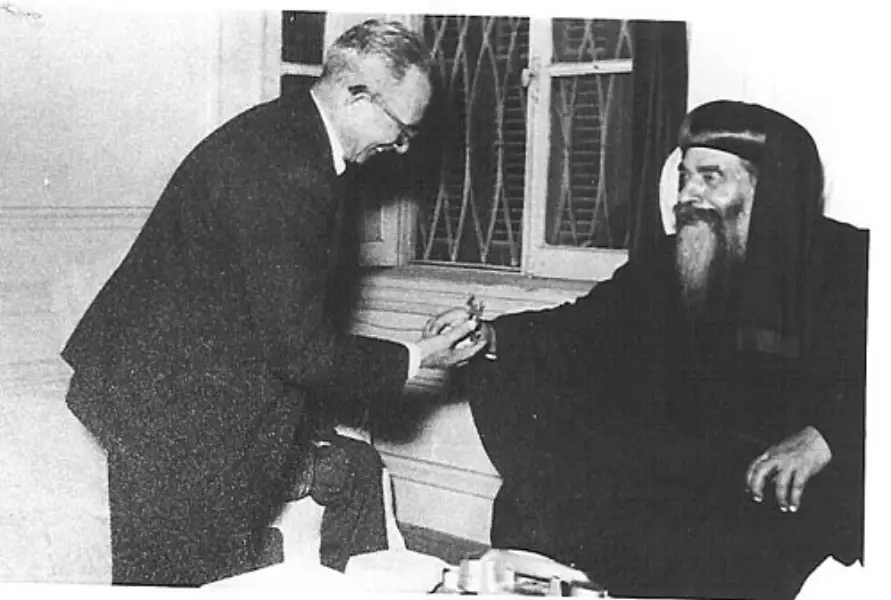
Cyril VI, born Azer Youssef Atta on 2 August 1902 at Damanhur in the governorate of Beheira, occupied the patriarchal throne of Alexandria as its 116th occupant from 10 May 1959 until his death, and stands among the most beloved figures in the modern history of the Coptic Orthodox Church. He abandoned a civil service career in July 1927 to become a monk, taking his vows at the Paromeos Monastery as Father Mina el-Baramosy, and passed years of hidden asceticism, first in a windmill in Old Cairo converted into a chapel, then as abbot-nominee of the Monastery of Saint Samuel the Confessor. In 1947 he built the Church of Saint Mina in Cairo. Chosen pope as the only monk in the twentieth century to be elevated to the patriarchate without first becoming a bishop, he presided over a season of remarkable renewal: he laid the foundation of the new Monastery of Saint Mina in the Desert of Mariout, built the great Saint Mark's Cathedral in Abbasseya, welcomed home the relics of the Evangelist Mark from Venice, and elevated the Ethiopian church to its own patriarchate. After a short illness he died on 9 March 1971, and forty-two years later the Holy Synod enrolled him among the saints.
The Complete Life
The Boy from Damanhur
The future patriarch first saw the light of day on 2 August 1902 in Damanhour, a town of the Beheira governorate, born to a Coptic Orthodox family of comfortable but modest standing, and for his first twenty-five years his life followed the ordinary paths of an educated Egyptian. In July 1927 he resigned from his civil service position in order to become a monk, a decision that exchanged security and advancement for the desert and the altar. Having passed his probationary period, he received the monastic habit on 24 February 1928 at the Paromeos Monastery, one of the four ancient houses of Scetis, where he was given the religious name Father Mina el-Baramosy — Father Mina of the Paromeos — and became known also as Father Mina the Elder. His gifts for peacemaking soon appeared: when a conflict broke out between the abbot of the monastery and some of its elder monks, Father Mina helped to resolve it, and then sought from Pope John XIX permission to pursue the solitude he craved in one of the old windmills built in Old Cairo under Muhammad Ali. There he lived at first with neither door nor roof, out of love for solitude, until local clergy and a lay leader of a nearby church pressed him to renovate the structure into a habitable dwelling.
§ Early life
A Windmill Chapel and a Desert Abbey
The windmill became the first sanctuary of Father Mina's hidden ministry. He divided its two levels with monastic ingenuity: the ground floor served as his living quarters, while on the upper level he arranged a sanctuary with an altar, where he offered the liturgy day by day. He remained in the windmill for some time before transferring to the monastery of Saint Samuel the Confessor; after he had died, a church rose around the old windmill, keeping the scene of his early solitude as a shrine. In 1944 he was nominated abbot of the Monastery of Saint Samuel the Confessor, and under his direction the desert community was renewed: he was instrumental in raising a new centre for the community at El Zawra, restoring its ancient churches and constructing fresh cells for its monks. In 1947 he built the Church of Saint Mina in Cairo, honoring the soldier-saint whose name he bore, and in the years before the patriarchate he cultivated the habit of praying in the Church of the Holy Virgin in Babylon El-Darag. Thus the man who would be patriarch formed himself in both directions of Coptic holiness, the desert and the city, the cell and the building site.
§ Early life
Patriarch of a Church Reborn
Father Mina was enthroned as Pope of Alexandria on 10 May 1959, taking the name Cyril VI, and by old Coptic tradition he holds a distinction unmatched in his century: he was the only monk chosen for the papacy without having served first as a bishop or metropolitan, whereas his three immediate predecessors and his successor had all been bishops. Through another bishop he addressed his people at the enthronement, opening his heart to them and asking the faithful to keep him and the Church constantly before God in their intercessions. His twelve years on the throne of Mark transformed the face of Coptic Christianity. In November 1959 he set the first stone of the new Saint Mina monastery rising in the Desert of Mariout. His seat began at Saint Mark's Cathedral in Azbakeya, but in 1968 he built the new Saint Mark's Cathedral in Abbasseya to replace it, an inauguration attended by President Nasser of Egypt, Emperor Haile Selassie of Ethiopia, and delegates from most other churches. In June of that same year the relics of the Evangelist Mark were restored to his church, carried home from Venice after more than eleven hundred years of exile, and laid beneath the newly completed cathedral. In the church's life these years also marked the alleged apparitions of the Virgin Mary at Zeitoun, beginning on 2 April 1968.
§ Coptic Pope
A Life of Unceasing Liturgy
The visible achievements of Cyril's patriarchate rested upon an invisible discipline of prayer. From his windmill chapel in Old Cairo to the patriarchal palace, his life was ordered around the daily offering of the liturgy, and his reputation for intercession became such that Egyptians of every confession sought his blessing. Pope Shenouda III, his successor and witness, bore testimony that no man in the whole history of the church had been able to pray so many liturgies as Pope Cyril VI, counting more than twelve thousand offerings over the course of his life, a thing unknown before among the popes of Alexandria or among the monks, and he concluded that his predecessor was wondrous in his prayers. The pastor who prayed thus also governed gently; his enthronement letter spoke not of authority but of love, the love that flows from the heart of the Saviour who redeemed humanity with His blood, and he begged his people to persevere in prayer for the Church, for his weakness, and for all the laboring servants. Monastic to the end, he showed that the highest office in his church could be held as an extension of the cell, the patriarchate itself lived as obedience, and the whole nation gathered into the orbit of a single interceding heart.
§ Coptic Pope
Death and a Will Fulfilled
Cyril VI died in Cairo on 9 March 1971, at the age of sixty-eight, after a short illness. His funeral was celebrated in the Saint Mark's Coptic Orthodox Cathedral in Abbasseya, the great church he himself had raised, before the crowds of a nation in mourning. He was first buried in a temporary tomb beneath the altar of the cathedral, but he had left written instructions concerning his resting place, and his will directed that he be laid with the desert monastery he had founded. In November 1971, Pope Shenouda III carried out that wish, relocating his predecessor's body from the cathedral to the Monastery of Saint Mina in Mariut, where it rests at the shrine of the monastery church. Thus the patriarch returned in death to the pattern of his life, from the city to the desert, from the throne of Mark to the community of monks gathered under the patronage of Saint Mina. The place of his burial became a place of pilgrimage for the countless faithful who regarded him already as a saint, years before the church formalized what popular devotion had long since decided.
§ Coptic Pope
Enrolled Among the Saints
Forty-two years after his death, the Coptic Orthodox Church gave canonical form to the devotion of its people. On 20 June 2013, corresponding to 13 Paoni in the year 1729 of the martyrs, Pope Tawadros II and the Holy Synod of the Coptic Orthodox Church canonized Cyril VI as a saint, enrolling him together with Archdeacon Habib Girgis, the pioneer of Coptic Sunday schools, another modern figure of renewal. The canonization took place in Cairo, and the church assigned his feast to 30 Meshir in the Coptic calendar, observed on 9 March in the Gregorian reckoning, the anniversary of his repose. His shrine at the Monastery of Saint Mina in Alexandria had already drawn generations of pilgrims who came to ask the prayers of the patriarch whom they had seen as a father in God; his patronage is invoked for the city of Alexandria itself. He is venerated throughout Coptic Orthodox Christianity as a saint of the twentieth century, a witness that the ancient desert tradition of Egypt had not spent itself but had flowered again in the age of printing presses, cities, and parliaments, through a monk who had never sought any throne but the altar.
§ Coptic Pope
Bridges to Ethiopia and the Wider Church
Cyril's patriarchate redefined the place of his church in the Christian world. Under him the chief hierarch of the Ethiopian Orthodox Tewahedo Church received the higher dignity of Patriarch-Catholicos: Abuna Basilios, an Ethiopian whom Pope Joseph II had earlier named archbishop of that nation, thus became his country's first Patriarch, completing the Ethiopian church's rise to equality within the Oriental Orthodox communion. In gratitude Emperor Haile Selassie awarded Pope Cyril the Grand Cordon of the Star of Solomon. In January 1965 he gathered the Committee of Coptic Orthodox Churches at Addis Ababa under his presidency — the opening non-Chalcedonian ecumenical synod of modern times for these ancient churches — an assembly that gathered the heirs of Alexandria, Antioch, and Armenia around one table. His reign also spanned the beginnings of a new ecumenical visibility for the Coptic church, crowned by the inauguration of the Abbasseya cathedral before presidents, emperors, and delegates of most other churches. The modern saint's most enduring monument, however, remains less architectural than spiritual: the memory of a praying patriarch who taught a modern church, by twelve thousand liturgies, that its future lay in the oldest of its practices.
§ Inter-Church relations
Timeline
- 2 Aug 1902
Born Azer Youssef Atta at Damanhur in the governorate of Beheira, into a middle-class Coptic Orthodox family.
§ Early life
- Jul 1927
Left his government post behind and entered monastic life.
§ Early life
- 24 Feb 1928
Made his lifelong profession at the Paromeos Monastery and received the religious name Father Mina el-Baramosy.
§ Early life
- 1944
Nominated abbot of the Monastery of Saint Samuel the Confessor, building its centre at El Zawra and renovating its ancient churches.
§ Early life
- 1947
Built the Church of Saint Mina in Cairo.
§ Early life
- 10 May 1959
Became Pope of Alexandria as the 116th patriarch, the only monk of the twentieth century elevated without prior episcopacy.
§ Coptic Pope
- Nov 1959
Set the first stone of a new monastery honoring Saint Mina in the Desert of Mariout.
§ Coptic Pope
- Jan 1965
Presided over the Committee of Coptic Orthodox Churches in Addis Ababa, the first non-Chalcedonian ecumenical synod of modern times.
§ Inter-Church relations
- 2 Apr 1968
His papacy marked the beginning of the alleged apparitions of the Virgin Mary in Zeitoun.
§ Coptic Pope
- Jun 1968
Received the relics of Saint Mark the Evangelist, returned from Venice after eleven centuries, and interred them beneath the newly completed cathedral.
§ Coptic Pope
- 9 Mar 1971
Passed away in Cairo following a brief sickness; the funeral rites were celebrated in his new cathedral at Abbasseya.
§ Coptic Pope
- Nov 1971
Pope Shenouda III relocated his body from the cathedral tomb to the Monastery of Saint Mina in Mariut, according to his will.
§ Coptic Pope
- 20 Jun 2013
Canonized by the Holy Synod of the Coptic Orthodox Church, forty-two years after his death, alongside Archdeacon Habib Girgis.
§ Coptic Pope
In Their Own Words
But as for you, I hope to open my heart to you, that you might perceive the deep love for all therein; this is the love that emanates from the heart of our Saviour who loved us and redeemed us with His Blood. And so, I beseech all of you to persist in raising prayers for the safety of the Church and for my weakness, and for all the labouring servants.
The Record
- Major works
- Church of Saint Mina, Cairo (1947)·Monastery of Saint Mina, Desert of Mariout·Saint Mark's Coptic Orthodox Cathedral, Abbasseya (1968)·Monastic centre of the Monastery of Saint Samuel at El Zawra
- Patron of
- patron of Alexandria
- Canonization
- Canonized 20 June 2013 in Cairo by Pope Tawadros II and the Holy Synod of the Coptic Orthodox Church, together with Archdeacon Habib Girgis
Prayer
Bibliography
Show 4 sources
- Fanous, Daniel (2019). A Silent Patriarch: Kyrillos VI (1902-1971): Life and Legacy. SVS Press. pp. 1–2. ISBN 978-0-88141-649-7.
- Elmasry, Iris Habib. History of the Coptic Church, Volume five.
- Kyrillos VI. "Papal Pastoral Letter of Anba Kyrillos" [Al-Risāla al-rā‛wiyya al-bābawiyya lil-anba Kīrillos]. Sunday School Magazine 13, no. 4/5 (April/May 1959): 9–11. Translated by Samuel Kaldas and Ramza Bassilious. Archive of Contemporary Coptic Orthodox Theology, Sydney, NSW: St Cyril's Coptic Orthodox Theological College.
- Dunn, Michael Collins (30 June 2013). "Coptic Church's Synod Recognizes Two Modern Saints". Middle East Journal, Editor's Blog.
Profile text adapted from the Wikipedia article, licensed CC BY-SA 4.0.
Pray with this saint every day
Save St. Cyril VI of Alexandria to your favorites, read the full profile, and get feast-day reminders in the Saints app.
Get the Saints AppFree on the App Store for iPhone and iPad