
c. 305 – 384·Feast December 11
St. Damasus I
Pope of the Biblical Canon and the Martyrs' Tombs
Overview
Damasus I, bishop of Rome from October 366 until his death in December 384, shepherded the church at the moment when the Roman Empire turned from persecutor to patron of Christianity. Born around 305, perhaps in Rome or in Hispania, to parents from Lusitania, he was raised in the household of his father Antonius, a priest of the church of Saint Lawrence, and served there first as deacon and then as priest. As archdeacon he stood at the center of Roman church government during Liberius's banishment, and upon Liberius's death he was elected pope amid bloody factional strife against the deacon Ursinus, a dispute that shadowed his reputation for years before a synod of 378 cleared him. His pontificate proved epochal. He condemned the heresies of Apollinarianism and Macedonianism in Roman synods, dispatched legates to the First Council of Constantinople, and presided over the Council of Rome of 382, which fixed the canon of Sacred Scripture as the West would know it until Trent. He set Jerome to the revision of the Latin Bible that became the Vulgate, received refugees from Arian persecution, supported the Christian senators against the Altar of Victory, and welcomed the edict of Theodosius establishing the Catholic faith as the religion of the state. Above all he uncovered, adorned, and inscribed the tombs of the martyrs, becoming the poet of the catacombs.
The Complete Life
A Priest's Son from Lusitania
Damasus came into the world around 305, either in the city of Rome or in Hispania, before his parents brought him to Rome at a young age. His family roots lay in Lusitania, the western province of the Iberian peninsula, and his father Antonius had become a priest at the church of Saint Lawrence in Rome, serving alongside his wife Laurentia. In that household the boy absorbed the faith of a community that had just emerged from the great persecutions, and his own ecclesiastical career unfolded within his father's parish: he began as a deacon in the church of Saint Lawrence, the congregation that would grow into the basilica of Saint Lawrence outside the Walls, and rose to serve there as a priest. His abilities carried him to the summit of the Roman clergy. He was archdeacon of the Roman church in 354, when Emperor Constantius II banished Pope Liberius to Berea. Damasus followed the exiled pontiff into banishment, though he returned to the city almost immediately, and during the troubled interval before Liberius's restoration he carried a principal share of the Roman church's administration. The experience marked him as the leading man of the Roman clergy, a position that would prove both his elevation and his burden when the see itself fell vacant.
§ Early life
A Throne Bought in Blood
When Liberius died on 24 September 366, the election of his successor fractured along the social lines of a church newly at ease in the empire. The deacons and the common people stood by Liberius's deacon Ursinus, while the patrician remnant of the faction of Felix, who had occupied the see while Liberius endured banishment, threw themselves behind Damasus. The two were chosen simultaneously, Damasus's election being held in the basilica of San Lorenzo in Lucina, and what followed disgraced the memory of both parties. In Kelly's telling, Damasus engaged armed ruffians who burst into the Julian Basilica and spent three days slaughtering the Ursinian party; disorder ran so far that the city's prefects were called in, and after a first reversal they banished Ursinus to Gaul, but only after a slaughter of one hundred and thirty-seven in the basilica of Sicininus. The rival narrative of the Gesta, dating to 368, describes still other assaults, including an attack on the Liberian basilica in which one hundred and sixty people, men and women, perished when the doors were broken down and fire set beneath it. Damasus faced accusations of murder and adultery in his early pontificate, claims whose accuracy has been questioned and which may have been manufactured by his Arian opponents. The historians of the church, Jerome and Rufinus among them, took Damasus's part; at a council held in 378 Ursinus was condemned, exonerated Damasus, and declared him the true pope, though the former antipope intrigued against him for years.
§ Succession crisis
Guardian of the Faith and of the Canon
Once seated upon the chair of Peter, Damasus proved an active defender of the Church against schism and heresy. Two councils gathered at Rome, in 368 and again in 369, pronounced against Apollinarianism and Macedonianism at his direction, and from his see went legates to the First Council of Constantinople convoked in 381 against those same errors, thereby helping to consolidate the faith the empire was about to adopt. His most consequential act came in 382, when he presided over the Council of Rome, which determined the canon, the official list, of Sacred Scripture. The list it promulgated, later reproduced by Gelasius and hence known as the Gelasian Decree, is identical with the canon later defined at the Council of Trent, and scholars such as William Jurgens regard the decree as an authentic act of that council. The same year Damasus appointed Jerome of Stridon as his confidential secretary; the scholar, first summoned to a synod convened to heal the schism of Antioch, made himself indispensable to the pope and spent three years in Rome in close counsel with him. Jerome would later recall his work aiding the bishop of Rome's ecclesiastical correspondence, composing on his behalf the replies sent back to the councils consulting him from both halves of the empire. Out of that partnership came the commission to revise the Old Latin Bible against the Greek New Testament and the Septuagint, the labor that produced the Vulgate and fixed the biblical canon in the West.
§ Council of Rome of 382 and the Biblical canon
The Pope Who Loved the Martyrs
Beneath the politics of Damasus's reign lay a devotion that has shaped Christian piety ever since: his love for the martyrs. He labored to spread their cult throughout the church, opening up and beautifying the burial galleries where the martyrs lay, in Rome's catacombs and at other sites as well, and raising at those holy places tablets inscribed with verse compositions of his own, several of which survive or are recorded among his Epigrammata. In these inscriptions the bishop of Rome became a poet of the catacombs, carving into marble the memory of those who had died rather than sacrifice to idols, so that pilgrims descending into the dark galleries might read the names of the witnesses and pray at their bedsides. The same piety governed his building. He rebuilt or repaired the church named for Lawrence that his father had served, the basilica of Saint Lawrence outside the Walls, a sanctuary that seventh-century pilgrims still visited on their rounds of the martyrs' tombs; and tradition relates that he raised in his own house a church devoted to the same martyr, San Lorenzo in Damaso. In the man who had seen the church emerge from persecution, honoring the tombs of its victims was a form of gratitude and of doctrine: a public claim that the blood of the martyrs, not the favor of emperors, was the true foundation of Christian Rome.
§ Devotion to the martyrs
Eighteen Years and Two Months
Damasus governed the Roman church for eighteen years and two months, breathing his last at Rome on 11 December 384, under Theodosius, having all but completed eight decades of life. By the time of his death he had lived to see the revolution his long life had spanned: the faith that was persecuted in his boyhood had been proclaimed by imperial edict as the religion of the Roman state, the edict De fide Catholica of 27 February 380 declaring as law the doctrine that Peter had preached to the Romans. He had backed the petition of Rome's Christian senators asking Gratian to take the Victory altar out of the curia, and he watched the ancient pagan order surrender its privileges, including the properties and honors of the Vestals. In his final years he remained engaged with the wider church, receiving Peter II of Alexandria as a refugee from persecuting Arians and supporting him against his oppressors. He was buried beside his mother and his sister in a funerary basilica situated somewhere between the Via Appia and the Via Ardeatina, a road of tombs whose Christian monuments he had done so much to open and adorn; the exact location of his burial is now lost, a quiet irony for the man who had labored to keep the graves of others from being forgotten.
§ Devotion to the martyrs
A Saint of the Undivided Church
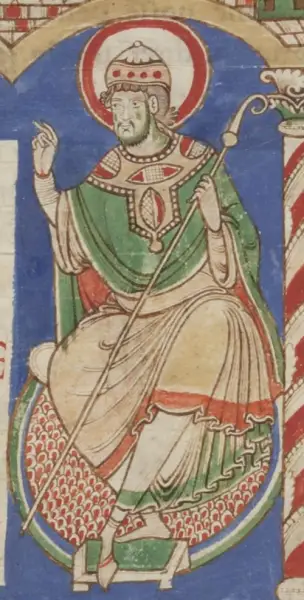
Damasus was never formally canonized, for he belongs to the centuries when the church's saints were made by the acclaim of the faithful rather than by process. The Catholic Church numbers him among her saints, and the memory is likewise honored in the Eastern Orthodox and Oriental Orthodox communions, a rare breadth of witness for a pope whose Roman election had once been contested in blood. His feast is kept on 11 December in the Catholic Church and in Western Rite Orthodoxy, the anniversary of his death in 384. In art he is depicted as a pope bearing the patriarchal cross and a model of a church, emblems of the two works for which posterity has chiefly remembered him: the guarding of the faith proclaimed across the empire and the raising up of houses of prayer over the bones of the martyrs. His patronage extends to archaeologists, a fitting appointment for the pontiff who first made the catacombs accessible as places of pilgrimage, and his intercession is sought against fever. The judgment of history has remained divided over the violence of his election, but over his achievement there has been no dispute: the canon of Scripture he confirmed, the Latin Bible he commissioned, and the martyrs he commemorated have outlasted every accusation against him.
§ Pope Damasus I
The Bible, the Poems, and the First Images of a Pope
The consequences of Damasus's pontificate reached far beyond his own century. The Vulgate he encouraged from Jerome became the Bible of the Latin West for a thousand years, and the canon confirmed at his Council of Rome of 382, transmitted through the Gelasian Decree, remained the Church's list of inspired books until Trent defined it anew in 1546. Jerome's letters to the pope became enduring witnesses to the primacy of the See of Peter, addressed as they were to the successor of the fisherman and to the chair upon which, in Jerome's words, the church itself is built. His own literary work survived in the Epigrammata, verse inscriptions in heroic metre that Jerome praised and that modern scholars, such as Alan Cameron and Dennis Trout, have studied as documents of fourth-century Roman Christianity; to him has even been ascribed the anonymous Carmen contra paganos, the song against the pagans. Gold-glass cups preserving the name "DAMAS" are thought to show the pope himself and would constitute the earliest contemporary likenesses of any Roman pontiff to survive, though no true portrait was attempted. Commentators have styled him the first society pope, and he may well have belonged to a web of interrelated Hispanic Christians surrounding Theodosius; his epitaph for the young girl Projecta draws scholarly attention because the gilded casket of the Esquiline Treasure, kept in the British Museum, is thought to have been wrought for her.
§ Jerome, the Vulgate and the Canon
Timeline
- 305
Born around this year, in Rome or in Hispania, to parents from Lusitania.
§ Early life
- 354
As archdeacon, followed Pope Liberius into banishment at Berea under Constantius II, though he returned to Rome at once.
§ Early life
- 24 Sep 366
Pope Liberius died, opening a contested succession between Damasus and the deacon Ursinus.
§ Succession crisis
- 1 Oct 366
Elected Bishop of Rome in San Lorenzo in Lucina, while rivals chose Ursinus simultaneously.
§ Succession crisis
- 368
Convened a Roman synod that condemned the heresies of Apollinarianism and Macedonianism.
§ Papacy
- 369
Held a second Roman synod reaffirming the condemnation of the same heresies.
§ Papacy
- 378
A synod condemned Ursinus, exonerated Damasus, and declared him the true pope.
§ Succession crisis
- 27 Feb 380
Welcomed the edict De fide Catholica of Theodosius I proclaiming Catholic doctrine the religion of the Roman state.
§ Relations with the Eastern Church
- 381
Sent legates to the First Council of Constantinople, convoked to address the same heresies.
§ Papacy
- 382
Presided over the Council of Rome, which determined the canon of Sacred Scripture, later known through the Gelasian Decree.
§ Council of Rome of 382 and the Biblical canon
- 382
Appointed Jerome of Stridon as his confidential secretary, beginning the collaboration that produced the Vulgate.
§ Jerome, the Vulgate and the Canon
- 11 Dec 384
Died in Rome after a pontificate of eighteen years and two months, at nearly eighty years of age.
§ Devotion to the martyrs
In Their Own Words
he had a fine talent for making verses and published many brief works in heroic metre. He died in the reign of the emperor Theodosius at the age of almost eighty.
Yet, though your greatness terrifies me, your kindness attracts me. From the priest I demand the safe-keeping of the victim, from the shepherd the protection due to the sheep.
The Record
- Major works
- Epigrammata (verse inscriptions for the martyrs' tombs)·Prose letters and other pieces·Latin verse in heroic metre·Commissioning of the Vulgate revision·Possibly the Carmen contra paganos
- Patron of
- patron of archaeologists·against fever
- Symbols
- depicted as a pope with a patriarchal cross·model of a church
- Canonization
- Pre-congregation canonization; recognized as a saint by the Catholic Church from antiquity
Prayer
Bibliography
Show 6 sources
- Trout, Dennis. Damasus of Rome: The Epigraphic Poetry. Oxford University Press, 2015.
- Cameron, Alan. "The Date and the Owners of the Esquiline Treasure". American Journal of Archaeology, Vol 89, No. 1 (Jan., 1985), pp. 135–145.
- Cross, Frank Leslie; Livingstone, Elizabeth A., eds. (2005). "Damasus". The Oxford Dictionary of the Christian Church. Oxford University Press. ISBN 978-0-19-280-290-3.
- Grig, Lucy. "Portraits, Pontiffs and the Christianization of Fourth-Century Rome". Papers of the British School at Rome, Vol. 72 (2004), pp. 203–230.
- Reutter, Ursula. Damasus, Bischof von Rom (366–384). Leben und Werk. Mohr Siebeck, Tübingen, 2009. ISBN 978-3-16-149848-0.
- Kelly, J. N. D. (1988). "Damasus I". The Oxford Dictionary of Popes. Oxford: Oxford University Press. p. 32. ISBN 0192820850.
Profile text adapted from the Wikipedia article, licensed CC BY-SA 4.0.
Pray with this saint every day
Save St. Damasus I to your favorites, read the full profile, and get feast-day reminders in the Saints app.
Get the Saints AppFree on the App Store for iPhone and iPad