
c. 127 – c. 232·Feast October 9
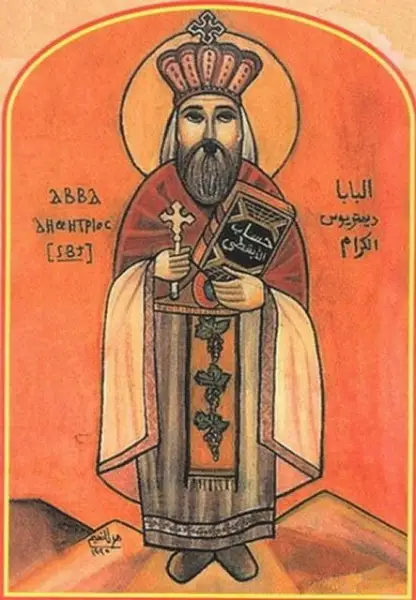
St. Demetrius I of Alexandria
Second Founder of the Church of Alexandria
Overview
Demetrius I, the twelfth bishop and patriarch of Alexandria, governed the church of the great metropolis for forty-two years, from his accession in the tenth year of Commodus, around 189, until his death in 232 at the extraordinary age of one hundred and five. He had been a farmer, living with his wife in pledged continence for forty-seven years before his elevation; the Coptic Synaxarium relates that the dying Patriarch Julian was told in a vision that his successor would come to him bearing a cluster of grapes out of season, and the next day Demetrius arrived at his door with exactly such a gift. As patriarch he labored to give the Egyptian church order and permanence. He established the liturgical calendar by which fasts and feasts were fixed, and he was the first bishop to apply the calculated method for determining the date of Easter, a reckoning later ratified by the Council of Nicaea and followed by the Oriental Orthodox churches to this day. He sent Pantaenus as a missionary to India, and upon Clement's departure from Alexandria around 203 he appointed the young Origen head of the Catechetical School. His long patronage of Origen ended in rupture when the scholar accepted ordination at Caesarea; a synod of 232 banished him. Posterity ranks Demetrius among the makers of Alexandrian Christianity, the patriarch who gave the Egyptian church its enduring shape and structure.
The Complete Life
The Farmer with the Grapes
Before he was a bishop, Demetrius was a tiller of the soil, and the story of his call belongs to the treasury of Coptic hagiography. He had lived with his wife in complete continence for forty-seven years, the two keeping their marriage as a covenant of virginity, when the aged and ailing Patriarch Julian received a heavenly communication: the man who would succeed him would come to visit bearing a cluster of grapes, though grapes were then long out of season. On the following day a farmer named Demetrius appeared before the bishop carrying precisely such a cluster, asking for his blessing. The sign was recognized at once, and the farmer was announced as Bishop Demetrius I, the twelfth bishop of Alexandria. The sources disagree on the exact year of his accession: Sextus Julius Africanus, who visited Alexandria during Demetrius's episcopate, places it in the tenth year of the emperor Commodus, while Eusebius of Caesarea sets it in the tenth year of Septimius Severus. Eusebius also preserved a traditional list of the bishops of Alexandria from Mark the Evangelist down to Demetrius, though that list is judged apocryphal. Whatever the precise date, the church of Alexandria received as its shepherd a man formed not in its schools but in its fields, and he would govern it longer than any before him.
§ Life
Ordering Time and Raising Scholars
Demetrius governed the church of Alexandria at the moment when it was growing from a gathered community into an institution, and his principal work was the ordering of its common life. Eager to establish a fixed calendar for the church's fasts and feasts, he established a liturgical calendar by which the dates of fasting were determined, giving Egyptian Christianity the annual rhythm it has kept ever since. As bishop of the great metropolis he was drawn into the empire-wide controversy over the canonical calculation of Easter, and he became the first to apply the calculated method for determining the feast's date. His edict on the question received the approval of the Council of Nicaea in 325, and the Oriental Orthodox churches continue to follow the reckoning of Alexandria to this day, a living monument to his labor. His patronage extended to the church's intellectual life as well. Following Jerome's account, he dispatched Pantaenus on a mission to India; by the time of his own patriarchate the Catechetical School had likely passed from Pantaenus to Clement; and when Clement left Alexandria around 203, Demetrius appointed as his successor Origen, a young man still in his eighteenth year. In the beginning the patriarch supported Origen's career and is said to have admired his scholarship, dispatching him even to Arabia at the invitation of letters from the prefect.
§ Life
The Rupture with Origen
The long friendship between the patriarch and his brilliant pupil broke apart in the last decade of Demetrius's life. When Emperor Caracalla sacked Alexandria in 215, Origen fled to Caesarea in Palestine, where the local bishops asked him to preach; Demetrius, indignant that a layman should exercise so public a teaching office, wrote to rebuke him, and although Alexander of Jerusalem and Theoctistus of Caesarea defended Origen and cited precedents for lay preaching, the patriarch recalled him to Alexandria. The final rupture came in 230, when a contested matter in Achaea demanded Origen's presence and he traveled toward it through Palestine; at Caesarea he was ordained priest. Demetrius regarded the ordination as an act of emancipation from his authority, and their relationship collapsed. He convened a synod at Alexandria in 232 that banished Origen, and circulated a condemnation of his conduct to all the churches; Rome accepted the verdict, while Caesarea, Phoenicia, Arabia, and Achaea disputed it, and Origen himself sent forth letters of self-defense from Caesarea attacking the patriarch. It is evident that personal jealousy, and not merely the question of ordination, was alleged as the motive for such severity. Demetrius then entrusted the Catechetical School to Heraclas, long Origen's associate and assistant, a decision that may have been his final act as bishop before his death on 9 October at the age of one hundred and five.
§ Life
Honored in East and West
The memory of Demetrius has been cherished by the churches that inherited the tradition he organized. He is venerated in the Oriental Orthodox Church, whose Coptic Synaxarium preserves the story of his miraculous election, in the Coptic Catholic Church, and in the Roman Catholic Church, a triple witness to his sanctity across the ancient divisions of the communion. His feast is celebrated by the Coptic Church on 12 Paopi, corresponding to 9 October in the Julian calendar, and the Catholic Church likewise keeps his memory on 9 October, the date associated with his death. He was buried at Baucalis in Alexandria, in the quarter of the city where the church's early generations had lived and prayed, and his body rested there under the care of the church he had governed for more than four decades. No formal process raised him to the altars; like the bishops of the subapostolic age he was canonized by the gratitude of the communities that kept his feast, told his story, and named him in the diptychs of their saints. In the calendars of three traditions he stands among the great patriarchs of Alexandria, the farmer who was found worthy to succeed the successor of Mark.
§ Saint Demetrius of Alexandria
Second Founder of a Church
The judgment of history on Demetrius has outweighed the quarrels of his old age. History has set him beside Mark himself as a second founder — of the Alexandrian church and of Egyptian Christianity at large — crediting the organization of the church's hierarchy across the region to his long labors: under his long episcopate the Christian communities of the Nile country received the structure, the calendars, and the institutions of a mature church rather than the improvised arrangements of a persecuted minority. The liturgical calendar he established fixed the fasts and feasts of Egyptian Christianity; his method for computing Easter, sanctioned at Nicaea, has ordered the worship of the Oriental Orthodox for seventeen centuries. Through his appointments the Catechetical School of Alexandria, already the intellectual glory of African Christianity, passed into the hands of Origen and then of Heraclas, and though his banishment of Origen embittered his final years and drew protests from half the Christian world, the school he had stewarded went on shaping Christian theology for generations. Forty-two years of governance, spanning the reigns of Commodus and Septimius Severus through the sack of Caracalla, gave the church of the second founder an unusually long apprenticeship in institutional wisdom, and the farmer who arrived with impossible grapes left behind a church that could endure the storms of the third century.
§ Life
Timeline
- 127
Born at Alexandria, Egypt, around this year.
§ Life
- 189
Chosen Patriarch of Alexandria, in the tenth year of Emperor Commodus according to Julius Africanus.
§ Life
- 203
Appointed Origen, then in his eighteenth year, as head of the Catechetical School after Clement left Alexandria.
§ Life
- 215
When Caracalla sacked Alexandria and Origen fled to Caesarea, rebuked him for preaching as a layman and recalled him despite episcopal defenses.
§ Life
- 230
Origen departed for Achaea by way of Palestine and was ordained priest at Caesarea, provoking the patriarch's anger.
§ Life
- 9 Oct 232
Convened a synod that banished Origen; later that year died at the age of 105 after forty-two years governing the church.
§ Life
- 325
The Council of Nicaea approved his edict on the calculation of Easter, a method the Oriental Orthodox churches still follow.
§ Life
The Record
- Major works
- Liturgical calendar fixing the fasts and feasts of the Egyptian church·First application of the calculated method for the date of Easter·Mission of Pantaenus to India
- Canonization
- Pre-congregation canonization; venerated by the Oriental Orthodox, Coptic Catholic, and Roman Catholic churches
Prayer
Bibliography
Show 5 sources
- "Dimitrios (189–232)". Official web site of the Greek Orthodox Patriarchate of Alexandria and All Africa. Retrieved 2024-01-11.
- Mitchell, Margaret; Young, Frances, eds. (2006). The Cambridge History of Christianity: Origins to Constantine. Vol. 1. Cambridge University Press. ISBN 9780521812399.
- "Lives of Saints :: Baba 12". www.copticchurch.net. Retrieved 2018-03-14.
- Eusebius of Caesarea. Historia Ecclesiastica, VI, 2.
- "St. Demetrius". Catholic Online.
Profile text adapted from the Wikipedia article, licensed CC BY-SA 4.0.
Pray with this saint every day
Save St. Demetrius I of Alexandria to your favorites, read the full profile, and get feast-day reminders in the Saints app.
Get the Saints AppFree on the App Store for iPhone and iPad