
early 3rd century – 268·Feast December 26
St. Dionysius
Bishop of Rome who rebuilt the Church after persecution
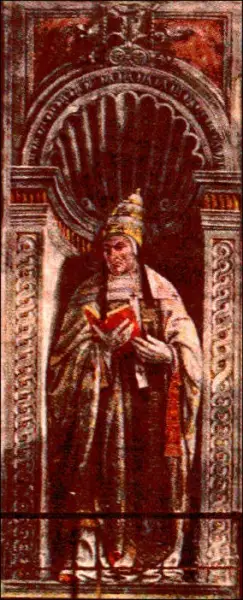
Overview
Dionysius served as Bishop of Rome from 22 July 259 until his death on 26 December 268, a pontificate that carried the Roman church out of the shadow of imperial persecution and into nearly four decades of tranquility. Born in Terranova da Sibari in the early third century, he was raised to the episcopal throne only after a vacancy of almost a year, since choosing a successor to the martyred Sixtus II was dangerously difficult while the violence of Valerian's assault on Christians still raged. Once the pressure eased, he confronted a community in disarray and set about reshaping it, organizing presbyters into parishes and sending generous funds to Cappadocian churches ravaged by Gothic raiders, and ransom for prisoners taken there. He also engaged the doctrinal struggles of the age: the synods that condemned Paul of Samosata addressed their letter jointly to him and to Maximus of Alexandria, and he convoked a Roman council to examine the Trinitarian language of his Alexandrian namesake. His sole surviving writing, the letter issued after that synod, defends the divine monarchy while rejecting both Sabellian confusion and subordinationist drift, and insists that the Son is no created thing. Athanasius later cited him as having anathematized Arian error long before Nicaea.
The Complete Life
A Son of Calabria in an Age of Peril
Dionysius was born in Terranova da Sibari, a town in the far south of Italy, at the opening decades of the third century. Of his family, education, and path to the clergy the records of the period preserve almost nothing; what can be known with confidence is the world into which he came. The church of Rome he would one day lead stood at the center of an empire increasingly hostile to Christian profession, and by the middle of the century that hostility had hardened into the empire-wide edicts of the emperor Valerian. Bishops, priests, and deacons were the first targets, and in August of 258 Sixtus II, bishop of the Roman church, was seized and put to death. For nearly a year afterward the Roman See stood empty, because the assembly of Christians could not safely meet to elect a successor while the storm lasted. Only when the violence began to abate could the choice be made, and it fell upon the Calabrian Dionysius. That a man from the provinces should be raised to the most exposed office in Western Christianity tells something of the church he joined: a community whose leadership was formed less by privilege than by the willingness to accept mortal risk. His Calabrian origin would long be remembered in his native town, which counts him among the popes it gave to the Church.
§ Pontificate
Elected in the Aftermath of Martyrdom
Dionysius assumed the bishopric of Rome on 22 July 259, immediately after the great trial that had claimed his predecessor. The circumstances of his election shaped the whole character of his pontificate. The Holy See had been vacant for close to a year, and the church he inherited had fallen into serious disorder: congregations scattered, properties seized, and the ordinary structures of pastoral care broken. Providence ordered events so that relief arrived as he took office. In 260 the emperor Valerian, whose reign had unleashed the persecution, was captured by the Persians and perished in captivity, and his son and successor Gallienus published an edict of toleration that restored to the Christians their churches, cemeteries, and other properties. What followed has been remembered as the Little Peace of the Church, nearly forty years in which the faith could be practiced openly. Upon the new pope fell the task of rebuilding, and he carried it out with administrative clarity, assigning presbyters to individual parishes so that the revived community would be served in an orderly and stable way. His election thus marks not merely a succession in office but a turning point between the age of martyrs and the first long breathing space the Roman church had known.
§ Pontificate
Rebuilding, Ransoming, and Refuting
The work of Dionysius extended in three directions at once: the reorganization of the Roman community, charity toward suffering churches abroad, and the defense of the faith against doctrinal distortion. Within Rome he reconstituted pastoral structures, giving each district its presbyter and thereby anchoring the recovered freedom of the church in stable ministry. Beyond Italy he turned to the churches of Cappadocia, which marauding Goths had devastated, sending them large sums of money for their relief and for the ransom of captives — an early and striking instance of the Roman See acting as a center of material solidarity for the whole Christian world. He also watched over doctrine. When teaching concerning the relation of God to the Logos arose from Dionysius, the bishop of Alexandria, the pope called for explanations; a satisfactory response came back, though some Alexandrian Christians objected to being called to account from Rome. In the same years the synods assembled at Antioch between 264 and 268 to judge Paul of Samosata addressed their conciliar letter jointly to Dionysius and to Maximus of Alexandria — the earliest decree of that kind on record. And when Christians of the Libyan Pentapolis challenged the Alexandrian bishop's anti-Sabellian formulations, the pope convened a Roman synod to weigh the matter.
§ Pontificate
The Synodal Letter and a Peace Earned
The judgment of the Roman synod was set out in a letter, the only writing of Dionysius that survives. In it he defended the divine monarchia against error from both sides: against the Western confusion of Sabellianism, which collapses the distinctions among Father, Son, and Spirit, and against the Alexandrian tendency toward hierarchy and subordination within the Godhead. He stated plainly that the Son of God is not a created work. Fragments of this teaching, preserved by Athanasius in his De Decretis, show a pre-Nicene theologian of remarkable penetration, and scholars judge that his synodal theology established early Trinitarian orthodoxy as if nipping the errors of Arius in the bud. Athanasius himself appealed to Dionysius as proof that the Church had condemned the Arian position from the beginning, long before the Council of Nicaea met. Dionysius governed the Roman church until his death on 26 December 268. The peace he had done so much to consolidate held firm for decades afterward, lasting until the new persecution of 303, some thirty-five years after his passing. Felix I succeeded him in the Roman See.
§ Pontificate
Witness Before Nicaea
Dionysius is honored as a saint of the earliest period, counted among the long line of holy bishops of Rome before any formal process of canonization existed. His enduring significance lies in the convergence of pastoral and doctrinal service at a decisive moment. Administratively, the parish order he established helped the Roman community convert a generation of catastrophe into stable growth, and the alms he dispatched to Cappadocia set a precedent for the bishop of Rome as a source of aid to churches in distress. Theologically, his synodal letter stands among the most advanced confessions of the third century: an affirmation that the Son is not a creature, grounded in a defense of the one divine principle that refused both Sabellian merger and subordinationist diminishment. Athanasius, writing a lifetime later against the Arians, reached back to Dionysius as an authoritative witness that the Church had always confessed the true divinity of the Word. In Christian art he is shown in papal vestments with a book, the emblem of the teaching that outlasted him. His feast is kept on 26 December, the anniversary of his death at Rome, where he was buried among the bishops who had governed the Church in its hardest first hours.
§ Pontificate
Timeline
- 258
Sixtus II won the crown of martyrdom, leaving the Roman See vacant amid Valerian's persecution.
§ Pontificate
- 22 Jul 259
Dionysius became Bishop of Rome once persecution had eased enough to allow an election.
§ Pontificate
- 260
Valerian perished in Persian captivity, and Gallienus granted toleration, returning churches and cemeteries to the Christians.
§ Pontificate
- 264
The councils assembled at Antioch against Paul of Samosata sent their joint conciliar letter to both Dionysius and Maximus of Alexandria.
§ Pontificate
- 268
He convoked a Roman synod to answer Libyan Christians who accused Dionysius of Alexandria of unsound doctrine.
§ Pontificate
- 26 Dec 268
Dionysius died in Rome after nine years as bishop, having set the church on a footing of order.
§ Pontificate
In Their Own Words
For Dionysius, Bishop of Rome, having written also against those who said that the Son of God was a creature and a created thing, it is manifest that not now for the first time but from of old the heresy of the Arian adversaries of Christ has been anathematised by all.
The Record
- Major works
- Post-synodal letter defending the divine monarchia and the uncreated Son
- Symbols
- Papal vestments·Book·Crozier
- Canonization
- Pre-congregation canonization; venerated as a saint from the earliest centuries of the Church.
Prayer
Bibliography
Show 9 sources
- Davis, R. (1997). Pre-Constantinian chronology: The Roman bishopric from AD 258 to 314. Journal of Theological Studies, 48(2), 444, 460.
- Frend, W. H. C. (1984). The rise of Christianity. Darton, Longman and Todd. pp. 327, 403, 932.
- Mommsen, T. (1898). Liber pontificalis, gesta pontificum Romanorum (L. Duchesne, Ed.; Vol. 1). Bibliotheque des Ecoles Francaises d'Athénes et de Rome. pp. 27, 148.
- Eusebius. (2023). Historia Ecclesiastica 7.29–30; translated by Schott, H. The History of the Church. Brill, pp. 374–380.
- Behr, J. (2001). The formation of Christian theology: The way to Nicaea. Brill. p. 209.
- Athanasius. (1892). De sententia Dionysii 13 (A. Robertson, Trans.). In P. Schaff & H. Wace (Eds.), A select library of the Nicene and Post-Nicene fathers of the Christian church, second series (Vol. 4). Christian Literature Company.
- Kelly, J. N. D. (1960). Early Christian doctrines. Harper & Row. p. 134.
- Kirsch, Johann Peter (1909). "Pope St. Dionysius" in The Catholic Encyclopedia. Vol. 5. New York: Robert Appleton Company.
- Herbermann, Charles, ed. (1913). "Pope St. Dionysius". Catholic Encyclopedia. New York: Robert Appleton Company.
Profile text adapted from the Wikipedia article, licensed CC BY-SA 4.0.
Pray with this saint every day
Save St. Dionysius to your favorites, read the full profile, and get feast-day reminders in the Saints app.
Get the Saints AppFree on the App Store for iPhone and iPad