
died September 454·Feast September 17
St. Dioscorus I of Alexandria
Patriarch of Alexandria and defender of Cyrillian Christology
Overview
Dioscorus the Great led the church of Alexandria as pope and patriarch of the See of St. Mark from 444 until 451, and the Coptic Church continued to acknowledge him as its rightful shepherd until his death in exile in September 454. Born in Alexandria and by origin not a Copt, he rose through the city's great institutions: dean of the Catechetical School, then private secretary to Patriarch Cyril, at whose side he attended the great Council of Ephesus of 431, and in time archdeacon and named heir to the throne of St. Mark. His patriarchate unfolded amid the Christological storms that followed Cyril's death. When the archimandrite Eutyches was condemned at Constantinople in 448, Dioscorus received his appeal, and under Emperor Theodosius II he presided over the Second Council of Ephesus in 449, which reinstated Eutyches and deposed Flavian of Constantinople and other bishops. Pope Leo of Rome branded that assembly a robber synod. Two years later the Council of Chalcedon deposed Dioscorus — formally for canonical violations rather than heresy, and by a notably narrow attendance — and Emperor Marcian banished him to Gangra in Paphlagonia. Alexandria refused to accept his replacement, and his death in exile confirmed his cause. The Coptic, Syriac, and other Oriental Orthodox Churches honor him as a saint, while Chalcedonian churches long judged him harshly; modern historians increasingly view his deposition as a matter of ecclesiastical politics.
The Complete Life
Formation in the School of Alexandria
Dioscorus' origins remain unknown, though the sources are clear that he was not an ethnic Copt. What can be traced is a career built entirely within the intellectual and ecclesiastical machinery of Alexandria, the city where he was born. He became dean of the Catechetical School of Alexandria, the ancient academy that had trained generations of the church's greatest teachers, and he rose to be the personal secretary of Cyril, the patriarch whose Christological writing would define the age. In that capacity he accompanied Cyril to the Council of Ephesus in 431, the assembly that condemned Nestorius and ratified Cyril's second letter to him, so that Dioscorus witnessed the decisive christological battle of the century from beside its central figure. He advanced to the office of archdeacon of the Alexandrian church, and Cyril marked him out as his designated successor. This formation mattered for everything that followed: Dioscorus had absorbed the Alexandrian formula — one incarnate nature of God the Word — not as an abstract slogan but as the living inheritance of his mentor. When he ascended the throne of St. Mark in 444, he did so as the heir and guardian of a theological tradition, prepared to defend it against any formula he believed diminished it.
§ Early life
Patriarch in a Divided Church
Dioscorus succeeded Cyril in the summer of 444, at a moment when the quarrels of the previous decade were far from settled. Even his opponents attested the quality of the man: Theodoret of Cyrrus, though he had written against Cyril's twelve anathemas, sent the new patriarch a letter praising his modesty and humility, and later historians note that such testimony from an adversary cannot be suspected. Yet his accession was contested at home. Cyril's nephew Athanasius, a wealthy priest and potential rival, led a powerful circle of the dead patriarch's relatives, and Dioscorus, legally obliged to pursue their misappropriation of church property, recovered boats and other holdings for the Church and cleared illegal buildings from its lands. Bitter accusations flew on both sides, and at Chalcedon a deacon named Ischyrion charged the patriarch with exiles, fines, and profiteering from government wheat. The wider crisis soon dwarfed these Alexandrian feuds. The archimandrite Eutyches of Constantinople, denouncing covert Nestorianism around him, was himself accused of heresy and condemned by a synod under Bishop Flavian in November 448. Eutyches appealed, labeling Flavian a Nestorian — and the appeal found its way to Alexandria, where Dioscorus resolved to support him.
§ Patriarch of Alexandria
Ephesus II and the Robber Synod
The dispute over Eutyches gave Dioscorus the stage on which his reputation would be made and unmade. Through the court influence of Chrysaphius, the archimandrite's godson, Emperor Theodosius II convened a council at Ephesus in 449, and — in memory of Cyril's role at the council of 431 — asked Dioscorus himself to preside. The assembly reinstated Eutyches and deposed Flavian of Constantinople together with Eusebius of Dorylaeum, Theodoret of Cyrrus, Ibas of Edessa, and Domnus II of Antioch. The legates of Pope Leo protested and were ignored; Leo, whose Tome had confirmed Flavian's position while urging mercy for Eutyches, branded the whole assembly a robber synod. When spring 450 came and Dioscorus journeyed toward the court, he compelled the ten Egyptian bishops accompanying him to sign an act excommunicating the pope of Rome. He was now the most powerful churchman in the East, and the most endangered. The death of Theodosius on 28 July 450 transformed the situation: Pulcheria returned to power, raised Marcian to the throne, and joined Pope Leo in calling for a new council. An assembly to overturn the results of 449 would need to reckon, above all, with the patriarch of Alexandria.
§ Second Council of Ephesus
Chalcedon, Deposition, and Exile
The Council of Chalcedon met in October 451 and took up both the errors of Eutyches and the conduct of the patriarch who had restored him. Summoned to explain his condemnation of Flavian, Dioscorus answered from the council minutes that his opponent had been judged for confessing two natures after the union, and he appealed to Athanasius, Gregory, and Cyril as witnesses against such language — adding that if Eutyches held opinions contrary to the Church's doctrine he deserved not merely punishment but hell fire. The council deposed him, in the end, not for heresy but for canonical violations, chief among them his failure to appear from the third session forward in defiance of an imperial summons; even so, more than half the bishops who had attended earlier sessions stayed away from his condemnation. The empress Pulcheria taunted him with the fate of John Chrysostom, and tradition records that she struck him, breaking teeth, and that Dioscorus sent the broken teeth and pulled-out beard hair to Alexandria as the fruit of his faith. Marcian exiled him to Gangra in Paphlagonia. A priest named Proterius was installed at Alexandria with imperial approval and was met by riots; the native Christians kept faith with Dioscorus as their lawful patriarch. He died in exile in September 454, and on the news his supporters elected his disciple Timothy, inaugurating the lasting separation of the Coptic Church from the imperial church.
§ Exile
Column of Faith
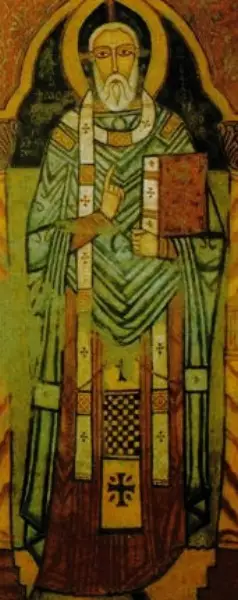
Few figures of late antiquity divide Christian memory as sharply as Dioscorus. The Coptic, Syriac, and other Oriental Orthodox Churches number him among their saints, portraying him in fresco upon a column — in the Syrian Monastery he stands beside Severus of Antioch — to signify the ancient title Column of Faith. Eastern Orthodox and Catholic tradition, by contrast, repeatedly condemned him as a heretic, though the council that deposed him studiously declined to do so on doctrinal grounds. Modern theologians, and even some ancient ones such as Basil of Seleucia, have suggested that Leo and Dioscorus were both orthodox in their adherence to Cyril's twelve chapters, and commentators such as John S. Romanides argue that Dioscorus fell for grave administrative failures at Ephesus II — the restoration of Eutyches, the downfall of Flavian, the excommunication of Leo — rather than for false doctrine. The Oriental Orthodox Churches firmly reject the label Eutychian, confessing instead miaphysitism: that in Christ divinity and humanity are one incarnate nature. Ecumenical dialogue has steadily narrowed the quarrel of Chalcedon's day: in 1973 Shenouda III journeyed to Rome, where he and Paul VI together professed one faith concerning the nature of Christ — the very question behind the ancient schism — and in 1990 the Oriental and Eastern Orthodox churches agreed to lift the anathemas of the past.
§ Legacy
Timeline
- 431
Accompanied Patriarch Cyril of Alexandria to the Council of Ephesus as his personal secretary.
§ Early life
- 444
Succeeded Cyril as Patriarch of Alexandria in the summer, having been the designated heir.
§ Patriarch of Alexandria
- Nov 448
A synod under Bishop Flavian of Constantinople condemned and exiled the archimandrite Eutyches, whose appeal Dioscorus would later receive.
§ Reception of Eutyches
- 449
Presided over the Second Council of Ephesus, which reinstated Eutyches and deposed Flavian, Eusebius of Dorylaeum, Theodoret, Ibas, and Domnus II.
§ Second Council of Ephesus
- 450
While traveling to the imperial court, caused ten Egyptian bishops at Nicaea to sign a document excommunicating Pope Leo of Rome.
§ Second Council of Ephesus
- 28 Jul 450
Emperor Theodosius II, who had supported the decisions of Ephesus, died, and Pulcheria with Marcian took power.
§ Second Council of Ephesus
- Oct 451
The Council of Chalcedon deposed him for canonical violations rather than doctrine and annulled his decrees; Marcian exiled him to Gangra.
§ Council of Chalcedon
- Sep 454
Died in exile at Gangra in Paphlagonia; his Egyptian supporters then elected his disciple Timothy as patriarch.
§ Exile
In Their Own Words
you do not behold the multitude of your subjects nor the exaltation of your throne, but you see rather human nature, and life's rapid changes, and follow the divine laws whose observance gives us the kingdom of heaven
Flavian was deposed for this reason, that he spoke of two natures after the union. But I have quotations from the holy fathers Athanasius, Gregory and Cyril saying in numerous places that one should not speak of two natures after the union
If Eutyches holds opinions contrary to the doctrines of the church, he deserves not only punishment but hell fire. For my concern is for the apostolic faith and not for any human being.
this is the fruit of my faith
The Record
- Major works
- Alexandrian Christological formula: mia physis tou theou logou sesarkomene (one incarnate nature of God the Word), upheld with Cyril's teaching
- Symbols
- Depicted on a column, signifying his title 'Column of Faith'
- Canonization
- Pre-congregation; venerated as a saint by the Coptic Orthodox Church and the other Oriental Orthodox Churches since antiquity.
Prayer
Bibliography
Show 10 sources
- Menze, Volker (2023). Patriarch Dioscorus Of Alexandria: The Last Pharaoh And Ecclesiastical Politics In The Later Roman Empire. Oxford University Press. ISBN 978-0192871336.
- Frend, William (1972). The Rise of the Monophysite Movement. ISBN 978-0227172414.
- Haas, Christopher (15 November 2006). Alexandria in Late Antiquity: Topography and Social Conflict. JHU Press. ISBN 978-0-8018-8541-9.
- Seleznyov, Nikolai N. (2010). "Nestorius of Constantinople - Condemnation, Suppression, Veneration: With special reference to the role of his name in East-Syriac Christianity". Journal of Eastern Christian Studies. 62 (3–4): 165–190.
- Chapman, John. "Eutyches" The Catholic Encyclopedia Vol. 5. New York: Robert Appleton Company, 1909.
- Chadwick, Henry (1955). The Exile and Death of Flavian of Constantinople: A Prologue to the Council of Chalcedon. Oxford Publishing Limited (England).
- Price, Richard; Gaddis, Michael (2007). The Acts of the Council of Chalcedon. Liverpool University Press. ISBN 978-1-84631-100-0.
- Davis, SJ, Leo Donald (1990). The First Seven Ecumenical Councils (325–787): Their History and Theology (Theology and Life Series 21). Collegeville, Minnesota: Michael Glazier/Liturgical Press. ISBN 978-0-8146-5616-7.
- Meyendorff, John (1989). Imperial unity and Christian divisions: The Church 450-680 A.D. The Church in history. Vol. 2. Crestwood, New York: St. Vladimir's Seminary Press. ISBN 978-0-88-141056-3.
- "Commemorations for Tout 7". Coptic Orthodox Church Network. Archived from the original on 6 January 2014.
Profile text adapted from the Wikipedia article, licensed CC BY-SA 4.0.
Pray with this saint every day
Save St. Dioscorus I of Alexandria to your favorites, read the full profile, and get feast-day reminders in the Saints app.
Get the Saints AppFree on the App Store for iPhone and iPad