
died 24 May 189·Feast May 26
St. Eleutherius
Pope of the early Church remembered for liberty in food and faith
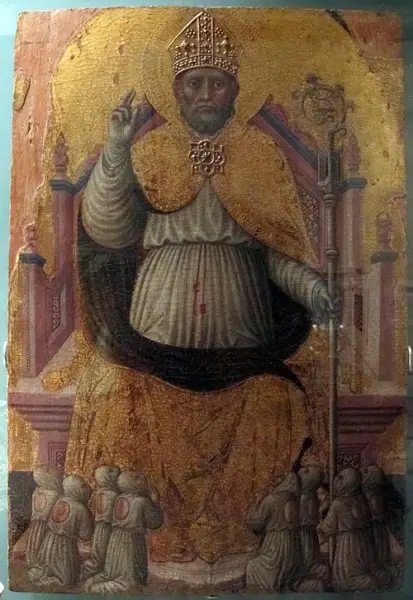
Overview
Eleutherius, whose Greek name means 'free man,' governed the church of Rome as bishop from about 174 until his death on 24 May 189, though some authorities date his pontificate 171–185 or 177–193. The Liber Pontificalis records that he was a Greek, born at Nicopolis in Epirus, and his contemporary Hegesippus relates that he served the Roman church as a deacon under Pope Anicetus, around 154 to 164, continuing in that office under Soter before succeeding him. Two much-discussed traditions attach to his name. The sixth-century Felician Catalog credits him with affirming that no food created by God should be repudiated by Christians firm in their faith, provided it is wholesome and fit to eat — a decree read as a rebuke both to lingering Jewish dietary observance and to the food taboos of Gnostic and Montanist circles. The same source also links him to a letter from Lucius, a king of the Britons seeking to become a Christian, the celebrated seed of the legend of Britain's first Christian king, which later medieval writers elaborated at length. Eleutherius died on 24 May and, according to the Liber Pontificalis, was buried on the Vatican Hill near the body of the Apostle Peter. His remains were translated to the church of Santa Susanna in 1591, and his feast is kept on 26 May.
The Complete Life
A Greek in the Roman Church
Eleutherius was born at Nicopolis in Epirus, on the Greek side of the Adriatic, and both Greek and Albanian traditions have claimed him as a son of their soil. The Book of the Popes records his origin plainly: a Greek from Nicopolis. Of his youth and how he came to Rome nothing definite survives, but his later career is fixed by the testimony of one of the most valuable witnesses of the second century. Hegesippus, a contemporary churchman, wrote that Eleutherius served as a deacon of the Roman Church under Pope Anicetus, whose episcopate fell roughly between 154 and 164, and that he remained in that office under Anicetus's successor Soter. The diaconate of the Roman church in that age was no mere liturgical post; its holders administered the charity and the daily business of a community that was growing rapidly and living under the intermittent menace of imperial suspicion. Hegesippus's notice carries particular weight because he wrote as an eyewitness of the period rather than a later compiler. When Soter died, around 174, the choice of the Roman Christians fell on this experienced deacon, and Eleutherius was raised from service to oversight, becoming bishop of the city where the Apostles Peter and Paul had died and where the church's unity found its earliest visible focus.
§ Life
No Food Refused to the Faithful
The most distinctive act ascribed to Eleutherius concerns the Christian's freedom at table. The sixth-century recension of the Liber Pontificalis known as the Felician Catalog adds to the older entry on his pontificate a decree of striking tenor: Eleutherius is remembered as renewing the rule that the faithful must reject none of the foods God has made, so long as what is eaten remains wholesome and fit for human use. Such a rule suggests a decree issued against survivals of Jewish dietary observance within the Christian community and against kindred prohibitions practiced among the Gnostics and Montanists, movements that in different ways treated the material creation with suspicion. To affirm that nothing God created should be rejected by the faithful, so long as it is reasonable and wholesome, was to take a stand for the goodness of creation and the liberty of the Gospel that Paul had defended in his letters to Rome and Galatia. Historians add a caution: it is possible that the Felician editor borrowed a decree issued around the year 500 and placed it under Eleutherius's name to lend it older authority. Even so, the tradition shows how the second-century pope was remembered — as a guardian of Christian freedom in the common things of daily life, and as an opponent of any discipline that made superstitious servants of the faithful at God's own table.
§ Dietary law
The King of Britain's Letter
Eleutherius' name is forever joined to one of the most retold stories of British Christianity. A further addition to the Liber Pontificalis tells of a letter reaching the pope from Lucius, a king in Britain, who announced his desire to become a Christian. Bede seems to have taken the story from the Book of the Popes, and the ninth-century History of the Britons attributed to Nennius recounts how a papal mission baptized Lucius together with the under-kings of the whole British people, though it dates that baptism to 167 and credits it to Evaristus. Medieval writers multiplied details: Geoffrey of Monmouth named the papal envoys Fagan and Duvian, while the Book of Llandaf set Lucius's court in southern Wales and called his messengers Elfan and Medwy. Modern scholars have been skeptical — Haddan, Stubbs, and Wilkins judged the passage to be of mid-fifth-century tone, Duchesne dated it near 530, and Harnack proposed that the original text referred not to Britain but to Britio, the fortress of Edessa, making the king the known Christian ruler Abgar VIII of Syria. Yet the tradition ran deep through Gildas, Bede, Geoffrey of Monmouth, and the English annals, which gave the year 183 for the return of Lucius's emissaries from Rome. Whatever its historical kernel, the legend rooted Britain's faith in the age of the apostolic fathers.
§ British mission
Death and the Vatican Hill
Eleutherius governed the Roman church until his death on 24 May 189, closing a pontificate of roughly fifteen years that had carried the community through the final years of Marcus Aurelius. The Book of the Popes records that he found burial on the Vatican Hill, within the Vaticano itself, close beside the remains of the Apostle Peter — a placement that joined him in death to the prince of the apostles whose see he had occupied, and that attests how early the Vatican necropolis was becoming the chosen resting place of the bishops of Rome. Later tradition attaches further journeys to his relics: his body is said to have rested for a time at San Giovanni della Pigna by the Pantheon, until in 1591 Camilla Peretti, sister of Sixtus V, had it enshrined once more at the church of Santa Susanna, where it remains today. The church has never ceased to number him among its saints; he appears in the ancient lists of holy pontiffs, and his feast is celebrated on 26 May, the day after the anniversary of his burial. He was succeeded in the Roman See by Victor I, under whom the question of the Easter observance would convulse the churches of Asia — a controversy that the quiet decades of Eleutherius had done nothing to anticipate.
§ Death
Timeline
- 154
Served as a deacon of the Roman Church under Pope Anicetus, according to his contemporary Hegesippus.
§ Life
- 174
Succeeded Pope Soter as bishop of Rome, beginning a pontificate some sources date to 171 or 177.
§ Life
- 183
British annals date the return of King Lucius's emissaries from their visit to Bishop Eleutherius at Rome to this year.
§ British mission
- 24 May 189
Died in Rome on 24 May; his burial followed on the Vatican Hill, close beside the remains of the Apostle Peter.
§ Death
- 1591
Camilla Peretti, sister of Sixtus V, had his relics enshrined anew at the church of Santa Susanna in Rome.
§ Death
In Their Own Words
And he again affirmed that no food should be repudiated by Christians strong in their faith, as God created it, [provided] however that it is sensible and edible.
The Record
- Major works
- Decree on the freedom of Christians in the use of food, ascribed to him by the Felician Catalog of the Liber Pontificalis
- Canonization
- Pre-congregation canonization; venerated as a saint in the Catholic Church from the earliest centuries.
Prayer
Bibliography
Show 11 sources
- Kirsch, Johann Peter (1909). "Pope St. Eleutherius". In Herbermann, Charles (ed.). Catholic Encyclopedia. Vol. 5. New York: Robert Appleton Company.
- Brusher, Joseph Stanislaus (1980). Popes Through the Ages. San Rafael, California: Neff-Kane. ISBN 978-0-89-141110-9.
- Butler, Alban; Attwater, Donald; Thurston, Herbert (1956). Butler's Lives of the Saints. Vol. 2. London: Burns & Oates.
- Davis, Raymond (1989). The Book of Pontiffs (Liber Pontificalis) (1st ed.). Liverpool University Press. ISBN 9780853232162.
- Kelly, J. N. D.; Walsh, Michael (2015). Dictionary of Popes. Oxford University Press. p. 52. ISBN 978-0-19-104479-3.
- Coulombe, Charles A. (2003). Vicars of Christ. Kensington Publishing Corporation. p. 31. ISBN 9780806523705.
- Haddan, Arthur West; Stubbs, William; Wilkins, David, eds. (1869). "Appendix A: Date of Introduction of Christianity into Britain". Councils and Ecclesiastical Documents Relating to Great Britain and Ireland. Vol. I. Oxford: Clarendon Press. p. 25.
- Bede (1903) [731]. The Ecclesiastical History of the English Nation. Translated by Lionel Cecil Jane. London: J.M. Dent & Co.
- Nennius, [attributed] (1848) [c. 830]. History of the Britons. Translated by W. Gunn and J. A. Giles. London: Henry G. Bohn.
- Knight, David J. (2012). King Lucius of Britain. Stroud, England: History Press. ISBN 9780752474458.
- von Harnack, Adolf (1904). Sitzungsberichte der Berliner Akademie. Vol. I.
Profile text adapted from the Wikipedia article, licensed CC BY-SA 4.0.
Pray with this saint every day
Save St. Eleutherius to your favorites, read the full profile, and get feast-day reminders in the Saints app.
Get the Saints AppFree on the App Store for iPhone and iPad