
died 2 June 657·Feast June 2
St. Eugene I
Pope who held the Roman church between emperor and orthodoxy
Overview
Eugene I served as bishop of Rome from 10 August 654 until his death on 2 June 657, an election born of one of the most painful crises of the seventh-century papacy. A Roman from the Aventine and son of Rufinianus, he had been raised from boyhood in the service of the Church and was already an elderly priest when the quarrel over Monothelitism brought Emperor Constans II down upon Pope Martin I, who was seized and carried from Rome on 18 June 653 and banished to Cherson. Under pressure applied through the exarch of Ravenna, Eugene was chosen as the new pope in Martin's lifetime — an appointment Martin himself accepted, though the court at Constantinople expected a more tractable occupant of the See of Peter. Eugene showed more deference to imperial wishes than his predecessor had and made no public attack on the Monothelite patriarchs of Constantinople, yet he proved no instrument of the court. When the synodical letter of Patriarch Peter was read to the clergy and people at St. Mary Major in 656, its studied silence on the wills and operations of Christ was rejected with such indignation that the crowd would not release the pope until he promised never to accept it. Constans threatened to treat Eugene as he had treated Martin, but the defense of the empire against the Muslim conquests diverted him. Eugene died on 2 June 657, was buried in Old St. Peter's Basilica, and was acclaimed a saint.
The Complete Life
A Priest of the Aventine in a Broken Time
Eugene came from the Aventine hill of Rome and was the son of a man named Rufinianus. He was brought up from his youth in the Church's ministry and had grown old in priestly service when events swept him to the summit of that ministry against every expectation. The quarrel that destroyed his predecessor concerned the doctrine of Monothelitism — the imperial-backed teaching that Christ possessed only a single will — which the Roman church had condemned. Emperor Constans II answered papal resistance with force: Martin I was deposed, dragged from Rome on 18 June 653, and eventually shipped to banishment at Cherson in the Crimea, where he would die. Of what happened in the city during the following months little is recorded, though it was customary in such intervals for the Holy See to be administered by the archpriest and archdeacon. Martin prayed that no successor would be chosen while he lived, but the imperial court pressed Rome through the exarch of Ravenna, and on 10 August 654 Eugene was appointed pope. To his credit, Martin acceded to the arrangement. Constantinople ratified the election in the belief that the elderly and conciliatory priest would prove cooperative; the Christians of Rome, it turned out, had chosen a man of different mettle.
§ Unusual election
Pastoral Care Under the Imperial Shadow
Within the bounds left to him, Eugene governed the church as a shepherd of the whole Christian world. He consecrated twenty-one bishops for different regions, maintaining the church's ministry across a generation of political upheaval, and his doors received pilgrims from the far edges of Latin Christendom — among them the youthful Wilfrid, the future English bishop, making his earliest journey to Rome in about 654. In the quarrel with Constantinople Eugene proceeded more warily than Martin had, making no public denunciation of the Monothelite patriarchs; but neither did he surrender. His first major act was to send legates to Constantinople carrying letters that informed the emperor of his election and professed his faith. The mission went astray: the legates were deceived or bribed, and returned with a synodical letter from Patriarch Peter, while the emperor's envoy brought gifts for Saint Peter and a request that the pope enter communion with the patriarch. Peter's letter proved deliberately obscure, avoiding any statement on whether Christ possessed one will or two, one operation or two. When its contents were read aloud in the basilica of St. Mary Major in 656, clergy and people rejected it with indignation and held the pope in the church until he promised he would never on any account accept it. The imperial officials were enraged; Constans threatened to deal with Eugene as he had dealt with Martin.
§ Pontificate
Death Before the Emperor's Wrath
Eugene's last years were lived under the threat that had destroyed his predecessor. Constans II, humiliated by the Roman rejection of the patriarch's letter, declared his intention to dispose of Eugene as he had disposed of Martin — by seizure, trial, and banishment. What saved the pope was not diplomacy but geography: the emperor's attention was consumed by the defense of the empire against the advancing Muslim conquests, and the blow never fell. Eugene died at Rome on 2 June 657, before Constans could act, after a reign of not quite three years. He was buried in Old St. Peter's Basilica, among the bishops of Rome who had gone before him, and Vitalian succeeded to the See of Peter. The Christians of Rome acclaimed him a saint almost immediately, without any formal process, fixing his feast on 2 June, the day of his death. It is a striking verdict on a pontificate conducted under duress: the church remembered not a compromise but a quiet fidelity — a pope who avoided provocation yet refused the one thing his people would never forgive, the acceptance of a doctrinal formula that left the truth about Christ's wills unspoken. His memory endures in the Church of California as well, where the Cathedral of Saint Eugene in the Diocese of Santa Rosa bears his name.
§ Death and legacy
Saint Between Two Thrones
The judgment of history on Eugene I belongs to the long quarrel over Monothelitism that would finally be settled only at the Sixth Ecumenical Council of Constantinople in 680–681, a generation after his death. His three-year pontificate sits in the eye of that storm: elected at imperial command while the lawful pope rotted in exile, expected to deliver submission, he instead preserved the Roman position intact without provoking a second martyrdom. His biographers note the deference he showed the emperor's wishes — a prudence some might call weakness — and yet the outcome was that the faith of the Roman church suffered no alteration. The people of Rome, who had watched Martin be carried away for refusing the imperial formula, made their own will unmistakable in the basilica of St. Mary Major in 656, and Eugene did not overrule them; he yielded to his flock rather than to the patriarch. In this sense his pontificate demonstrated that the Roman See in the seventh century was constrained by two powers, empire and people, and that a pope could honor one without betraying the other. His acclamation as a saint fixed his feast on the day of his death, 2 June, and the church that bore his memory in later centuries spread it across the world — down to the cathedral that carries his name in Santa Rosa, California.
§ Death and legacy
Timeline
- 18 Jun 653
Pope Martin I was seized by order of Emperor Constans II and carried off from Rome, later banished to Cherson.
§ Unusual election
- 10 Aug 654
Eugene, an elderly Roman priest, was appointed pope under imperial pressure, and Martin I acceded to the choice.
§ Unusual election
- 654
Received the youthful Wilfrid, future bishop of York, on the Englishman's first visit to Rome.
§ Pontificate
- 656
The obscure synodical letter of Patriarch Peter of Constantinople was read at St. Mary Major and indignantly rejected by the Roman clergy and people.
§ Pontificate
- 2 Jun 657
Died at Rome before Constans II could carry out his threat against him, and was buried in Old St. Peter's Basilica.
§ Death and legacy
The Record
- Major works
- Consecration of twenty-one bishops for churches across the world
- Patron of
- Patron and namesake of the Cathedral of Saint Eugene in the Diocese of Santa Rosa, California
- Symbols
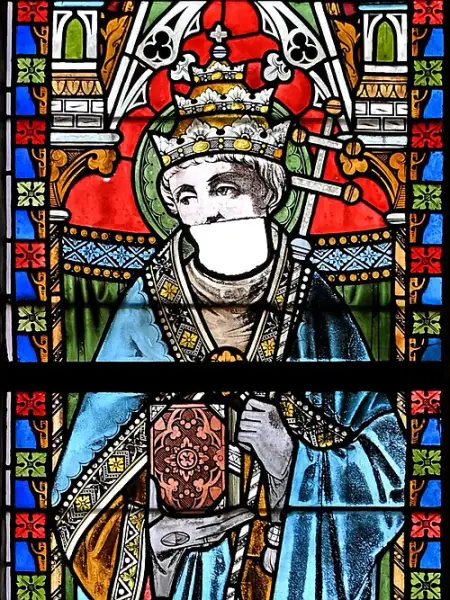
- Papal vestments·Stained-glass depictions
- Canonization
- Acclaimed a saint by popular veneration after his death; feast kept on 2 June.
Prayer
Bibliography
Show 3 sources
- Attwater, Aubrey (1939). A Dictionary of Popes: From Peter to Pius XII. pp. 72–73.
- Mann, Horace Kinder (1909). "Pope St. Eugene I". In Herbermann, Charles (ed.). Catholic Encyclopedia. Vol. 5. New York: Robert Appleton Company.
- Chisholm, Hugh, ed. (1911). "Eugenius". Encyclopædia Britannica. Vol. 9 (11th ed.). Cambridge University Press.
Profile text adapted from the Wikipedia article, licensed CC BY-SA 4.0.
Pray with this saint every day
Save St. Eugene I to your favorites, read the full profile, and get feast-day reminders in the Saints app.
Get the Saints AppFree on the App Store for iPhone and iPad