
died 7 December 283·Feast December 8
St. Eutychian
Bishop of Rome who blessed the harvest and buried the martyrs
Overview
Eutychian, also called Eutychianus, governed the church of Rome as its bishop from 4 January 275 until his death on 7 December 283. Born in Tuscany, he succeeded Felix I in an office the young Church was still learning to define. The chronology of his leadership is disputed: the Liber Pontificalis allows him eight years and eleven months, while Eusebius compresses the same span into ten months, a disagreement that shows how fragile the records of the third century had become. To his name later tradition attached two memorable customs, permission to bless grapes and beans upon the altar and the claim that he buried 324 martyrs with his own hands, though some historians question both and would place such rites in a later age. Whatever weight these stories carry, they preserve the memory of a pastor who honored the dead and sanctified the produce of the earth. He died in Rome and was laid to rest in the Catacomb of Callixtus, where his original epitaph, bearing the Greek words for Bishop Eutychian, was later recovered.
The Complete Life
A Tuscan Called to the See of Peter
Eutychian came from Tuscany, the region of hills and river valleys north of Rome, and nothing beyond that homeland is recorded of his family or his formation. He emerges into history at the moment he was chosen to succeed Felix I as bishop of Rome, entering upon the office on 4 January 275. The Church he inherited kept its outward forms in peace, yet it still lived under the shadow of the empire's changing temper, for the great persecution that would shake it to its foundations lay only decades ahead. His election set him in the unbroken chain of the successors of Peter, between Felix I before him and Caius who followed. How long he actually governed is one of the small puzzles of third-century chronology. The Liber Pontificalis, the ancient book of the popes, allots him eight years and eleven months, running from 275 to 283, while Eusebius reckons a pontificate of only ten months. Later reference works follow the longer reckoning, but the discrepancy remains a reminder of how much of the period's documentation was lost or distorted in transmission.
§ Pope Eutychian
Blessings of the Harvest, Care for the Dead
Two customs are traditionally linked with Eutychian's name. The first is a permission that the grapes and beans brought to the church might receive a blessing upon the altar, an early witness to the sanctification of the produce of the fields. Some scholars believe this practice belongs to a later period and cannot be verified for his own day, yet the tradition has clung to his memory for centuries. The second is more striking still: the claim that he buried 324 martyrs with his own hands. Such labor, if historical, would have been the work of a pastor tending the dead in the aftermath of persecution. Students of the period are divided. Some reject these accounts outright; others observe that the empire's assaults on Christianity did not cease during his lifetime but continued until the Edict of Serdica, which Emperor Galerius proclaimed in 311 and which at last made the Christian religion lawful and tolerated. Whatever the verdict of criticism, the traditions sketch a coherent figure: a bishop who sanctified the earth's first fruits and honored with his own hands the bodies of those who had died for the faith.
§ Pope Eutychian
Death and Burial among the Popes
Eutychian died at Rome on 7 December 283. He was buried in the Catacomb of Callixtus, the burial ground of the bishops of Rome on the Appian Way, taking his place among the predecessors interred there. Of his grave a remarkable physical witness survives: his original epitaph was recovered from the catacomb and is recorded in the archaeological literature on Rome's underground cemeteries. The stone bears the Greek inscription Eutychianos Episkopos, Bishop Eutychian, a terse memorial of the office he held rather than of the man himself. Few bishops of Rome from the third century have left so direct a trace, for the epigraphic remains of that age are fragmentary and often disputed. The discovery of the inscription anchors Eutychian in the soil of the catacomb at a time when nearly every other detail of his life rests on tradition of uncertain weight. He was succeeded by Caius, who took up the government of the Roman Church as the fourth century drew near and with it the final and fiercest assault of the empire upon Christianity.
§ Pope Eutychian
A Saint Remembered on 8 December
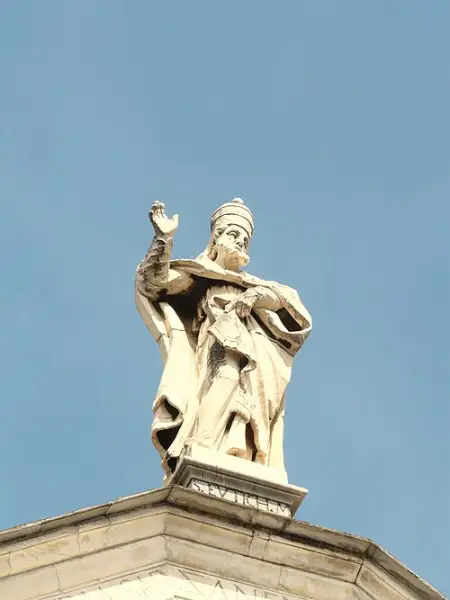
Eutychian is honored as a saint, with his feast kept on 8 December. Beyond that date, and the statue that stands on the facade of the cathedral of Sarzana in Liguria, little of his outward circumstance survives; the ancient notice is content to say that almost nothing more of him is known. Yet his name has been carried through the centuries on the lists of the bishops of Rome and in the catalogues of the saints. He stands among the earliest successors of Peter whose pontificates are commemorated without recorded decrees or writings, remembered not for documents but for the office itself and for the pious traditions that gathered about his memory. For the Roman Church his generation was a bridge: the last quiet decades between the intermittent truces the empire allowed and the great persecution that would test the Church he had served. The faithful who keep his feast on 8 December remember a bishop who blessed the harvest, buried the martyrs, and completed his course in obscurity and fidelity, leaving a name that the Church has never struck from her rolls.
§ Pope Eutychian
Timeline
- 4 Jan 275
Entered upon the government of the church of Rome, succeeding Felix I.
§ Pope Eutychian
- 7 Dec 283
Died in Rome after a pontificate recorded as either eight years and eleven months or ten months.
§ Pope Eutychian
- 311
Emperor Galerius proclaimed the Edict of Serdica, which made Christianity a legal and accepted religion and closed the age of persecution under which the Roman martyrs had suffered.
§ Pope Eutychian
The Record
- Major works
- Permission attributed to him for the blessing of grapes and beans on the altar
- Canonization
- Pre-congregation canonization; venerated as a saint since the earliest centuries of the Roman Church
Prayer
Bibliography
Show 4 sources
- The Editors of Encyclopædia Britannica. "Saint Eutychian". Encyclopædia Britannica. Retrieved 16 August 2016.
- Annuario Pontificio, 2012.
- Kirsch, Johann Peter (1909). "Pope St. Eutychianus". In Herbermann, Charles (ed.). Catholic Encyclopedia. Vol. 5. New York: Robert Appleton Company.
- Chisholm, Hugh, ed. (1911). "Eutychianus". Encyclopædia Britannica. Vol. 9 (11th ed.). Cambridge University Press. p. 958.
Profile text adapted from the Wikipedia article, licensed CC BY-SA 4.0.
Pray with this saint every day
Save St. Eutychian to your favorites, read the full profile, and get feast-day reminders in the Saints app.
Get the Saints AppFree on the App Store for iPhone and iPad