
died c. 108·Feast October 26
St. Evaristus
Second-century Bishop of Rome who ordered the city's clergy
Overview
Evaristus, also known as Aristus, led the church of Rome from about the year 100 until his death around 107 or 108. The Liber Pontificalis describes him as Greek by stock, his father a Greek Jew named Judah out of Bethlehem, so that the bishop of the imperial capital came from the very town of the Nativity. Eusebius dates his accession to the third year of Trajan's reign and his death to the twelfth, after roughly nine years in office. His tenure fell at the close of the Apostolic Age: it was probably during these years that John the Apostle died. Tradition credits him with practical organization of the Roman Church, dividing the titles among the priests of the city and ordaining seven deacons to assist the bishop in preaching. A decree preserved under his name required that weddings be celebrated openly, with a priest's blessing spoken over them. Later writers describe him as a martyr, though the Roman Martyrology commemorates him on 26 October without the martyr's title. He was buried in the Vatican near the tomb of Peter.
The Complete Life
A Greek of Bethlehem
The Liber Pontificalis preserves the little that is known of Evaristus's origins: he was a Greek by birth, the son of a Greek Jew named Judah who came from the city of Bethlehem. The detail is a striking one, for it means that the man who would govern the church of the imperial capital was born, by family root, in the very town where Christ was born. Between the infancy of Jesus in Bethlehem and the maturity of the Roman Church lay barely a lifetime, and Evaristus stands at the point where that world had already crossed the Mediterranean. His Greek speech and Jewish descent mark the cosmopolitan character of earliest Roman Christianity, which drew its members from the East, from traders, travelers, and immigrants who carried the gospel to the Tiber. It was probably during the years of his Roman ministry that John the Apostle, the last survivor of the Twelve, died, an event that marked the end of the Apostolic Age. The Church that Evaristus served no longer had living apostles; it had tradition, Scripture, and the succession of bishops.
§ Biography
Called to Succeed Clement
Evaristus succeeded Clement I as bishop of Rome, entering on his office around the year 100. Eusebius, in his Ecclesiastical History, fixes the date with unusual precision: the third year of the emperor Trajan's reign, corresponding to AD 99 or 100. The same historian records that Evaristus held the office for nine years, dying in the twelfth year of Trajan, around 108 or 109. Such calculations were among the earliest attempts to anchor the Roman succession in imperial chronology, and they gave later generations a framework for the otherwise obscure decades of the subapostolic Church. Nothing is recorded of the manner of his election or of the circumstances that brought a Greek of Bethlehem to the head of the Roman community. What matters in the record is continuity: the sixth or seventh successor of Peter holding the same office, teaching the same faith, and governing the same city's faithful that Peter had served half a century before. In that quiet succession the Roman Church found its identity, an unbroken line of bishops guarding what the apostles had handed on.
§ Biography
Ordering the Household of the Roman Church
To Evaristus tradition ascribes the first recorded steps in the practical organization of the Roman clergy. The Liber Pontificalis relates that he apportioned the titles of the city among its priests, giving each clergy body its own sphere of service, and that he ordained seven deacons to assist the bishop's preaching. The sevenfold number echoes the choice of the first deacons in Jerusalem recorded in the Acts of the Apostles, and it gave the growing Roman community a structure it had lacked: a preacher's voice multiplied through the city's districts, and a settled clergy with defined responsibilities. Another ordinance, recorded by the Reverend John F. Sullivan, required that marriages take place openly and receive a priest's blessing, following apostolic practice. The ordinance lifted Christian marriage out of purely private arrangement and set it within the liturgical life of the community, with the Church's blessing spoken over it openly. These measures, modest as they appear, belong to the slow work by which the early Church became an institution: parishes formed, orders defined, and the sacraments given public and recognizable shape.
§ Biography
Martyrdom and Burial near Peter
The manner of Evaristus's death is a matter of conflicting testimony. The Liber Pontificalis describes him as crowned with martyrdom, and the French historian Alexis-François Artaud de Montor repeats the same account, contrasting his death at the hands of executioners with the wounds inflicted on Ignatius by wild beasts. Yet the Roman Martyrology, the Church's official calendar of the saints, lists him on 26 October without the title of martyr, a silence that suggests the evidence for a violent death was never firm. Whether he shed his blood or died in peace, he died in the faith, after roughly nine years of service to the Roman community. His grave rests close to Saint Peter's own body in the Vatican, beneath the site of the great basilica that now rises above the apostle's tomb. That burial, beside the prince of the apostles, was itself a profession of the communion he had served: the bishop laid to rest with the martyr whose see he held. The place of his grave, remembered through the centuries, was confirmed when excavations beneath the basilica laid bare the ancient Vatican cemetery.
§ Biography
Remembered on 26 October
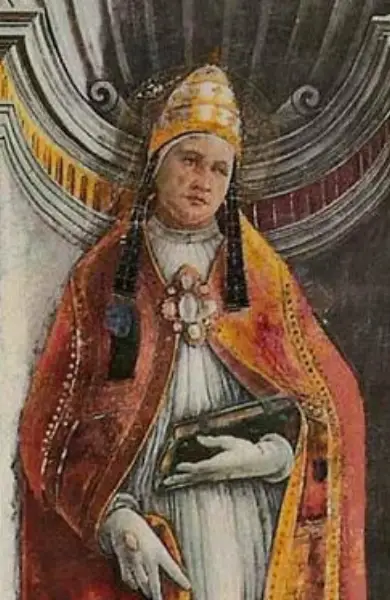
Evaristus receives the veneration of the Catholic Church, the Eastern Orthodox Churches, and Oriental Orthodoxy as a saint, his feast kept on 26 October. The divergence among the ancient sources over whether he died as a martyr has never divided the Churches in their reverence for him; East and West alike honor him among the earliest occupants of the Roman see. Artists of the later Middle Ages gave him a face: the fifteenth century depicts him among the portraits of the popes, and a fifteenth-century image by Sandro Botticelli stands in the Sistine Chapel, while a marble representation of Evaristus may be seen in Saint Peter's Basilica itself. His historical importance lies less in recorded deeds than in what he represents, the settled ordering of the Roman Church at the moment the apostolic age closed. The division of titles, the seven deacons, the public celebration of marriage: these are the first strokes of the portrait of the Church as an ordered society. The communities that kept his memory did so because in his tenure the Church of Rome began to take the shape it would keep for centuries.
§ Biography
Timeline
- 100
Took office as bishop of Rome in the third year of the emperor Trajan, around the year 100.
§ Biography
- 108
Died after roughly nine years of leadership; the Annuario Pontificio places his death in 108.
§ Biography
In Their Own Words
In accordance with Apostolic tradition marriage should be celebrated publicly and with the blessing of the priest.
Ignatius died of the wounds that were inflicted by ferocious beasts; Evaristus died under the hands of executioners, more cruel than the wild beasts themselves.
The Record
- Major works
- Division of the titles among the priests of Rome·Ordination of seven deacons to assist the bishop's preaching·Decree that marriage be celebrated publicly with the blessing of a priest
- Canonization
- Pre-congregation canonization; the Liber Pontificalis crowns him with martyrdom, though the Roman Martyrology lists him without the title
Prayer
Bibliography
Show 6 sources
- Herbermann, Charles, ed. (1913). "Pope St. Evaristus". Catholic Encyclopedia. New York: Robert Appleton Company.
- Loomis, Louise Ropes (2006) [1917]. The Book of the Popes (Liber Pontificalis). Arx Publishing, LLC. pp. 9–10. ISBN 978-1-889758-86-2.
- Burgess, Richard W. (1999). Studies in Eusebian and Post-Eusebian Chronography. Franz Steiner Verlag. p. 29. ISBN 978-3-515-07530-5.
- Sullivan, Reverend John F. (1918). The Externals of the Catholic Church. Aeterna Press.
- Artaud de Montor, Alexis-François (1911). The Lives and Times of the Popes. p. 21. Via archive.org.
- "Martyrologium Romanum". Libreria Editrice Vaticana, 2001. ISBN 88-209-7210-7.
Profile text adapted from the Wikipedia article, licensed CC BY-SA 4.0.
Pray with this saint every day
Save St. Evaristus to your favorites, read the full profile, and get feast-day reminders in the Saints app.
Get the Saints AppFree on the App Store for iPhone and iPad