
died 20 January 250·Feast January 20
St. Fabian
Bishop of Rome and martyr of the Decian persecution
Overview
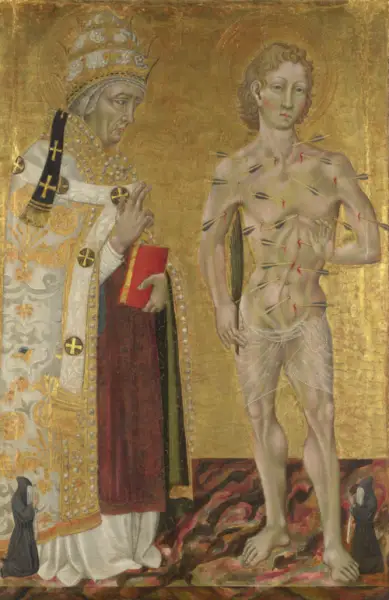
Fabian, a noble Roman whose father was named Fabius, held the office of bishop of Rome from 10 January 236 to 20 January 250, the day of his martyrdom. His election was wholly unexpected: as the electors deliberated for thirteen days over illustrious candidates, a dove descended and settled on his head, and the assembly proclaimed him bishop at once, reading in the bird the sign of the Holy Spirit. His fourteen years in office were a season of relative calm between persecutions, and he used them to organize the Roman Church on a lasting plan. He divided the city's Christians into seven districts under deacons, appointed seven subdeacons to gather the records of the martyrs' trials, and undertook extensive works in the cemeteries, including the burial of Pontian among the tombs of Callixtus. To Gaul he sent seven missionary bishops, the men tradition calls the apostles to the Gauls. When the emperor Decius demanded that all subjects offer incense to the Roman gods, Fabian was among the first victims, dying on 20 January 250, probably in prison. Cyprian judged the glory of his death worthy of the purity of his life.
The Complete Life
A Noble Roman of Obscure Origins
Fabian, as the Liber Pontificalis records, came of noble Roman stock, his father named Fabius, and there its knowledge ends; nothing more of his background, education, or early service to the Church is anywhere preserved. One ancient authority refers to him instead as Flavian, a discrepancy that shows how lightly the traditions of his origins rested on documentation. He had come to Rome from the countryside by the time the papal election of 236 opened, a detail preserved in the account of his elevation, which pictures him as a man of no particular prominence in the capital's Christian community. Whatever his station, he belonged to a Church that had recently known the strain of schism and the exile of two of its leading figures, Pontian the bishop and Hippolytus the antipope, both sent to die in the Sardinian mines. Fabian thus rose from obscurity into a community that needed reconciliation and order more than it needed brilliance. The silence of the sources about his first decades is fitting for a man whose whole significance was to begin suddenly, in the sight of the whole assembly, with the descent of a bird.
§ Early life and accession
Marked by a Dove
After the short reign of Anterus, the Roman Church gathered to choose a successor, and for thirteen days the electors weighed the names of illustrious and noble churchmen. Fabian, a newcomer from the countryside, stood among the candidates in body only; Eusebius says that although present he was in the mind of none. Then, in the midst of the deliberations, a dove suddenly descended and settled on the top of his head. To the assembled Christians the sight recalled the gospel scene in which the Holy Spirit came down upon Jesus at his baptism in the Jordan, and they read the bird as heaven's own nomination. The congregation took it as a sign that Fabian was marked out for the dignity, and he was proclaimed bishop at once, by acclamation rather than by the long counting of votes. The story, preserved by Eusebius from the fourth century, became one of the most famous election narratives of the early Church, and the dove remained Fabian's iconographic emblem ever after. On 10 January 236 he entered on the government of the Roman Church, an unknown man raised to the first see of Christendom in a single afternoon.
§ Early life and accession
Organizing the Church of the City
Fabian's fourteen years of office were devoted largely to giving the Roman community administrative shape. The Liber Pontificalis says that he divided the Christian quarters of the city into seven districts, each placed under the oversight of a deacon, a scheme that brought charity, worship, and discipline within reach of every neighborhood. Eusebius adds that he appointed seven subdeacons whose particular charge was to collect the acta of the martyrs, the official records of the court proceedings at their trials, so that the memory of the Church's witnesses might rest on documents rather than hearsay. One later tradition would make him founder of the minor clerical grades of porter, lector, exorcist, and acolyte, though most scholars judge that these offices grew up gradually and were fixed at a later time. The Liberian Catalogue of the popes reports that he initiated extensive work on the catacombs, the underground cemeteries where the honored dead were laid, and there, at his command, the body of Pontian found its tomb in the catacomb of Callixtus. The book of the popes sums up his administration: he divided the regions among the deacons, set secretaries over the deeds of the martyrs, and ordered many works in the cemeteries.
§ Papacy
Peace, Memory, and the Martyrs
The greater part of Fabian's pontificate passed in a lull of persecution, and he used the respite not for ease but for memory. The exile of Pontian and of Hippolytus, the antipope who had died reconciled to the Church in the Sardinian mines, had left wounds that Fabian set himself to heal. He possessed influence enough at court to secure the return of the bodies of both men from Sardinia, an undertaking that could not have been managed without imperial approval, and he laid Pontian to rest among the bishops in the catacomb of Callixtus. The reconciliation of the schismatic Hippolytus, honored afterward as a saint alongside the bishop who had opposed him, remains one of the quiet triumphs of Fabian's government. The tale that he baptized the emperor Philip the Arab together with the emperor's son is probably legend, though his court connections were real. To the Church beyond Rome he reached outward as well: in 245, according to Gregory of Tours, he dispatched seven bishops to preach the Gospel through Gaul, and in Africa he condemned Privatus, the author of a new heresy. His spirituality was one of order, remembrance, and outreach.
§ Papacy
The Decian Storm
The accession of the emperor Decius in 249 ended the long truce. Decius ordered every inhabitant of the empire, the Jews alone excepted, to prove loyalty to Rome by offering incense before the cult images of the state's deities, and he expected a certificate as evidence of compliance. For Christians who took the commandment against idolatry seriously, the requirement was impossible to meet, and the empire that had ignored the Church for decades suddenly sought out its leadership. Fabian was among the earliest victims of the persecution that followed. He died on 20 January 250, at the very beginning of the Decian assault, and the sources suggest that he perished in prison, worn out by captivity, rather than under the executioner's hand. The bishop who had spent fourteen years gathering the records of other men's trials had become a trial's subject himself, and the community he had organized now kept his own acts among its treasures. He was buried in the catacomb of Callixtus, among the bishops he had honored in life, and the Greek inscription on his tomb, reading Fabian, Bishop, Martyr, has survived to this day.
§ Martyrdom and legacy
Venerated East and West
The Church received Fabian's death as martyrdom and honored him as a saint without any formal process, in the manner of the ancient Church. His veneration spread across the whole of Christendom and has remained undivided: the Catholic Church, the Orthodox Church, the Oriental Churches, and the Anglican Communion all keep his memory. In the Roman calendar his feast falls on 20 January, where he shares the day with the soldier martyr Sebastian, an association so old that the two are often pictured together in art. The Orthodox Church commemorates him on 5 August, and the Coptic Church keeps his martyrdom twice over, on 7 and on 11 Meshir, testimony to how far the fame of the Roman bishop's death traveled through the Christian East. The Episcopal Church in the United States likewise honors him on 20 January. In Rome his memory took architectural form: the Villa Fiorelli church of Santi Fabiano e Venanzio, raised in 1936, bears his name together with Venantius of Camerino's, who died in the same persecution that ended Fabian's life. Fourteen years of peace, closed by one day of confession, were enough to make him immortal.
§ Martyrdom and legacy
Incomparable in Life and Death
Few bishops of the third century were judged by their contemporaries as highly as Fabian. Cyprian of Carthage, writing to Fabian's successor Cornelius, called him incomparable and declared that the glory of his martyrdom answered to the purity and holiness of his life, a verdict from the toughest moralist of the African Church. Novatian, the Roman theologian, spoke of his memory as most noble, and Fabian is recorded to have corresponded with Origen, the most demanding scholar of the age, a sign that the bishop of Rome was taken seriously in the republic of letters as well as in the order of bishops. His institutional work outlasted him: the seven districts of Rome, the secretaries of the martyrs, and the works in the cemeteries became permanent features of the Roman Church's life, and the seven missionaries he sent to Gaul, Gatianus of Tours, Trophimus of Arles, Paul of Narbonne, Saturnin of Toulouse, Denis of Paris, Austromoine of Clermont, and Martial of Limoges, are honored as the founders of its ancient sees. Centuries on, Pope Clement XI brought his remains to the basilica of San Sebastiano outside the walls, where the Albani family's chapel honors him, and his dove-marked figure stands among the colonnade statues of Saint Peter's Square.
§ Martyrdom and legacy
Timeline
- 10 Jan 236
Proclaimed bishop of Rome by acclamation after a dove descended on his head during the election.
§ Early life and accession
- 245
Sent seven bishops from Rome to preach the Gospel across Gaul, the missionaries tradition calls the apostles to the Gauls.
§ Papacy
- 20 Jan 250
Died a martyr at the outset of the Decian persecution, probably in prison rather than by execution.
§ Martyrdom and legacy
In Their Own Words
Although present, he was in the mind of none.
Fabian, Bishop, Martyr
Incomparable
The Record
- Major works
- Division of the Christian communities of Rome into seven districts under deacons·Appointment of seven subdeacons to collect the records of the martyrs·Building works in the cemeteries of Rome·Mission of the seven apostles to the Gauls
- Symbols
- Dove·Papal vestments·Papal tiara
- Canonization
- Pre-congregation canonization; martyred in 250 and venerated as a saint by the Catholic Church and the Orthodox Church
Prayer
Bibliography
Show 8 sources
- Meier, Gabriel (1909). "Pope St. Fabian". The Catholic Encyclopedia. Vol. 5. New York: Robert Appleton Company.
- Pirlo, Paolo O. (1997). "St. Fabian". My First Book of Saints. Sons of Holy Mary Immaculate – Quality Catholic Publications. p. 24. ISBN 978-971-91595-4-4.
- Attwater, Donald; John, Catherine Rachel (1993). The Penguin Dictionary of Saints (3rd ed.). New York: Penguin Books. ISBN 0-14-051312-4.
- Chisholm, Hugh, ed. (1911). "Fabian, Saint". Encyclopædia Britannica. Vol. 10 (11th ed.). Cambridge University Press. p. 113.
- Gregory of Tours, Historia Francorum I §30, citing the Martyrdom of Saturnin.
- Herbermann, Charles, ed. (1913). "Pope St. Fabian". Catholic Encyclopedia. New York: Robert Appleton Company.
- Gross, Ernie (1989). This Day in Religion. New York: Neal-Schuman Publishers. ISBN 1-55570-045-4.
- "Fabian, Bishop and Martyr, 250". The Episcopal Church. Retrieved 19 July 2022.
Profile text adapted from the Wikipedia article, licensed CC BY-SA 4.0.
Pray with this saint every day
Save St. Fabian to your favorites, read the full profile, and get feast-day reminders in the Saints app.
Get the Saints AppFree on the App Store for iPhone and iPad