
died 1 March 492·Feast March 1
St. Felix III
Bishop of Rome who broke with the Henotikon
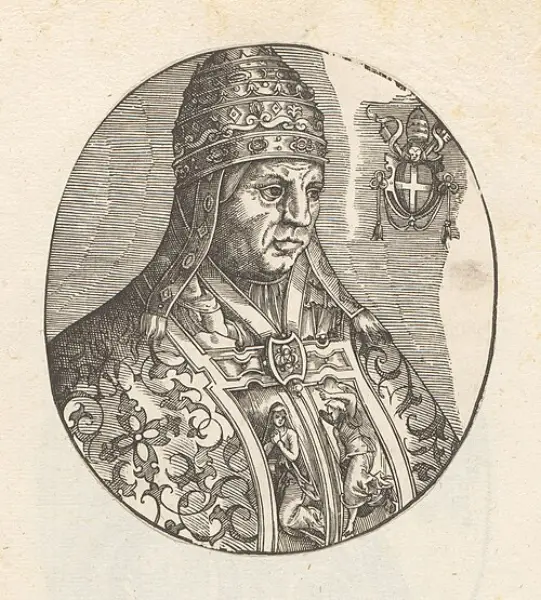
Overview
Felix III led the church of Rome from 13 March 483 until his death on 1 March 492, and his repudiation of the Henotikon is counted the beginning of the Acacian schism, the rupture between East and West that lasted until 519. His family belonged to the Roman senatorial aristocracy, and he may have been a priest's son; marriage and widowhood had both come to him before the election, and two children were his. Through his son Gordianus, himself a priest, he is thought to have been the great-great-grandfather of Pope Gregory the Great. His pontificate was shaped by the controversy over the teachings of Eutyches: when Emperor Zeno, at the urging of Patriarch Acacius of Constantinople, issued the Henotikon in 482 as a bond of reconciliation, Felix's first act as pope was to reject it, since it evaded the definition of Chalcedon on the natures of Christ. He rebuked Acacius, deposed him, and excommunicated the intruded bishops of Antioch and Alexandria. In North Africa, after the Vandal persecutions, his synod of 487 set the conditions on which those who had lapsed might return to the Church. He is commemorated on 1 March.
The Complete Life
A Senator's Household
Felix belonged to the Roman senatorial class, one of the last generations of nobles to see the Western Empire still standing in name. The tradition adds that he may have been the son of a priest, a detail that would make his own ordination a family inheritance of grace. Unusually among the early bishops of Rome, Felix is known to have been a married man: he wed, fathered two children, and was widowed before he was ever elected pope, so that he came to the see as a mature man who had known the full weight of domestic life, of loss, and of the discipline that follows bereavement. His son Gordianus became a priest, and through that son the family line ran on into the Church's future: Felix is thought to have been the great-great-grandfather of Pope Gregory the Great, and possibly related to Pope Agapetus I. The fact that a former husband and father could be raised to the Roman see in the fifth century is a reminder of how flexible the discipline of the early Church was before the later law on clerical marriage hardened. His household was, in the fullest sense, a seedbed of the papacy.
§ Family
Chosen in a Divided World
Felix was elected bishop of Rome on 13 March 483, succeeding Pope Simplicius, and he took office in a world coming apart at its seams. The Western Empire had fallen the year before with the deposition of Romulus Augustulus, and Italy passed under the rule of Odoacer; in the East, the emperor Zeno was searching for a formula to reunite the Christians divided by the christological controversies. Whether Felix had served Simplicius as an adviser or administrator is not recorded, but he assumed the see with a clear program, for his first act was to repudiate the Henotikon, the edict of union that Zeno had issued in 482. That decision set the course of his entire pontificate: nine years of resistance to the compromise of Chalcedon, conducted through letters, synods, and excommunications. The Roman Church he inherited was also a church of saints in his own bloodline, as later generations delighted to recount; an old tradition held that after his death he appeared in vision to his great-granddaughter Trasilla, an aunt of Gregory the Great, calling her home. His vocation, begun in a senatorial house and completed in the papal office, thus reached even into heaven's courtesies, as the family remembered it.
§ Family
Against the Henotikon
The Henotikon, issued by Zeno in 482 at the suggestion of Patriarch Acacius, was intended as a bridge of peace between Catholics and Eutychians. It repeated the Chalcedonian condemnation of Eutyches and Nestorius and sanctioned Cyril's twelve anathemas, yet on the crucial question, whether Christ possessed one nature or two, it deliberately said nothing definitive. Instead of healing division it bred more: the edict divided the Eastern church into three or four camps and drew the opposition of the Roman see. Felix's first act as pope was to repudiate it, and he followed with a letter of remonstrance to Acacius. The patriarch refused to submit, and the Roman see deposed him by sentence. Meanwhile the emperor had expelled the rightful patriarchs of Antioch and Alexandria from their thrones: Peter the Fuller had seized Antioch, deposing Martyrius, and Peter Mongus had taken the see of Alexandria. In his first synod Felix excommunicated Peter the Fuller, and in 484 he excommunicated Peter Mongus as well. That act opened the Acacian schism between East and West, a rupture that would not be healed until 519, long after both protagonists had died.
§ Eutychian heresy
The Faith of Chalcedon
Behind Felix's stern diplomacy lay a precise theological conviction. The council of Chalcedon had confessed Christ in two natures, divine and human, without confusion or division, and had condemned both Nestorius, who divided him, and Eutyches, who in opposing Nestorianism had run to the opposite extreme of merging his humanity into his divinity. The Henotikon, by refusing to say whether Christ had one nature or two, sought peace at the price of the council's central word, and for Felix that price could not be paid. His resistance expressed the Roman conviction that the faith confessed at Chalcedon was not a party platform but the apostolic deposit, not negotiable for the sake of imperial tranquillity. It was a spirituality of confession: the belief that unity purchased by doctrinal ambiguity is a false unity, and that the Church's peace must be built on truth or it will not stand. The schism his firmness provoked was, in his own reckoning, no rupture of his making; the rupture lay in the Edict that set aside the council. Later centuries, reading the affair, have generally judged that Felix's refusal to trade definition for concord preserved the christological faith of the West at a moment when it might have been quietly dissolved.
§ Eutychian heresy
Rome and the Wounds of Africa
In the last years of his pontificate Felix turned from the quarrels of Constantinople to the suffering Church of North Africa. That province, conquered by the fervently Arian Vandals, had endured decades of persecution under King Genseric and his son and successor Huneric, who drove many Catholic Romans into exile. When Huneric died the persecutions were eased, and a delicate pastoral question arose: many of those who, out of fear, had been rebaptized as Arians now desired to return to the Church, while the Vandal masters themselves remained resolutely heretical. The Catholics of Africa appealed to Felix, and in 487 he convened a synod to address their case. From that synod a letter went out to the African episcopate, setting the terms on which those who had yielded unwillingly were to be readmitted, a policy of mercy ordered by truth, neither refusing the penitent nor pretending that betrayal of the faith was a small matter. It was a fitting final work for the pontificate: the pope who had refused to soften doctrine for the empire showed the other face of the same firmness, a readiness to welcome home all who returned in truth. Felix died on 1 March 492, and Gelasius I succeeded him.
§ Aftermath of the Vandals
Commemorated on 1 March
Felix was honored as a saint by the Church of his own city from the first generation after his death, without any formal process, in the ancient manner. He is venerated in the Catholic Church and the Eastern Orthodox Church alike, an accord that has its own quiet irony, for the East he excommunicated in the person of its patriarch keeps his feast with the West that upheld him; sanctity, the two Churches agree, outlives schism. His commemoration falls on 1 March, the anniversary of his death in 492. No writings of devotion from his own hand survive beyond the acts of his pontificate, no sermons or commentaries; his sanctity was of the administrative and confessional kind, expressed in letters of rebuke, sentences of deposition, and synodal legislation for penitents. Yet the Church has never found that kind of holiness foreign to her saints. To resist an emperor's edict, to tell a patriarch that he has unchurched himself, and then to legislate mercy for the weak who fell under pressure, is a coherent spiritual portrait. The feast of 1 March keeps before the faithful a man whose love of truth and love of the lapsed were the same love, differently exercised.
§ Pope Felix III
Ancestor of Gregory, Seed of Unity
Felix's legacy ran through two channels, blood and doctrine. Through his son Gordianus, a priest, he was thought to be the great-great-grandfather of Pope Gregory the Great, and possibly related to Pope Agapetus I, so that the apostolic firmness he embodied passed, by family tradition, into the greatest of the early medieval popes. The family memory was treasured: his great-granddaughter Trasilla, an aunt of Gregory, was said to have received a visitation from Felix himself, bidding her enter Heaven, and she died on the eve of Christmas, seeing Jesus Christ beckoning. His doctrinal legacy was the Acacian schism itself, the first great rupture between the sees of Rome and Constantinople, which lasted from his excommunication of 484 until 519 and taught both Churches lasting lessons about the cost of imperial formulas of unity. The repudiation of the Henotikon set a precedent that Roman theologians would cite whenever reunion was proposed at the expense of definition. Historians of the period treat his pontificate as the hinge between the ancient and medieval papacy: a senator, husband, father, and widower, who made the Roman see the acknowledged guardian of Chalcedon and bequeathed to his descendant Gregory both the faith and the spine to defend it.
§ Family
Timeline
- 482
Emperor Zeno, at the suggestion of Patriarch Acacius of Constantinople, issued the Henotikon, an edict intended to reconcile Catholics and Eutychians.
§ Eutychian heresy
- 13 Mar 483
Began his pontificate as bishop of Rome, succeeding Simplicius.
§ Pope Felix III
- 484
Excommunicated Peter Mongus, who had taken the see of Alexandria, an act that opened a schism between East and West lasting until 519.
§ Eutychian heresy
- 487
Gathered a synod whose letter to the African episcopate set the terms on which those rebaptized under Vandal pressure might be readmitted.
§ Aftermath of the Vandals
- 1 Mar 492
Died in Rome, closing a pontificate of nine years.
§ Pope Felix III
- 519
The Acacian schism opened by his excommunication of Peter Mongus was at last healed.
§ Eutychian heresy
In Their Own Words
On the eve of Christmas Trasilla died, seeing Jesus Christ beckoning.
The Record
- Major works
- Repudiation of the Henotikon·Letter of remonstrance to Patriarch Acacius of Constantinople·Synodal letter of 487 to the bishops of Africa on receiving back the lapsed
- Canonization
- Pre-congregation canonization; venerated as a saint in the Catholic Church and the Eastern Orthodox Church
Prayer
Bibliography
Show 6 sources
- "CATHOLIC ENCYCLOPEDIA: Pope St. Felix III". www.newadvent.org. Retrieved 2024-01-04.
- Markus, R.A. (1997). Gregory the Great and his world. Cambridge: University Press, p. 8.
- Herbermann, Charles, ed. (1913). "Sts. Trasilla and Emiliana". Catholic Encyclopedia. New York: Robert Appleton Company.
- Coleman, Ambrose (1909). "Pope St. Felix III". In Herbermann, Charles (ed.). Catholic Encyclopedia. Vol. 6. New York: Robert Appleton Company.
- Victor of Vita. History of the Vandal Persecution, 2.3-6 (John Moorhead, trans.). Liverpool: University Press, 1992, p. 25.
- Bautz, Friedrich Wilhelm (1990). "Felix II.". Biographisch-Bibliographisches Kirchenlexikon (BBKL). Vol. 2. Hamm: Bautz. col. 10. ISBN 3-88309-032-8.
Profile text adapted from the Wikipedia article, licensed CC BY-SA 4.0.
Pray with this saint every day
Save St. Felix III to your favorites, read the full profile, and get feast-day reminders in the Saints app.
Get the Saints AppFree on the App Store for iPhone and iPad