
c. 489 – 530·Feast January 30
St. Felix IV
Bishop of Rome chosen by Theodoric the Great
Overview
Felix IV, born in Samnium around 489 or 490, the son of Castorius, was bishop of Rome from 12 July 526 until his death on 22 September 530. He owed his elevation to an extraordinary circumstance: his predecessor John I had died in prison in Ravenna after a diplomatic mission for King Theodoric the Great, and the papal electors, acceding to the king's demands, chose Felix as pope after a vacancy of nearly two months. With a king's favor behind him, Felix could press for larger advantages for the Church, and when Theodoric died before the year was out the new pope was free to shape his own course undisturbed. He raised the basilica of Santi Cosma e Damiano amid the Imperial forums on ground given by Queen Amalasuntha, and consecrated thirty-nine bishops in four years, and benefited from an imperial edict reserving cases against clergy to the pope or an ecclesiastical court. Answering a request from Faustus of Riez, he set out the Church's doctrine on grace and free will against Semi-Pelagianism and endorsed the Council of Orange in 529. He died at about forty years of age, leaving a contested succession and the distinction of being the last pope to bear the name Felix.
The Complete Life
A Son of Samnium
Felix came from Samnium, the mountainous region of the central Apennines whose peoples had been Roman allies and rivals since the days of the Republic, and he was born around 489 or 490, the son of a man named Castorius. His birthplace lay within the kingdom that Odoacer, the Germanic commander who had deposed the last Western emperor, had established over Italy, so that Felix's generation was the first to grow up entirely without an emperor in the West. Of his childhood, his education, and his rise through the Roman clergy nothing is recorded; the sources pick up his story only at the moment the papal throne fell vacant in the summer of 526. What may be inferred is a man of the Italian provinces who made his way into the Church of Rome at exactly the juncture when the relations between the Roman see and the Ostrogothic court were at their most delicate. He died at about forty years of age, which means his whole adult life was spent within the new Italy of the barbarian kingdoms. He would govern the Roman Church in the same world into which he had been born, a church living under Arian kings yet confessing the faith of Chalcedon.
§ Pope Felix IV
The King's Candidate
Felix's road to the papacy passed through a royal prison. His predecessor John I had been sent by Theodoric the Great on an embassy to Constantinople, and though the mission was diplomatically successful, the king's suspicion had been aroused; John returned to an imprisonment in Ravenna in which he died. The apostolic see stood vacant for nearly two months while the king's wishes were made known. The electors bowed to the king's demands, and on 12 July 526 they chose Felix, the man on whom Theodoric's choice had fallen. An elevation of this kind carried an obvious taint, and Felix's first months in office were lived in the shadow of his royal patron. Yet circumstances turned quickly: Theodoric died later in 526, and the constraint under which Felix had been raised vanished as suddenly as it had been imposed. Freed from the king's hand, Felix was able to pursue his own policies in peace, and nothing in his subsequent conduct suggests subservience to the Gothic court. The standing he enjoyed in Theodoric's eyes yielded one further gain even after the king's death, for it had let him seek larger advantages for the Church at a court where Arian masters ruled Catholic subjects.
§ Rise
Builder, Consecrator, and Teacher
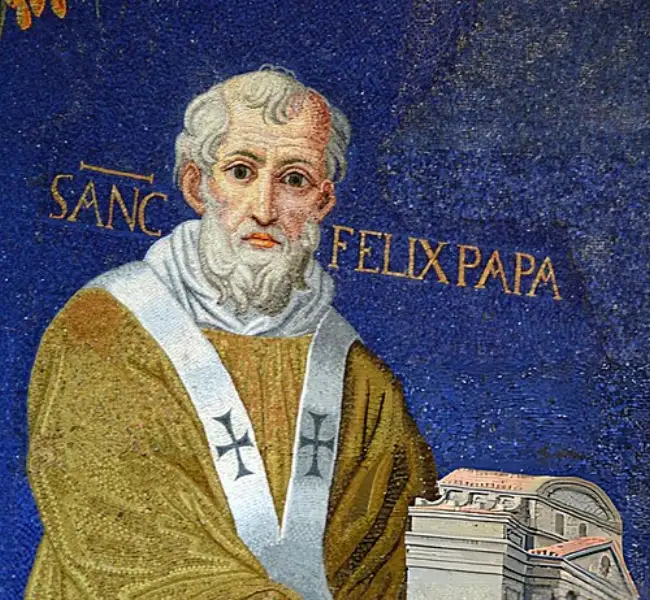
Felix's four years of office were strikingly productive. He built the church of Santi Cosma e Damiano in the Imperial forums, adorning the Roman heartland with a sanctuary in honor of the twin martyr physicians, on land donated by Queen Amalasuntha, Theodoric's daughter, and the mosaic of Christ and the apostles placed there under his patronage survives as one of the great artistic treasures of early medieval Rome. In a tenure of only four years he consecrated no fewer than thirty-nine bishops, filling the sees of Italy at a pace that suggests both energy and the wide reach of the Roman office. His relations with the imperial government in the East bore practical fruit: an imperial edict of this pontificate ruled that accusations brought against clergy were to be heard by the pope or by an ecclesiastical tribunal of his appointment, and that any breach of the rule drew a fine earmarked for the poor, a measure that strengthened the Church's internal discipline and turned penalties into alms. Above all Felix taught. Asked by Faustus of Riez, in Gaul, for a ruling against Semi-Pelagianism, he laid down the Church's doctrine concerning grace and free will, and in 529 he gave approval to the teaching of the Council of Orange, which set out likewise the doctrine of original sin.
§ Pontificate
A Contested Succession
Felix's death approached when he was still a young man of about forty, and he confronted it in a manner no pope before him had dared: he attempted to designate his own successor, naming the archdeacon Boniface as the man who should sit in Peter's chair after him. The reaction was immediate and hostile. The Roman Senate forbade the discussion of a pope's successor during a pope's lifetime and forbade the acceptance of any such nomination, an assertion of lay authority over the succession that reveals how political the office had become in Ostrogothic Italy. The clergy divided as well: the majority, resisting Felix's arrangement, nominated Dioscorus as pope, while only a minority stood by the dying pontiff's choice of Boniface. Thus the man whom a king had raised to the see ended his days trying to bind it to his own candidate, and his attempt produced precisely the contested election the Senate's decree foresaw. Felix died on 22 September 530, and the dispute he had provoked outlived him, resolved only when Dioscorus himself died weeks later and Boniface II took the throne, stained in the memory of the Church by the struggle his patron had begun.
§ Pontificate
Honored on 30 January
The Church of Rome numbered Felix among her saints from the first ages, without formal process, in the manner of the ancient Church. His feast is kept on 30 January, the date on which his memory has been celebrated since the medieval calendars. Nothing is recorded of miracles at his tomb or of a cult that spread beyond Rome; his sanctity rests on the judgment of the Roman Church that a bishop who governed in a difficult age, built for the martyrs, taught against error, and consecrated the bishops of Italy faithfully, had finished his course worthily. The brevity of his life, closed at about forty, and the ambiguity of his elevation under Theodoric did not stand in the way of his veneration; the Church has always distinguished between the circumstances of a man's rise and the fidelity of his service. In the long catalogue of the successors of Peter, Felix IV belongs to the company of the early bishops of Rome whose names the canon of the Mass preserved and whose feasts the Roman calendar kept. The 30 January observance keeps alive the memory of a short, active pontificate that left both a basilica and a doctrine to the Church.
§ Pontificate
The Last Pope Named Felix
Felix IV holds a small but permanent place in the history of the papacy: no pope since has taken the pontifical name Felix. That name, worn by four lawful popes and claimed later by an antipope, Felix V, who took it in 1439, has never again been chosen since Felix's death in 530, so that a name once favored by the Roman Church fell silent a millennium and a half ago. His material legacy stands in the heart of Rome, for the church of Santi Cosma e Damiano, built from two imperial structures in the forums of Vespasian and Peace, was the first sanctuary inserted into the monumental center of ancient Rome and retains the sixth-century mosaic that Felix's builders set above its altar, showing Christ presenting the twin martyrs in the presence of the apostles. His doctrinal legacy proved equally durable: the teaching on grace he defined at Faustus of Riez's request and the Council of Orange he approved settled the Augustinian doctrine of grace for the Latin West, closing the Semi-Pelagian controversy in the Church's official teaching. A short pontificate, contested at its beginning and its end, thus left the Church a building, a doctrine, and a name that no successor has dared to take again.
§ Pontificate
Timeline
- 489
Born at Samnium, in the kingdom of Odoacer, the son of Castorius.
§ Pope Felix IV
- 12 Jul 526
Chosen bishop of Rome after a vacancy of nearly two months, the electors acceding to the demands of King Theodoric the Great.
§ Rise
- 526
Theodoric the Great died before the year was out, freeing Felix to shape his own policies undisturbed.
§ Rise
- 529
Approved the teachings of the Council of Orange on grace, free will, and original sin.
§ Pontificate
- 22 Sep 530
Died in Rome at about forty years of age after a pontificate of four years.
§ Pontificate
The Record
- Major works
- Basilica of Santi Cosma e Damiano in the Imperial forums of Rome·Definition of church teaching on grace and free will against Semi-Pelagianism·Approval of the teaching of the Council of Orange (529)
- Canonization
- Pre-congregation canonization; venerated as a saint in the Catholic Church
Prayer
Bibliography
Show 3 sources
- Kirsch, Johann Peter (1913). "Pope St. Felix IV". In Herbermann, Charles (ed.). Catholic Encyclopedia. New York: Robert Appleton Company.
- Coulombe, Vicars of Christ: A History of the Popes. MJF Books, p. 93.
- Monks of Ramsgate. "Felix IV". Book of Saints, 1921. CatholicSaints.Info. 12 August 2018.
Profile text adapted from the Wikipedia article, licensed CC BY-SA 4.0.
Pray with this saint every day
Save St. Felix IV to your favorites, read the full profile, and get feast-day reminders in the Saints app.
Get the Saints AppFree on the App Store for iPhone and iPad