
died 21 November 496·Feast November 21
St. Gelasius I
Bishop of Rome who taught the freedom of the Church
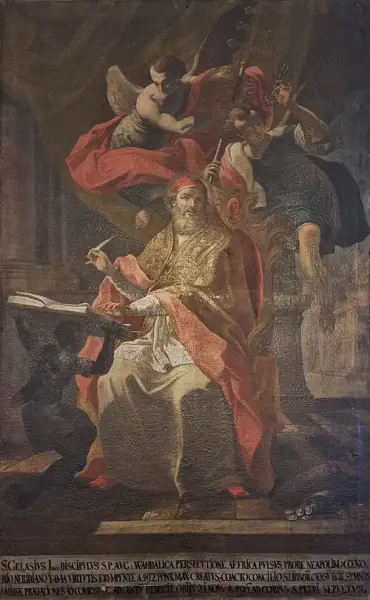
Overview
Gelasius I led the church of Rome from 1 March 492 until his death on 21 November 496. Remembered as the third African pope, he had his origins in the Roman province of Africa, although in a letter to the emperor Anastasius he called himself born a Roman, and one modern scholar reads that claim simply as proof of a birth in Roman Africa before the Vandal invasion. He came to the see after service in which some scholars believe his predecessor Felix III employed him to draft papal documents. His pontificate pressed the claim of Rome to authority over the whole Church and deepened the Acacian schism, demanding that the name of the dead patriarch Acacius be struck from the diptychs. In 494 he wrote the letter Duo sunt to Anastasius on the relation of Church and state, a text whose political influence lasted more than a millennium. He defended strict Catholic orthodoxy, authored De duabus in Christo naturis on the two natures of Christ, and kept cordial relations with the Arian Ostrogoths. He finally suppressed the ancient Lupercalia at Rome. A prolific author, with over a hundred surviving letters and six extant treatises, he died on 21 November 496.
The Complete Life
The Third African Pope
Gelasius was known in the tradition as the third African pope, and where he was born has left a small puzzle for historians. The Liber Pontificalis records his birth in the Roman province of Africa, land of modern Tunisia, and styles him of the African nation. Yet Gelasius himself, in a letter addressed to the Roman emperor Anastasius, declared that he had been born a Roman. The two statements can be reconciled: Jonathan Conant judged that the pope meant only that his birthplace lay in Roman Africa during the years before the Vandal invasion, making him an African by land yet a citizen of the empire by law. If that reading is right, Gelasius belonged to the Romanized Christian society of Proconsular Africa, the world of Augustine's heirs, which the Vandal conquest had thrown into persecution and exile. Whether his family fled to Italy or he rose through the Roman clergy from an African boyhood, the record does not say. The uncertainty has one clear lesson: by the late fifth century the Church of Rome drew its bishops from the whole Roman Mediterranean, and a man of African origin could stand, in his own estimation and that of his contemporaries, as simply a Roman.
§ Place of birth
From Papal Secretary to Successor of Peter
Before his elevation Gelasius had served close to the center of the Roman Church, and some scholars have argued that a number of scholars believe that Felix III, his predecessor, may have had him compose official papal papers, although the attribution is not certain. If true, it would explain much: the mastery of Latin prose that made him one of the most prolific authors among the early bishops of Rome, and the continuity of policy between the two pontificates, for Gelasius inherited the conflicts of Felix III with the Eastern emperor Anastasius and the patriarch of Constantinople and pressed them more assertively still. He was elected on 1 March 492, and the choice was read by contemporaries as a gesture of continuity, the elevation of the previous reign's pen to the throne that had dictated its letters. Nothing is recorded of his ordination as priest or of his service in the Roman clergy, but the character of his pontificate shows a man formed in administration, in doctrinal controversy, and in the composition of official church correspondence. Between the scholar who drafted another's letters and the bishop who signed his own there ran the short road of a Roman career, and Gelasius traversed it to the highest office the Western Church knew.
§ Pope Gelasius I
The Acacian Schism and the Primacy of Rome
The election of Gelasius on 1 March 492 signalled continuity in the age's deepest conflict. The Acacian schism, which had opened when his predecessor excommunicated the intruded bishops of the East, still divided the sees of Rome and Constantinople, and Gelasius exacerbated the dispute by insisting that the name of the deceased patriarch Acacius be struck from the diptychs, notwithstanding every overture of reconciliation made by patriarch Euphemius of the day. From the Western view the split was unavoidable, for the East courted the Monophysite teaching that Christ possessed only a divine nature, which Rome held to be heresy. Gelasius defended the full doctrine in a book, De duabus in Christo naturis, On the Dual Nature of Christ, describing the Catholic position on the matter. His grander argument was for the primacy of the Roman see throughout the universal Church, in East and West together, advanced in language that later popes took as their model when they claimed supremacy by succeeding Peter the Apostle, the first supreme pontiff. In 494 he addressed to the emperor himself the letter Duo sunt on the relation of Church and state, a text whose political impact would endure for more than a millennium.
§ Acacian schism
Orthodoxy at Home: The End of the Lupercalia
Gelasius's zeal for the faith was exercised at Rome as well as at Constantinople. At length, after protracted struggle, he abolished the Lupercalia, the old Roman festival combining fertility rites with purification, which had lived on for generations within a population Christian in name. His letter to the senator Andromachus treated the principal contentions of the controversy and, incidentally, preserved details of the festival that might otherwise have been lost, a rare case in which a polemic became an act of cultural memory. The festival had given its name to the month of February, from dies februatus, the day of purification, but Gelasius and his contemporaries distinguished it sharply from the Christian Feast of the Purification of the Blessed Virgin Mary, Candlemas, which falls on 2 February and commemorates the Holy Family's observance of the Mosaic law forty days after the birth of the firstborn son. His cordial relations with the Arian Ostrogoths, heretics in Nicene eyes, show the same discrimination of spirits: firmness where the faith itself was at stake, courtesy where mere human politics was not. A prayer from a missal attributed to him asks God for deliverance from unjust criticisms and insidious flatteries alike, and for the grace to love what God commands, the self-portrait of a controversialist at prayer.
§ Suppression of the Lupercalia
A Brief and Dynamic Ministry
Gelasius died in Rome on 21 November 496, after what the tradition calls a brief yet dynamic ministry. Four years and eight months in length, his pontificate had carried the Roman see into the sharpest assertion of its authority it had yet made, had produced some of the most influential political theology ever written, and had cleansed the city's religious calendar of its last great pagan survival. The strain of that program may be imagined: an African-born pope facing down an eastern emperor, refusing reconciliation with a patriarch he judged a heretic, writing books and more than a hundred letters, and overhauling the worship of the city. He was succeeded by Anastasius II, whose election marked, at least briefly, an attempt to soften the confrontation Gelasius had pressed. But the dead pope's work did not die with him. His letters continued to circulate through the sixth century, his doctrine of the two powers entered the bloodstream of Western political thought, and his name attached itself to the liturgical books of the Roman rite. He was buried in the faith he had defended, and the Church fixed his memory on the day of his death, 21 November, where it has remained ever since.
§ Death
A Saint of the Roman Church
The Church honored Gelasius as a saint from the earliest period, in the ancient manner, without formal process. He is venerated in the Catholic Church, and the Eastern Orthodox Church keeps him in its catalogue of the holy bishops of Rome as well, a fact worth pondering in the saint who deepened the very schism between those two communions: the East may dispute his politics while it keeps his sanctity. His feast is kept on 21 November, the anniversary of his death. The brevity of his pontificate never weighed against his cult; what the Church saw in him was a bishop who spent himself utterly in the four years given him, teaching, writing, and governing without respite. The portrait that the tradition preserved is of an ascetic and learned man, and a later age treasured a prayer from his tradition that begs to be unafraid of unjust criticism and unmoved by insidious flattery, the interior discipline behind the public combat. Sanctity, in his case, wore the garments of scholarship and administration, and the Church's judgment that such a life was holy has kept his name on her calendars for over fifteen centuries.
§ Death
A Voice That Outlasted a Millennium
Among the early bishops of Rome few wrote as much as Gelasius, and his writings gave him high standing with posterity. Over a hundred of his letters survive, though 49 of them are fragmentary, some only lines long, and six treatises bear his name, while his reputation, as Cassiodorus noted, attracted to it works he never wrote. The most famous of these pseudo-Gelasian pieces is the Decretum Gelasianum, the list of books to be received and not received, so that the determination of the biblical canon has traditionally been attributed to him. The Gelasian Sacramentary, the great Roman liturgical book, bears his name though it was compiled in eighth-century Gaul, and preserves some genuine prayers among its texts. His doctrine of the two powers, set out in Duo sunt of 494, shaped political thought for more than a thousand years: Pope Gregory XVI quoted it in Commissum divinitus of 1835 against the Baden articles, and Cardinal Giuseppe Maria Tomasi published from a Gelasian missal the prayer that Benedict XIV used against freemasonry in 1751. His image stands flanking the coronation of Charles the Bald in a ninth-century miniature, beside Gregory the Great, and statues of him keep his memory at Schloss Stainz and in the abbey of Brno.
§ Legacy
Timeline
- 1 Mar 492
Elected bishop of Rome in succession to Felix III, inheriting his predecessor's conflicts with Emperor Anastasius and the patriarchate of Constantinople.
§ Acacian schism
- 494
Addressed to Emperor Anastasius the influential letter Duo sunt on the relation of Church and state, whose political impact endured for more than a thousand years.
§ Acacian schism
- 21 Nov 496
Died in Rome after a brief but dynamic pontificate of four years and eight months.
§ Death
In Their Own Words
Grant, We beseech Thee, O Lord, that we do not trouble ourselves about the contradiction of spurious minds, but once that very wickedness has been spurned let us pray that you suffer us neither to be frightened by the unjust criticisms, nor to be attracted to the insidious flatteries, but rather to love that which Thou dost command.
The Record
- Major works
- De duabus in Christo naturis (On the Dual Nature of Christ)·Duo sunt, letter to Emperor Anastasius on Church and state (494)·Letter to the senator Andromachus against the Lupercalia·More than 100 surviving letters, 49 of them fragmentary·Six extant treatises bearing his name
- Canonization
- Pre-congregation canonization; venerated as a saint with his feast on the day of his death, 21 November
Prayer
Bibliography
Show 8 sources
- Browne, M. (1998). "The Three African Popes". The Western Journal of Black Studies. 22 (1): 57–8.
- Herbermann, Charles, ed. (1913). "Pope St. Gelasius I". Catholic Encyclopedia. New York: Robert Appleton Company.
- Ullmann, Walter (1981). Gelasius I. (492-496): das Papsttum an der Wende der Spätantike zum Mittelalter. Hiersemann. pp. 135–141. ISBN 3-7772-8135-2.
- Conant, J. (2012). Staying Roman: Conquest and Identity in Africa and the Mediterranean, 439–700. CUP, p. 83.
- Neil, Bronwen; Allen, Pauline, eds. (2014). The letters of Gelasius I (492-496): pastor and micro-manager of the Church of Rome. Turnhout, Belgium: Brepols. pp. 8–9. ISBN 978-2-503-55299-6.
- Duchesne, Louis Marie Olivier (1911). "Gelasius". In Chisholm, Hugh (ed.). Encyclopædia Britannica. Vol. 11 (11th ed.). Cambridge University Press. p. 554.
- Cohen, Samuel (2022). "Gelasius and the Ostrogoths: jurisdiction and religious community in late fifth-century Italy". Early Medieval Europe. 30 (1): 20–44. doi:10.1111/emed.12519.
- Pope Gregory XVI, Commissum divinitus, paragraph 8, Papal Encyclicals Online, accessed 8 March 2025.
Profile text adapted from the Wikipedia article, licensed CC BY-SA 4.0.
Pray with this saint every day
Save St. Gelasius I to your favorites, read the full profile, and get feast-day reminders in the Saints app.
Get the Saints AppFree on the App Store for iPhone and iPad