
c. 540-604·Feast September 3
St. Pope Gregory I (Gregory the Great)
Pope and Doctor of the Church
Overview
Gregory was born around 540 into a wealthy noble Roman family on the Caelian Hill — a forebear four generations back sat on Peter's chair as Pope Felix III, and his mother and two aunts are honored as saints. Trained in grammar, rhetoric, and law, he became prefect of Rome at about thirty, the city's highest civil office, in years scarred by plague and war. On his father's death he turned the family villa into the monastery of St. Andrew and embraced monastic life, which he loved and rarely enjoyed again. Pelagius II drew him out as a deacon and sent him as ambassador to Constantinople (579-585), where he contested the patriarch Eutychius over the resurrected body of Christ before an emperor. Chosen as pope in 590 over his own protests, he found the Lombards at the gates, refugees in the streets, and Constantinople unwilling to help; he organized the Church's vast estates into a relief administration, holding that the poor held real title to that wealth while the Church stood as mere custodian. He sent Augustine of Canterbury to evangelize the Anglo-Saxons, protected the Jews from forced conversion, reformed the Roman liturgy, and took as his title Servant of the Servants of God. His writings, above all the Pastoral Rule and Moralia in Job, made him 'the Father of Christian Worship' to the Middle Ages. He died on 12 March 604.
The Complete Life
Early Life
Gregory was born around 540 into a wealthy noble Roman family with a house on the Caelian Hill. A forebear four generations back had sat on Peter's chair as Pope Felix III, and his mother, Silvia, and two aunts are honored as saints — the family was of the surviving senatorial aristocracy of a city that no longer had an empire to run it. He was trained in grammar, rhetoric, and law, and became prefect of Rome at about thirty, the city's highest civil office, in years scarred by plague, flood, and the long war between Byzantium and the Goths. His father Gordianus died, and the young ex-prefect turned the family villa on the Caelian into the monastery of St Andrew and embraced monastic life, which he loved — and which he was rarely to enjoy again, since the Church of Rome had constant use for him. Rome in those years was a ruined city of a few tens of thousands, ruled by a Byzantine exarch at Ravenna, and its bishop was already the only functioning authority left.
§ Early life
Conversion and Vocation
The monastery lasted a few years before Pelagius II drew Gregory out as a deacon, one of the seven deacons of Rome, and sent him as apocrisiarius, ambassador, to Constantinople from 579 to 585. The posting was a failure in its object — he could not obtain imperial help against the Lombards — and fruitful in every other way: he lived in a pluralist imperial capital, contested the patriarch Eutychius on the nature of the resurrected body before the emperor Tiberius, and began the Moralia in Job, the book that would teach the Middle Ages to read Scripture. He also brought back from the East the monastic disciples who were to serve him later, and learned what a patriarchate was, which mattered when Rome acquired one. He returned to Rome and his monastery, became Pelagius's principal adviser, and on the pope's death in 590 was elected by clergy, senate, and people despite his own resistance.
§ External links
Mission and Ministry
Chosen as pope in 590 over his own written protests, Gregory inherited a city with the Lombards at the gates, refugees in the streets, plague in the houses, and an imperial government at Ravenna that would not help. His pontificate of fourteen years was the construction of an administration that could govern when the empire would not: the vast estates of the Roman Church, chiefly in Sicily and the south, were organized into a relief machine, with produce shipped to Rome, distributed to the poor by zones and lists, and accounted for by rectors under oath. He held that the poor had real title to the Church's wealth and that the Church stood as mere custodian — the tenant, not the owner. He negotiated with the Lombards when the exarch would not, ransomed captives by the thousand, protected the Jews from forced conversion, and sent Augustine of Canterbury with his monks to evangelize the Anglo-Saxons, the mission for which he is best remembered in the English-speaking world.
§ Papacy
Spirituality and Teaching
Gregory's teaching was the work of a sick man writing at speed: the Moralia in Job, thirty-five books of exposition; the Pastoral Rule, a short treatise on the government of souls that became the standard mirror for bishops for a thousand years and was one of the books Alfred the Great translated into English; the Homilies on the Gospels, preached to his own people; the Dialogues, the lives of Italian saints including Benedict; and some eight hundred and fifty letters that survive. His theology is pastoral rather than speculative: the contemplative who must return to action, the preacher as physician, the bishop as steward answerable for the poor. The liturgical corpus associated with him — the Gregorian sacramentary and the chant — is largely the work of later ages under his name, but the reformation of the Roman liturgy and the romanization of Frankish worship are genuinely his, and earned him the medieval title Father of Christian Worship.
§ External links
Trial and Final Years
The last years were illness and work. Gregory suffered from gout and slow fever, and by the end could barely walk from his bed to the church; his letters show him dictating policy between medical crises, managing the estates, the missions, the Lombard negotiations, and the quarrels with Constantinople over the title 'ecumenical patriarch' — the controversy in which he planted the papal claim to a universal primacy of service while rejecting the new style for himself. He died on 12 March 604 and was buried in St Peter's. His last years were spent, as he had asked his bishops to spend theirs, teaching the ignorant and feeding the poor, and his own estimate of his pontificate — that he had been the servant of the servants of God — is the one the Church accepted. His letters from these years are among the most personal documents of the early papacy, and they show a man doing the work of a government while expecting to die of it at any moment.
§ External links
Canonization
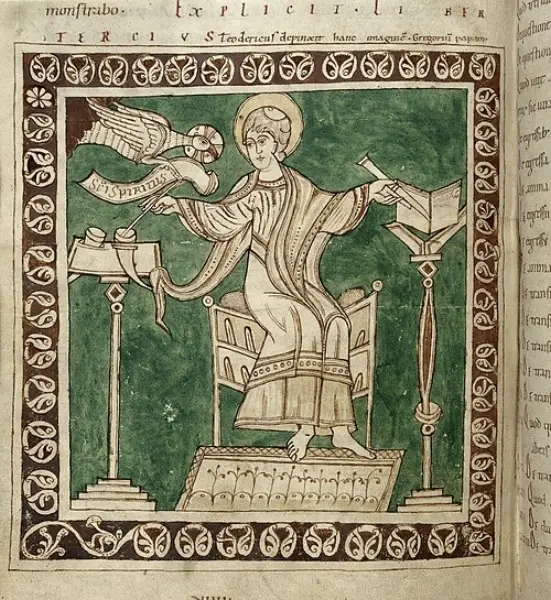
Gregory was canonized immediately by popular acclamation, before formal processes existed, and his cult has never required promotion. The Middle Ages counted him the fourth and last of the Latin Doctors, with Ambrose, Augustine, and Jerome, and gave him the epithet 'the Great' — one of only two popes to hold it. His feast, 3 September in the modern calendar, was long kept on 12 March, the day of his death. The titles accumulated: Doctor of the Church, Father of Christian Worship, and in the East one of the Cappadocian-adjacent fathers of the universal tradition, where he is honored as Gregory the Dialogist for the book that carried Italian monasticism, and Benedict's name, to Byzantium. The body of legend that gathered around him in the Middle Ages — the angle whispering the homilies, the story of the slave market — is itself evidence of the hold he had on the imagination of the Church that succeeded him.
§ Introduction
Legacy
Gregory's legacy is the medieval papacy itself. He governed a city and its hinterland as a sovereign administrator when no other authority would, and by doing so made the bishop of Rome the practical power that later popes would theorize; the title he chose, Servant of the Servants of God, is still the papal style. The mission to England, launched almost casually from the slave market anecdote of the Angle boys, created English Christianity and thereby much of the medieval Church's northern half. The Pastoral Rule governed episcopal self-understanding from Bede to the Reformation and beyond. In music, art, and liturgy his name attached itself to a whole tradition; and the pattern of his life — the contemplative forced into government, who did the work without surrendering the ideal — has made him the perpetual patron of reluctant administrators. Against all this he set a deliberate humility of style, refusing the imperial titles of the day, signing himself as a servant, and writing to his bishops as a fellow bishop; the combination of that manner with the reality of his power is what his successors have had to live up to ever since.
§ External links
Timeline
- 540
Born into a wealthy noble Roman family on the Caelian Hill, son of the patrician Gordianus and Silvia
§ Early life
- 573
Becomes Prefect of Rome, the city's highest civil office, at thirty-three years of age
§ Early life
- 579
Chosen by Pope Pelagius II as apocrisiarius, papal ambassador to the imperial court at Constantinople
§ Apocrisiariate (579–585)
- 585
Leaves Constantinople and returns to his monastery on the Caelian Hill
§ Papacy
- 3 Sep 590
Elected by acclamation to succeed Pelagius II, who had died of plague, and consecrated Bishop of Rome
§ Papacy
- 590
Organizes the church's resources into a famous administration of relief for Rome's poor and Lombard-war refugees
§ Alms
- 591
Completes the Pastoral Care and probably the Moralia in Job, founding works of his prolific writings
§ Writings
- 12 Mar 604
Dies in Rome after thirteen and a half years as pope; acclaimed a saint immediately by the Roman people
§ Introduction
- 713
At Whitby in Britain, the first full-length life of Gregory is written, about a century after his death
§ Lives
- 1606
His relics are enshrined in St. Peter's Basilica in Rome
§ Relics
- 1969
The revised General Roman Calendar moves his feast from 12 March to 3 September, the day of his consecration
§ Feast day
In Their Own Words
When, therefore, we offer the means of living to the indigent, we do not give them anything of ours, but that which of right belongs to them. It is less a work of mercy which we perform than the payment of a debt.
Holy Scripture presents a kind of mirror to the eyes of the mind, so that our inner face may be seen in it. There we learn our own ugliness, there our own beauty.
I hold the office of steward to the property of the poor.
No one does more harm in the Church than he who has the title or rank of holiness and acts perversely.
The Record
- Major works
- Pastoral Rule (Regula Pastoralis)·Moralia in Job (Morals on the Book of Job)·Dialogues·Homilies on Ezekiel and on the Gospels·Registrum Epistularum (some 850 surviving letters)
- Patron of
- Popes (his title Servant of the Servants of God)·Church musicians and singers (Gregorian chant bears his name)·Teachers and preachers (his Pastoral Rule guided them for centuries)
- Symbols
- Papal robes and tiara·Dove whispering in his ear (the Holy Spirit dictating)·Gospel book
- Canonization
- Canonized by popular acclaim immediately after his death in 604; one of the four Great Latin Doctors of the Church
Prayer
Bibliography
Show 8 sources
- ↑ Gregory had come to be known as 'the Great' by the late ninth century, a title which is still applied to him. See Moorhead 2005 , p. 1
- ↑ Gregory mentions in Dialogue 3.2 that he was alive when Totila attempted to murder Carbonius, Bishop of Populonia , probably in 546. In a letter of 598 ( Register , Book 9, Letter 1) he rebukes Bishop Januarius of Cagliari , Sardinia, exc
- ↑ The translator goes on to state that " Paulus Diaconus , who first writ the life of St. Gregory, and is followed by all the after Writers on that subject, observes that ex Greco eloquio in nostra lingua ... invigilator, seu vigilant sonne
- ↑ The name is biblical, derived from New Testament contexts: grēgorein is a present, continuous aspect, meaning to be watchful of forsaking Christ. It is derived from a more ancient perfect, egrēgora, "roused from sleep", of egeirein, "to a
- ↑ Whether III or IV depends on whether Antipope Felix II is to be considered pope.
- ↑ The dictionary account is apparently based on Bede , Book II, Chapter 1, who used the expression "...impalpable, of finer texture than wind and air."
- ↑ Later, these deacons became cardinals and from the oratories attached to the buildings grew churches.
- ↑ For the various literary accounts, see Anonymous Monk of Whitby 1985 , p. 157, n. 110
Profile text adapted from the Wikipedia article, licensed CC BY-SA 4.0.
Pray with this saint every day
Save St. Pope Gregory I (Gregory the Great) to your favorites, read the full profile, and get feast-day reminders in the Saints app.
Get the Saints AppFree on the App Store for iPhone and iPad