
669 – 731·Feast February 11
St. Gregory II
Pope who defied the Iconoclast Emperor
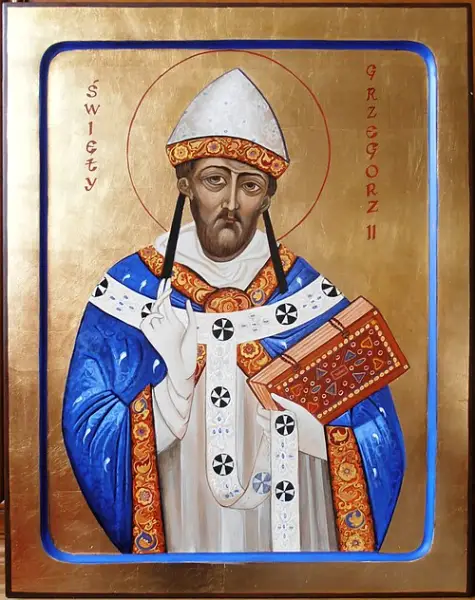
Overview
Gregory II governed the Roman Church from 19 May 715 until his death on 11 February 731, and his pontificate decisively shaped the future of both the papacy and western Europe. Born to a noble Roman family in 669, he rose through the papal court as subdeacon, sacellarius, deacon, custodian of the Roman Church's library, and finally papal secretary, in which role he negotiated with Emperor Justinian II over the canons of the Quinisext Council. As bishop of Rome he repaired the Aurelian Walls after floods, restored Monte Cassino, founded the monastery of St. Agatha in Suburra, and held a reforming synod on marriage in 721. His missionary vision transformed the north: he sent Boniface to preach in Germany, organized a church hierarchy in Bavaria, and strengthened ties with the churches of Britain and Ireland. His most consequential struggle came against Emperor Leo III, whose tax demands he resisted and whose iconoclast edict of 726 he rejected outright, inspiring revolt in Ravenna and the Pentapolis. Diplomacy with the Lombard king Liutprand yielded the Donation of Sutri in 729, the first papal territory beyond the Duchy of Rome. His defiance of imperial policy prepared the way for the popes' temporal power.
The Complete Life
A Roman Noble in the Papal Court
Gregory came into the world in 669, the child of Marcellus and his wife Honesta, members of Rome's nobility. A chronicler writing in the fifteenth century claimed he was related by blood to the later Savelli family, but no contemporary document supports the assertion, and the same dubious kinship was claimed for Pope Benedict II. What is certain is that the boy was placed early in the papal court, where his talents marked him out for responsibility. Under Pope Sergius I he was made a subdeacon and sacellarius, an official entrusted with the financial administration of the Roman See. He advanced to the diaconate and was given charge of the library of the Roman Church, a post that joined scholarly competence to administrative trust. During the pontificate of Constantine he served as papal secretary and traveled with the pope to Constantinople in 711, where the delicate question of Rome's refusal to accept the canons of the Quinisext Council was under discussion. Gregory himself conducted the actual negotiations, and his skill produced a remarkable concession: Emperor Justinian II agreed that the papacy might set aside whatever decisions of that council it chose. By the time Constantine died in April 715, the succession of the capable Roman deacon was a natural conclusion, and he was elected pope and consecrated bishop of Rome on 19 May of that year.
§ Early life
Shepherd of a Beleaguered City
The new pope took up his office with the practical energy that had distinguished his earlier career. Rome's ancient Aurelian Walls needed strengthening, and almost at once he set the work in motion, beginning at the Porta Tiburtina. In October 716 the Tiber burst its banks and submerged the city, spreading across the Campus Martius and the Plains of Nero to the foot of the Capitoline Hill, and receding only after eight days. Gregory ordered litanies to be sung against the waters and pressed on with the defenses of the city. His first year also brought correspondence with Patriarch John VI of Constantinople, who sought to justify his support of Monothelitism while pleading his difficult position before the emperor; Gregory answered with a firm statement of the traditional Roman position against that heresy. Diplomacy with the Lombards occupied him from the outset: in April 716 he persuaded King Liutprand to promise not to retake the Cottian Alps, lands once granted to the Roman Church. When the Lombard duke Romuald II captured Cumae in 717 and cut Rome off from Naples, neither threats nor bribes moved him, so Gregory financed Duke John I of Naples and recovered the city by arms. When the duke Faroald II seized Classis, the port of Ravenna, Gregory brokered its return through Liutprand, showing a consistent resolve to protect Italy's embattled population by every means the age allowed.
§ First years and expanding missionary activity
Apostle of the Northern Peoples
No pope of the eighth century did more to shape the conversion of the Germanic lands. In 716 Duke Theodo of Bavaria came to Rome to discuss his people's continuing conversion, and Gregory sent delegates with precise instructions to build a local church hierarchy under an archbishop. His enduring care for that land appeared again in 726, when he required the reluctant Corbinian, after reviewing his appeal before a synod, to leave monastic life and serve as bishop of Freising in upper Bavaria. Germany soon called more loudly. In 718 the Anglo-Saxon missionary Winfrid approached the pope seeking authorization for work among the German tribes; Gregory consented, and in May 719 commissioned him under his new name of Boniface to preach the Gospel there. When rumors questioned Boniface's doctrinal soundness, Gregory summoned him to Rome in 722, examined his written profession of faith in person, and, satisfied, consecrated him a bishop that November before sending him back to his field of labor. Their correspondence continued through the following years, the pope congratulating his missionary's progress in 724 and answering his practical questions about organizing the young German churches in 726. An anecdote from that Roman interview shows how far the spoken Latin of the day had drifted from the classical tongue: Boniface confessed he found the pope's Latin hard to follow, clear evidence that the Romance languages were emerging. Gregory likewise strengthened papal bonds with the churches of Britain and Ireland, and in 726 welcomed Ine, the former king of Wessex, who had renounced his throne to live as a pilgrim in Rome.
§ First years and expanding missionary activity
Reformer of Roman Worship and Monastic Life
Gregory's care for the Church at home was as diligent as his missions abroad. He transformed his own family house in Rome into the monastery of St. Agatha in Suburra, furnishing its altar with costly vessels, and erected a new church in honor of Saint Eustace. Monte Cassino, still desolate after the Lombard destruction of 584, received his restoration in 718, and he also intervened in a quarrel at the monastery of St. Vincent on the Volturno over the removal of its abbot. Canonical order mattered to him equally: in 721 he convened a Roman synod to remedy disorders surrounding illegitimate marriages. When the ancient rivalry between the patriarchs of Aquileia and Grado reignited in 723, he acted carefully, granting the pallium to Bishop Serenus at the request of King Liutprand, then rebuking both Serenus for overreaching into Grado's jurisdiction and Donatus of Grado for contesting the pope's own decision. Upon Donatus's death in 725, when Peter of Pola usurped the patriarchate of Grado, Gregory stripped him of both sees and instructed the people to choose a bishop according to canon law, whereupon they elected Antoninus with papal approval. His liturgical legislation was distinctive: he decreed that Thursdays in Lent, like the other weekdays, should be days of fasting, breaking with earlier popes who had hesitated because pagans once fasted on Thursday in honor of Jupiter, and he prescribed that the proper offices be celebrated on those days instead of repeating the previous Sunday's Mass.
§ Local church activities
Defiance of the Iconoclast Emperor
Strain with Constantinople dates from about 722, when Leo III moved to tax the papal estates in Italy so as to finance his war against the Arabs. Gregory refused, since Rome depended on those reserves to feed its people, and the imperial governor was driven from the city while the exarch of Ravenna, pressed by the Lombards, could do nothing. A conspiracy against the pope's life, encouraged in 725 by the official Marinus and resumed under Exarch Paul, was discovered and its participants executed. In 726 Leo promulgated his edict condemning the possession of icons of the saints, and Gregory rejected it at once. The Exarchate rose in revolt; Ravenna and the Pentapolis overthrew their loyalist officers, Paul fell in the fighting, and when the rebel armies contemplated choosing their own emperor, Gregory dissuaded them from marching on Constantinople. In 727 he summoned a synod to condemn iconoclasm and sent the emperor two letters denying any imperial right over doctrine, though Greek sources alone credit him with excommunicating Leo. A plot by the new exarch Eutychius to murder the pope in 728 was foiled, and when Eutychius and Liutprand marched on Rome in 729, Gregory split their alliance and secured an uneasy truce. Even so he remained loyal to the empire in its distress, supporting Eutychius against the usurper Tiberius Petasius, whose Tuscan rising collapsed in 730. His own death came on 11 February 731; his remains were laid to rest in St. Peter's Basilica.
§ Conflict with Emperor Leo III
Veneration and the Bread of Toulouse
Gregory was honored as a saint soon after his burial, though the ancient records do not name any formal act of canonization; his cult arose, as with so many early popes, from the devotion of the Roman people. He is commemorated in the Roman calendar and martyrology, with most authorities keeping his feast on 13 February and some on 11 February, the day of his death. A cherished story preserved by the Liber Pontificalis attached itself to his name from the wars of his era: in 720, according to that account, Gregory sent Odo, Duke of Aquitaine, three blessed baskets of bread. The duke kept them, and on the eve of the battle against Muslim forces outside Toulouse in 721 he distributed small portions to his soldiers to eat. When the fighting was over, it was reported that not one man who had shared in the pope's gift had been killed or wounded. Whatever the historians make of the tale, it testifies to the reputation for holiness that gathered around Gregory within a generation of his death, and to the sense among Christians of the West that the bishop of Rome watched over them not only as a ruler but as an intercessor before God. His tomb in St. Peter's Basilica, regretfully, has not survived the centuries, and its exact site is no longer known.
§ Miracle at the Battle of Toulouse (721)
The Road to Papal Independence
Gregory's pontificate marked a turning point in the history of the papacy and of Europe. His unbending resistance to Leo III's iconoclast policy and his refusal to surrender the Church's doctrine or property to imperial control prepared the long sequence of revolts, schisms, and civil wars that would end with the popes' temporal sovereignty. The settlement he reached with Liutprand at Sutri in 729, by which that town and certain hill towns of Latium passed to the papacy, marks the initial enlargement of papal lands past the borders of the Duchy of Rome — the seed from which the Papal States would grow. His deal with the Lombard king in 729 also ended, for the remainder of his life, the fighting between Lombards and Byzantines that had devastated the Exarchate. In the mission field his legacy proved even more durable: the hierarchy he planted in Bavaria and the great commission he gave to Boniface laid the foundations of the German Church, through which Christianity would later reach its full flowering north of the Alps. His cordial correspondence with Liutprand, reflected in the king's own legislation at the pope's urging, showed that the apostolic see could act as a moral authority even over barbarian kings. When he died in 731, his successor was Gregory III, and the direction he had set — Rome independent of Byzantium, allied with the new peoples of the West — would define the medieval papacy.
§ Relations with the Lombards
Timeline
- 669
Born in Rome into a noble family, son of Marcellus and Honesta.
§ Early life
- 711
Accompanied Pope Constantine to Constantinople and conducted negotiations over the Quinisext Council.
§ Early life
- 19 May 715
Elected pope and consecrated bishop of Rome after Constantine's death.
§ Early life
- Oct 716
The Tiber flooded Rome, interrupting his repairs of the Aurelian Walls begun at the Porta Tiburtina.
§ First years and expanding missionary activity
- 718
Restored Monte Cassino, still ruined from the Lombard attack of 584.
§ Local church activities
- May 719
Commissioned the missionary Winfrid, renamed Boniface, to preach in Germany.
§ First years and expanding missionary activity
- 721
Held a synod in Rome to address problems surrounding illegitimate marriages.
§ Local church activities
- Nov 722
Examined Boniface's profession of faith and consecrated him a bishop for the German mission.
§ First years and expanding missionary activity
- 726
Rejected Emperor Leo III's iconoclast edict, prompting revolt in the Exarchate of Ravenna.
§ Conflict with Emperor Leo III
- 727
Summoned a Roman synod to condemn iconoclasm and dispatched letters of protest to the emperor.
§ Conflict with Emperor Leo III
- 729
Met Liutprand at Sutri, securing the Donation of Sutri, the first papal territory beyond the Duchy of Rome.
§ Relations with the Lombards
- 11 Feb 731
Died in Rome and was buried in St. Peter's Basilica, where the location of his tomb was later lost.
§ Conflict with Emperor Leo III
In Their Own Words
The dogmas of the Church are not a matter for the emperor, but for the bishops.
The Record
- Major works
- Monastery of St. Agatha in Suburra, founded in his family mansion·Church dedicated to Saint Eustace in Rome·Restoration of Monte Cassino·Letters to Emperor Leo III defending sacred images
- Symbols
- Papal vestments·Pallium
- Canonization
- Pre-congregation; canonized after his death and kept in the Roman calendar and martyrology
Prayer
Bibliography
Show 10 sources
- Mann, Horace. "Pope St. Gregory II." The Catholic Encyclopedia, Vol. 6. New York: Robert Appleton Company, 1909.
- Ekonomou, Andrew J. (2007). Byzantine Rome and the Greek Popes: Eastern Influences on Rome and the Papacy from Gregory the Great to Zacharias, A.D. 590–752. Lexington Books.
- Levillain, Philippe, ed. (2002). The Papacy: Gaius-Proxies. Vol. 2. Routledge.
- Mann, Horace K. (1903). The Lives of the Popes in the Early Middle Ages, Vol. I: The Popes Under the Lombard Rule, Part 2, 657–795.
- Treadgold, Warren (1997). A History of the Byzantine State and Society. Stanford University Press.
- Gero, Stephen (1974). "Notes on Byzantine Iconoclasm in the Eighth Century". Byzantion. 44 (1): 23–42.
- Bury, John Bagnall, A History of the Later Roman Empire From Arcadius to Irene, Vol. II (1889).
- Herbermann, Charles, ed. (1913). "Pope St. Gregory II". Catholic Encyclopedia. New York: Robert Appleton Company.
- Delogu, Paolo: Gregorio II, santo. In: Massimo Bray (ed.): Enciclopedia dei Papi. Volume 1. Istituto della Enciclopedia Italiana, Rome 2000, pp. 647–651.
- Schieffer, Rudolf (1989). "Gregor II". Lexikon des Mittelalters, IV: Erzkanzler bis Hiddensee. Stuttgart and Weimar: J. B. Metzler. col. 1666–1667. ISBN 3-7608-8904-2.
Profile text adapted from the Wikipedia article, licensed CC BY-SA 4.0.
Pray with this saint every day
Save St. Gregory II to your favorites, read the full profile, and get feast-day reminders in the Saints app.
Get the Saints AppFree on the App Store for iPhone and iPad