
died 741·Feast December 10
St. Gregory III
Syrian Pope Against Iconoclasm
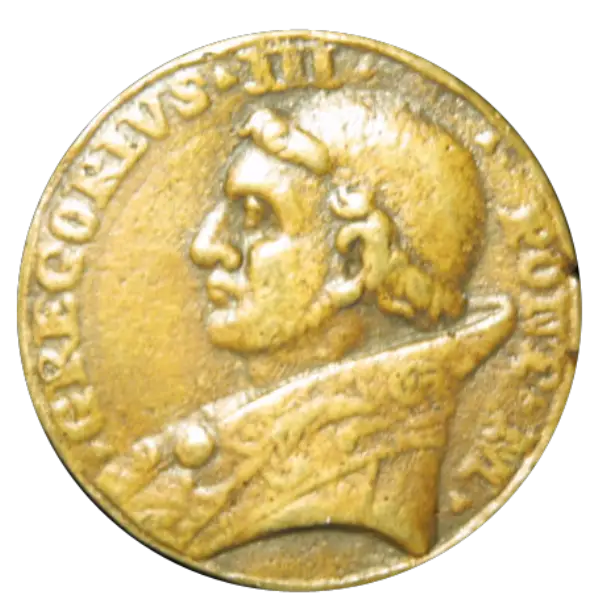
Overview
Gregory III led the Roman Church from 11 February 731 until his death on 28 November 741, governing through two perilous storms: the imperial campaign against sacred images and the Lombard advance on Rome. The son of a Syrian Christian named John, he was raised to the See of Peter by popular acclamation and became the final bishop of Rome to obtain an exarch's ratification of his elevation; no pope of Syrian birth has followed him, and none born beyond Europe until Francis, 1,272 years afterward. He at once appealed to Emperor Leo III to soften his iconoclast policy, and when his envoy was arrested he convoked a Roman synod that condemned iconoclasm outright. Leo retaliated by seizing papal estates in Sicily and Calabria, but could not break the pope. Gregory answered persecution with devotion, adorning the churches of Rome with images, raising an iconostasis in St. Peter's, and building an oratory for the relics of the saints. He advanced the northern missions by elevating Boniface to archbishop and papal legate for Germany, and he strengthened ties with the English Church. When Liutprand's Lombards threatened Rome, he turned in desperation to Charles Martel, the first of the fateful appeals that would one day draw the Franks into Italy. Unsuccessful in halting the Lombards, he died in 741 and was buried in the oratory he had built.
The Complete Life
A Son of Syria in Rome
Gregory came from Bilad al-Sham, the Syrian lands of the Umayyad Caliphate, and his father was a Christian named Ioannes, remembered also in the forms Yohannan and John. How he traveled from the Syrian East to Rome the surviving records do not say, but by 726 he had risen high enough in the Roman clergy to be created a cardinal deacon by Pope Gregory II, and he held that office for the five years leading to his own election. His Syrian birth gave his pontificate a distinction that history has not repeated: he was the last pope of Syrian origin, and no pope born outside Europe would follow him until the election of Francis 1,272 years later, in 2013. The Rome in which he matured was a Greek-speaking as well as a Latin city, full of eastern monks, refugees, and pilgrims, and a Syrian deacon of ability could rise within it. When Gregory II died on 11 February 731, the people acclaimed his cardinal deacon as successor on the very same day. Formal consecration, however, had to wait: like every pope of that embattled age, the new bishop of Rome required the consent of the Byzantine exarch at Ravenna before he could take his chair.
§ Election
The Last Pope to Ask the Exarch's Leave
Elected by acclamation on 11 February 731, Gregory waited more than a month for the ratification of the exarch of Ravenna and was consecrated bishop of Rome on 18 March. With him ended an era: he was the final pope to seek an imperial official's approval of his election, a formality that had bound Rome to Constantinople since the time of Justinian. He wasted no time in proving that spiritual loyalty to the empire would not mean silence about doctrine. Immediately upon taking office he sent a representative to Emperor Leo III, urging him to moderate his campaign against the sacred images. The emperor's answer was to arrest the envoy. Gregory replied by summoning a synod at Rome in November 731 that condemned iconoclasm outright, a direct challenge to imperial authority. Leo tried to bring the pope to heel, but the fleet dispatched to enforce his will went down in a shipwreck in the Adriatic. What remained to him was administrative: papal estates in Sicily and Calabria were confiscated, and the ecclesiastical jurisdictions of Illyricum were shifted to the patriarch of Constantinople. Even here the emperor met resistance, for when he ordered the duke of Naples to seize papal lands in the duchy, the duke sided openly with the pope and refused.
§ Anti-iconoclasm
Architect of the Northern Church
Gregory carried forward his predecessor's great work of organizing the young churches beyond the Alps. He supported the continuing mission of Boniface in Germany, raising him to the rank of archbishop in 732, and after Boniface came to Rome in person in 737 he appointed him papal legate for Germany and charged him with reorganizing its episcopal sees. Three letters accompanied the legate on his return to Bavaria: one commanded the bishops and higher clergy to aid Boniface in every way; a second urged the nobles and people of Germany to obey him; and a third, addressed to the bishops of Alamannia and Bavaria, confirmed Boniface as the papal vicar and ordered them to gather twice a year in council at Augsburg under his presidency. The pope likewise encouraged the mission of Willibald among the Saxons. Across the channel he tended the English Church with equal care: in 731 he approved Tatwine as archbishop of Canterbury after Tatwine came to Rome for the pallium, sanctioned the election of Tatwine's successor Nothhelm, and in 735, at the petition of King Ceolwulf of Northumbria, elevated Bishop Egbert of York to archiepiscopal dignity, completing the second English metropolitan see. One of his decrees touched daily life across his whole jurisdiction: in 732 he forbade the eating of horse flesh, whether of domestic or wild animals, calling it an abomination because of its association with pagan ritual feasting.
§ Ecclesiastical policy
Veneration Made Visible
Gregory's opposition to iconoclasm found its most eloquent expression in what he built. He repaired and beautified numerous Roman churches, furnishing them with icons and images of Christ, the Virgin Mary, and the saints, so that the city itself preached the doctrine the emperor condemned. In the heart of Old St. Peter's he raised an iconostasis, framed between six columns of onyx and marble that the exarch Eutychius had sent him as a gift, a striking sign that even the empire's own officer in Italy honored the pope's piety. He constructed a new oratory in the basilica to receive the relics of a great company of saints, and summoned a synod in 732 to settle how the prayers and masses of the place were to be celebrated, giving legal form to the cult he championed. Monasticism found in him an enthusiastic patron: the monastery of St. Chrysogonus owed its foundation to him, and he restored the hospice of Saints Sergius and Bacchus beside St. Peter's, giving it an endowment to sustain the poor — two saints of the Christian East honored by a pope of eastern birth. When a temporary lull came in the wars between Byzantines and Lombards, he used the peace to settle old quarrels within the Church, reaffirming the Synod of 731's judgment for Grado against Aquileia and reprimanding Patriarch Calixtus for trying to seize the island of Barbana from Grado's jurisdiction.
§ Anti-iconoclasm
Appeals to the Franks
The Lombard menace defined Gregory's last decade. In the early 730s he brought the repair of the Aurelian Walls to completion and refortified Centumcellae, buying back from Thrasimund II of Spoleto the fortress of Gallese, which commands the Via Flaminia, which the Lombards had seized to sever Rome's communications with Ravenna. When Liutprand renewed his assault on the Exarchate in 737, Gregory, though at odds with Constantinople over the images, still lent support to the Byzantine effort to recapture Ravenna after its fall around 738. That year Liutprand ordered the dukes of Spoleto and Beneventum to ravage the duchy of Rome; both refused, citing their treaty with the pope. Gregory then encouraged Thrasimund's rebellion, obliging the king to turn aside and annex Spoleto, while the fugitive duke found refuge in Rome. By mid-739 Liutprand was threatening the city itself, and Gregory sent ambassadors to Charles Martel, offering to transfer his allegiance from the Eastern Empire to Frankish protection. Charles, fully engaged against the Umayyad invaders of Gaul, made no promise, but a second anguished letter moved him to send an embassy to Rome, and Liutprand withdrew to Pavia by the end of August. Gregory backed Thrasimund's return to Spoleto that December, though the duke never surrendered the four towns he had promised. Liutprand attacked again in 740, and the Franks again declined to intervene. Gregory died on 28 November 741, succeeded by Pope Zachary.
§ Lombard threat
The Turning Toward the Franks
Gregory III stands at the hinge between two worlds. His was the last election ratified by a Byzantine exarch, and his desperate appeals to Charles Martel — offering, in effect, to exchange imperial allegiance for Frankish protection — began the diplomatic revolution that his successors would complete when Pepin and Charlemagne took up the defense of Rome. Though he died without halting the Lombards, the appeal he framed, that the pope was a loving son of St. Peter and the Franks his protector, became the founding logic of the Frankish-papal alliance. In the eastern quarrel his witness endured: the synod that condemned iconoclasm in 731 made Rome the unshakable center of Orthodox resistance to the imperial policy, a stance vindicated decades later when the veneration of images was restored. His gifts to the city — the iconostasis of St. Peter's, the relic oratory where he himself would be buried, the monastery of St. Chrysogonus, the hospice of the poor — embodied a spirituality of visible devotion that outlasted every edict against it. And his pontificate preserved the northern enterprise: Boniface's legation and the reorganized German episcopate, the second English province of York, the mission of Willibald, all flowed from his decisions and shaped the Christian map of Europe for centuries. He is honored as a saint in both the Roman Catholic and Eastern Orthodox Churches, his feast kept on 10 December.
§ Death
Timeline
- 726
Created a cardinal deacon by Pope Gregory II, serving in that office until 731.
§ Election
- 11 Feb 731
Elected pope by popular acclamation on the day Gregory II died.
§ Election
- 18 Mar 731
Consecrated bishop of Rome once the Byzantine exarch at Ravenna had granted his consent.
§ Election
- Nov 731
Convoked a synod that condemned iconoclasm outright after his envoy to Leo III was arrested.
§ Anti-iconoclasm
- 732
Elevated Boniface to archbishop of Germany and regulated the observance of his new relic oratory by synod.
§ Ecclesiastical policy
- 735
Granted King Ceolwulf of Northumbria's request by raising Bishop Egbert of York to archiepiscopal rank.
§ Ecclesiastical policy
- 737
Received Boniface in Rome and appointed him papal legate for Germany with authority to reorganize its dioceses.
§ Ecclesiastical policy
- 738
Supported the Byzantine attempt to recapture Ravenna after the city fell to the Lombards.
§ Lombard threat
- Aug 739
Sent desperate appeals for help to Charles Martel, whose embassy helped force Liutprand back to Pavia.
§ Lombard threat
- 740
Appealed once more to the Franks when Liutprand resumed his attacks on the Exarchate of Ravenna.
§ Lombard threat
- 28 Nov 741
Died in Rome, having failed to halt the Lombard advance, and was succeeded by Pope Zachary.
§ Death
In Their Own Words
Please come at once, to show your love towards St. Peter, and us, his own people.
gens ferocissima
The Record
- Major works
- Iconostasis of St. Peter's Basilica, set between six onyx and marble columns·Oratory in St. Peter's Basilica housing the relics of many saints·Monastery of St. Chrysogonus in Rome·Rebuilt hospice of Saints Sergius and Bacchus for the support of the poor·Restoration of the Aurelian Walls and refortification of Centumcellae
- Symbols
- Papal vestments·Icons and sacred images
- Canonization
- Pre-congregation; venerated in the Roman Catholic and Eastern Orthodox Churches
Prayer
Bibliography
Show 11 sources
- Houghton Mifflin Company (2003). The Houghton Mifflin Dictionary of Biography. Houghton Mifflin. p. 642. ISBN 9780618252107.
- Brusher S.J., Joseph. "St. Gregory III", Popes Through the Ages.
- "The Cardinals of the Holy Roman Church". Archived from the original on 5 March 2016.
- Mershman, Francis. "Sts. Willibald and Winnebald." The Catholic Encyclopedia, Vol. 15. New York: Robert Appleton Company, 1912.
- Schwabe, Calvin W. (1979). Unmentionable Cuisine. Charlottesville: University of Virginia Press. p. 157. ISBN 978-0813908113.
- Collins, Michael (1 August 2005). The Fisherman's Net: The Influence of the Popes on History (reprint, revised ed.). Paulist Press. p. 85. ISBN 9781587680335.
- Shahîd, Irfan (1984). Byzantium and the Arabs in the Fourth Century (illustrated, reprint ed.). Dumbarton Oaks. p. 187. ISBN 9780884021162.
- Levillain, Philippe (2002). The papacy: Gaius-Proxies. New York: Routledge. ISBN 9780415922302.
- Duffy, Eamon (2006). Saints & Sinners: A History of the Popes. New Haven, Conn.: Yale University Press. ISBN 9780300115970.
- Treadgold, Warren (1997). A History of the Byzantine State and Society. Stanford, California: Stanford University Press. ISBN 978-0804726306.
- Mann, Horace K. (1914). The Lives of the Popes in the Early Middle Ages. Vol. I: The Popes Under the Lombard Rule, Part 2, 657–795. pp. 203–224.
Profile text adapted from the Wikipedia article, licensed CC BY-SA 4.0.
Pray with this saint every day
Save St. Gregory III to your favorites, read the full profile, and get feast-day reminders in the Saints app.
Get the Saints AppFree on the App Store for iPhone and iPad