
c. 1015 – 1085·Feast May 25
St. Gregory VII
Reformer of the Investiture Controversy
Overview
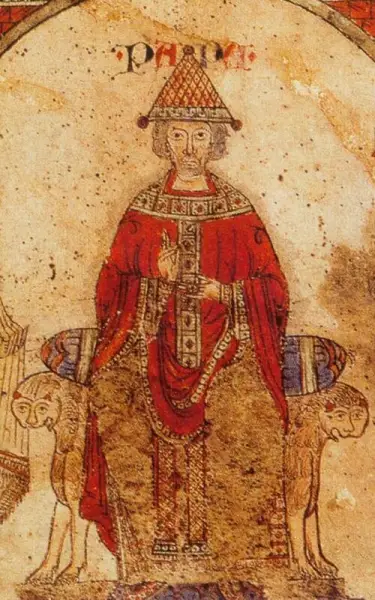
Gregory VII, born Hildebrand of Sovana around 1015, reigned as pope from 22 April 1073 until his death in exile on 25 May 1085, and stands among the greatest of the reforming pontiffs. The son of a blacksmith, he rose through the Roman curia to become archdeacon, the leading figure of the papal administration, before the crowds at Alexander II's funeral acclaimed him pope with the cry that blessed Peter had chosen him. His pontificate launched the Gregorian Reform: he attacked simony, imposed obligatory celibacy on a clergy that had commonly married, and reserved to the pope alone the naming and removal of bishops. These claims collided with Emperor Henry IV, who had him deposed at Worms in 1076; Gregory answered by excommunicating the emperor and absolving his subjects of allegiance, forcing Henry's famous barefoot penance in the snow at Canossa. The struggle reignited, and Henry raised the antipope Clement III against him. Driven from Rome, Gregory died at Salerno under Norman protection, leaving the epitaph that he had loved justice and hated iniquity, and therefore died in exile. Vindicated by history, he was beatified in 1584 and canonized in 1728, and his vision of a Church free from secular control reshaped medieval Europe.
The Complete Life
The Blacksmith's Son of Sovana
The future pope first saw the light at Sovana in the County of Grosseto, in what is now southern Tuscany, around the year 1015, and his father worked iron for a living. Sent as a boy to Rome, his schooling was at the Aventine house of St. Mary in Rome, where an uncle was said to govern a monastery on that hill. His teachers included the learned Lawrence, archbishop of Amalfi, and Johannes Gratianus, the man who would briefly reign as Pope Gregory VI. That connection drew him into the crisis of 1046: when Emperor Henry III deposed Gregory VI at the Council of Sutri in December and sent him into exile in Germany, the young Hildebrand followed his master to Cologne. On Gregory VI's death in 1048, chroniclers relate that he went to Cluny, though his own claim to have taken the habit there has been disputed. From Cluny he escorted Abbot Bruno of Toul to Rome, where Bruno was elevated as Pope Leo IX and appointed Hildebrand a deacon and papal administrator. In 1054 Leo dispatched him as legate to Tours to deal with the storm raised by Berengar of Tours, and under Leo's successors his responsibilities only grew: Victor II confirmed his legation, and Stephen IX dispatched him in the company of Anselm of Lucca to Germany, to win recognition from Empress Agnes.
§ Early life
Archdeacon of the Roman Church
The death of Stephen IX in 1058 plunged Rome into crisis when the Roman aristocracy chose an antipope, Benedict X. Hildebrand, backed by the empress's continuing support, saw Benedict replaced by the legitimate Nicholas II, and with three hundred Norman knights supplied by Richard of Aversa he personally led the assault on the castle of Galeria Antica where the pretender had taken refuge. Between 1058 and 1059 he was raised to the archdeaconry of the Roman church, the most powerful post in the papal government, and when Alexander II was elected in the contested conclave of October 1061, it was Hildebrand who stood behind the choice. Alexander's pontificate carried out the reform program that Hildebrand and his circle had devised, and during these years of advisory power he accomplished three signal achievements: the mending of relations between the papacy and the Norman kingdom in the Italian south, the compact with the Pataria movement against the Germans in the north, and above all the new ecclesiastical law that reserved the election of popes to the cardinals alone. When Alexander II was buried in the Lateran Basilica on 21 April 1073, the clergy and people erupted with the cry that blessed Peter had chosen the archdeacon. Hildebrand fled and hid himself, refusing what he called an uncanonical election, until he was found at San Pietro in Vincoli and elected there by the cardinals with the consent of the Roman clergy.
§ Election to the papacy
Correspondent of All Christendom
Gregory's gaze reached far beyond his quarrel with the emperor, and he established relations with nearly every land of Christendom. In England his appointment of the monk Dol Euen as bishop of Dol in 1076 — rejecting a simoniacal incumbent and a candidate too young — provoked the annoyance of William the Conqueror, who interfered with the church in his realm, forbade his bishops to visit Rome, and made his own appointments to sees and abbeys. Gregory lectured him on the proper relation of spiritual and temporal power, demanded recognition of papal suzerainty, and pressed for the division of ecclesiastical England into two provinces, but lacking the means to compel so strong a king, he could only ignore what he could not approve. In France, Philip I's simony and violence brought threats of excommunication and interdict in 1074, though the pope held his hand to keep his strength undispersed for the German struggle, and he attempted to organize a crusade against Al-Andalus under Count Ebles II of Roucy. His correspondence stretched to Poland, Kyivan Rus', and Bohemia, and he labored to draw Armenia nearer to Rome. Most farsighted of all was his concern for the East: grieving over the schism with Byzantium and the Muslim attacks on eastern Christians, he conceived a great military expedition to recover the Church of the Holy Sepulchre, urging the faithful of the West to aid their suffering brethren — the foreshadowing of the First Crusade.
§ Byzantine Empire
The Liberty of the Church
Every enterprise of Gregory's pontificate flowed from a single conviction: that the Church, founded by God and charged with embracing all humanity in one society, stands supreme over every human structure, and that the pope as its head is God's vice-regent on earth, so that disobedience to him is disobedience to God. As a practical statesman he acknowledged the state as a dispensation of providence and preached the union of priesthood and empire, but he refused absolutely to set the two powers on a level, holding the Church's superiority beyond all debate. He wanted every great dispute referred to Rome, which necessarily curtailed the independence of bishops and embroiled him with the higher clergy. The same conviction fired his campaign for a purified priesthood: there came from him in 1074 an encyclical releasing the faithful from obedience toward bishops who allowed married priests, and the following year he ordered action against such clerics and stripped them of their revenues, measures that met widespread resistance, as did his relentless attack on simony. Paul VI would later honor him as instrumental in affirming the real presence of Christ in the Eucharist, for the confession of that faith which Gregory imposed on Berengarius was quoted in the encyclical Mysterium fidei and helped inaugurate a Eucharistic renaissance in the churches of Europe from the twelfth century onward. His writings, gathered in his Register now kept in the Vatican Archives, are concerned with how the Church is to be governed in principle and in practice.
§ Internal policy and reforms
Exile and Death at Salerno
The last decade of Gregory's life was a long losing battle. After Henry IV's absolution at Canossa failed to settle the question of investiture, the German princes chose Duke Rudolf of Swabia as rival king in 1077, and Gregory's long neutrality collapsed after Rudolf's victory at Flarchheim in January 1080, when he renewed the emperor's excommunication and deposition. This time the censure fell flat, denounced as unjust and illegal; at Brixen in June 1080 thirty bishops declared Gregory deposed and set Archbishop Guibert of Ravenna in his place. Thirteen cardinals deserted him, Rudolf died in 1081, and Henry brought the war into Italy. Matilda of Tuscany blocked the western passes of the Apennines, but Rome surrendered in 1084, and Gregory withdrew into the Castel Sant'Angelo. He refused Henry's offer to exchange the antipope's capture for an imperial coronation, insisting instead that the emperor do penance before a council; when a remnant of bishops assembled, Gregory excommunicated Henry yet again. Guibert was enthroned as Clement III on 24 March 1084 and crowned Henry emperor, but Robert Guiscard marched to the pope's rescue and drove the king from the city. The excesses of the Norman troops then turned the Roman people against Gregory, who retreated to Monte Cassino and finally to Salerno. There he died on 25 May 1085, probably a prisoner of the Normans, having three days earlier lifted every excommunication except those of Henry and Guibert.
§ Exile from Rome
Raised to the Honors of the Altar
The Church was slow but certain in her judgment of the exiled pope. Gregory XIII beatified him on 25 May 1584, in the heyday of the Counter-Reformation, when the papacy that Hildebrand had defended was celebrating its own triumphs and reclaiming its great precedents. Nearly a century and a half later, on 24 May 1728, Benedict XIII canonized him, enrolling among the saints the man whose memory had divided Europe for four centuries. The recognition crowned a reputation that had survived every calumny: opponents of his memory, from the cardinal Beno, whose charges against him ran to necromancy, cruelty, tyranny, and blasphemy, to the Protestant polemicist John Foxe, had painted him as a tyrant, while his defenders pointed to his zeal, moral force, and religious conviction, which kept for him, to a remarkable degree, the devoted service of men and women of every temperament. The modern historian H. E. J. Cowdrey, an Anglican priest, found him surprisingly flexible, feeling his way between rigorous and cautious collaborators. His feast is kept on 25 May, the anniversary of his death, and his relics are venerated at Salerno, where a wax funeral effigy rests under glass in the cathedral beside the sarcophagus bearing his famous epitaph. He is honored as a pope and confessor, and his cult flourishes especially at Sovana and Salerno.
§ Legacy
The World the Reform Made
Gregory's defeat in his own lifetime proved to be victory in the long run. The Investiture Controversy he forced upon Europe ended a generation later in the Concordat of Worms, and the principle he died for — that no king may make and unmake the Church's shepherds — became permanent in Western Christendom. His dictatorship of reform, the Gregorian Reform, transformed the papacy from a local Italian bishopric into the legislative and judicial center of Latin Europe, and his insistence on clerical celibacy and the abolition of simony set the moral standard of the medieval priesthood. Historians have traced farther-reaching consequences still: historians have credited his reforms, which broke lay control over the Church, with an important part in the growth of self-governing cities across Europe, and his decree of 1079 ordering the regulated establishment of cathedral schools is credited with a critical role in the birth of the universities, those institutions that grew into the first of Europe's centers of higher learning. In later ages he became an exemplar of papal supremacy invoked alike by the papacy's champions and its enemies. The crusading ideal he first sketched would bear fruit two decades after his death. And the sentence he chose for his own tomb — loving justice, hating iniquity, therefore dying in exile — entered history as the very definition of the reformer's price, echoing in the memory of the Church long after the emperors who broke him had faded.
§ Internal policy and reforms
Timeline
- 1015
Born Hildebrand at Sovana in Tuscany, the son of a blacksmith.
§ Early life
- Dec 1046
Followed the deposed Pope Gregory VI, his former master, into exile in Cologne after the Council of Sutri.
§ Early life
- 1048
After Gregory VI's death, accompanied Abbot Bruno of Toul to Rome, where Bruno was elected Pope Leo IX and made him a deacon and papal administrator.
§ Early life
- 1054
Sent by Leo IX as legate to Tours to address the controversy raised by Berengar of Tours.
§ Early life
- 6 Mar 1058
Created a cardinal by Pope Stephen IX.
§ Early life
- 1059
Made archdeacon of the Roman church, the leading figure of the papal government.
§ Early life
- Oct 1061
Directed the election of Anselm of Lucca the Elder as Pope Alexander II.
§ Early life
- 22 Apr 1073
Acclaimed pope during Alexander II's funeral obsequies and elected by the cardinals at San Pietro in Vincoli.
§ Election to the papacy
- 22 May 1073
Ordained a priest on the Feast of Pentecost.
§ Election to the papacy
- 29 Jun 1073
Received episcopal consecration and was enthroned on the Feast of the Chair of St. Peter.
§ Election to the papacy
- 1074
Summoned a Lateran council that condemned simony and confirmed clerical celibacy, and excommunicated Robert Guiscard.
§ Election to the papacy
- 8 Dec 1075
Sent Henry IV a harsh letter accusing him of breaking his word and threatening deposition.
§ Start of conflict with the Emperor
- 22 Feb 1076
Placed Henry IV under excommunication after the Synod of Worms, stripped him of royal dignity, and released his subjects from their oaths.
§ Pope and emperor depose each other
- Jan 1077
Granted absolution to Henry IV after the emperor knelt barefoot in the snow at Canossa.
§ Walk to Canossa
- 7 Mar 1080
Pronounced a second excommunication and deposition of Henry IV after Rudolf of Swabia's victory at Flarchheim.
§ Later excommunications of Henry IV
- 25 Jun 1080
Deposed by thirty bishops at the council of Brixen, who elected Guibert of Ravenna in his place.
§ Later excommunications of Henry IV
- 24 Mar 1084
Forced to watch from the Castel Sant'Angelo as Guibert was enthroned as Antipope Clement III and crowned Henry emperor.
§ Later excommunications of Henry IV
- 25 May 1085
Died in exile at Salerno, probably a prisoner of the Normans, after withdrawing most of his excommunications.
§ Exile from Rome
- 25 May 1584
Beatified in Rome by Pope Gregory XIII.
§ Legacy
- 24 May 1728
Canonized by Pope Benedict XIII.
§ Legacy
In Their Own Words
I have loved justice and hated iniquity; therefore, I die in exile.
I believe in my heart and openly profess that the bread and wine that are placed on the altar are, through the mystery of the sacred prayer and the words of the Redeemer, substantially changed into the true and proper and lifegiving flesh and blood of Jesus Christ our Lord, and that after the consecration they are the true body of Christ.
The Record
- Major works
- The Gregorian Reform·Dictatus papae (1075–87)·Lateran council decrees of 1074 against simony and clerical marriage·1079 decree ordering the regulated establishment of cathedral schools·The Register of his letters, preserved in the Vatican Archives
- Patron of
- Diocese of Sovana·Salerno
- Symbols
- Papal vestments·Papal tiara·Benedictine habit
- Canonization
- Canonized 24 May 1728 by Pope Benedict XIII; beatified 25 May 1584 by Pope Gregory XIII
Prayer
Bibliography
Show 12 sources
- Cowdrey, H. E. J. (1998). Pope Gregory VII, 1073–1085. Oxford: Clarendon Press. ISBN 9780191584596.
- Oestreich, Thomas (1913). "Pope St. Gregory VII". In Herbermann, Charles (ed.). Catholic Encyclopedia. New York: Robert Appleton Company.
- Chisholm, Hugh, ed. (1911). "Gregory (Popes)/Gregory VII". Encyclopædia Britannica (11th ed.). Cambridge University Press.
- Butler, Alban (25 May 1866). "Saint Gregory VII., Pope and Confessor. Volume V: The Lives of the Saints". www.bartleby.com.
- Pirlo, Paolo O. (1997). "St. Gregory VII". My First Book of Saints. Sons of Holy Mary Immaculate - Quality Catholic Publications. p. 105. ISBN 978-971-91595-4-4.
- Emerton, Ephraim (1932). The correspondence of Pope Gregory VII: Selected letters from the Registrum. New York: Columbia University Press. ISBN 9780231096270.
- Robinson, Ian Stuart (1978). Authority and Resistance in the Investiture Contest: the Polemical Literature of the Late Eleventh Century. Manchester University Press.
- Leyser, Karl (1994). Communications and Power in Medieval Europe: The Gregorian Revolution and Beyond. London: The Hambledon Press. ISBN 978-0826430281.
- Robinson, I. S. (2003). Henry IV of Germany 1056–1106 (revised ed.). Cambridge University Press. ISBN 978-0521545907.
- Doucette, Jonathan Stavnskær; Møller, Jørgen (2025). "Papal Correspondence: Gregory VII's Influence Network, Urban Self-Government, and the Papal Revolution". Journal of Historical Political Economy. 5 (2): 189–214.
- Beno, Cardinal Priest of Santi Martino e Silvestro. Gesta Romanae ecclesiae contra Hildebrandum. c. 1084. In K. Francke, MGH Libelli de Lite II (Hannover, 1892), pp. 369–373.
- "Mysterium fidei". Vatican website.
Profile text adapted from the Wikipedia article, licensed CC BY-SA 4.0.
Pray with this saint every day
Save St. Gregory VII to your favorites, read the full profile, and get feast-day reminders in the Saints app.
Get the Saints AppFree on the App Store for iPhone and iPad