
died 248·Feast December 17
St. Heraclas of Alexandria
First Patriarch Called Pope
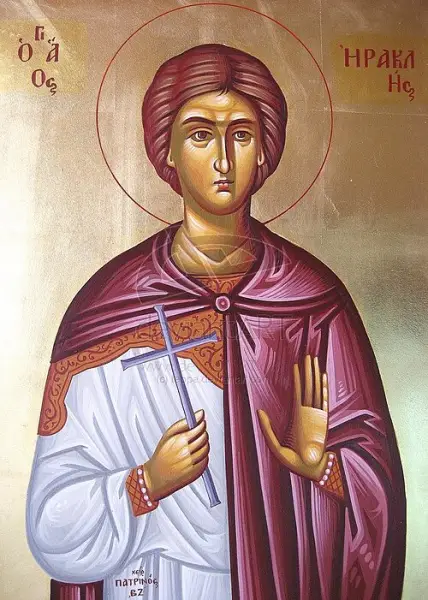
Overview
Heraclas served as the thirteenth Pope and Patriarch of Alexandria, occupying the throne of St. Mark from 232 until his death on 17 December 248. Born in Roman Egypt to pagan parents who were baptized as Christians after his birth, he received an unusual double formation: they taught him first the Greek philosophy, then Christian doctrine, and he went on to study the four Gospels and the epistles. Demetrius, the twelfth patriarch, ordained him deacon and then priest over the church of Alexandria, where he proved successful in ministry and faithful in everything entrusted to him. He succeeded Origen as head of the Catechetical School of Alexandria, the great center of Christian learning in the ancient world. When Demetrius died, Heraclas was chosen patriarch, and his sixteen-year pontificate was given to conversion and teaching: he brought many pagans to baptism and devoted his efforts to preaching and instruction, while assigning to the future St. Dionysius the work of judging among the believers and caring for their affairs. He holds a lasting distinction in the history of the Church: he was the first bishop of Alexandria to be called Pope, a title his successor Dionysius the Great explicitly records, and he is commemorated in the Coptic calendar on 17 December, the 8th of Koiak.
The Complete Life
A Household Turned to Christ
Heraclas was born in Roman Egypt to parents who at the time of his birth were still pagans, and the story of his childhood is the story of a household won to the Gospel. His mother and father were baptized as Christians after he came into the world, and they undertook their son's education with a plan that reflected their own journey: first they had him taught the Greek philosophy, the learning of the schools in which Alexandria abounded, and afterward they instructed him in Christian doctrine. On that double foundation he built a scriptural education, studying the four Gospels and the epistles until he knew them thoroughly. Such a formation marked him out for service in a church whose city was the intellectual capital of the age, where Christian teachers routinely mastered both traditions. Demetrius, the twelfth Patriarch of Alexandria, recognized his gifts and ordained him first to the diaconate and then to the priesthood over the church of Alexandria. The record of his life sums up those years in a phrase: he prospered in ministry and showed fidelity in every charge committed to him, a reputation for competence and reliability that would carry him, step by step, to the highest office of the Egyptian Church.
§ Pope Heraclas of Alexandria
Heir of Origen's School
The decisive trust of Heraclas's priestly years came at the Catechetical School of Alexandria, the famous academy where the Christian faith was taught to converts and inquirers at the highest intellectual level. There Heraclas followed Origen himself as head of the school, inheriting the chair of the most celebrated Christian teacher of the ancient world. The succession speaks volumes about the esteem in which he was held: the catechetical school demanded a commander equally at home in Greek philosophy and in the doctrines of the Church, precisely the double education his parents had given him. Under his direction the school continued its work of forming believers whose faith could withstand the questions of pagan philosophers and whose learning could serve the Gospel rather than rival it. His labors there, joined to his priestly service in the church of Alexandria, prepared him for the patriarchate in the natural order of the Egyptian Church, which entrusted its greatest teaching offices to those who had proven faithful in them. When Demetrius died after a long pontificate, it was this teacher and priest, tested in doctrine and administration alike, whom the Church of Alexandria chose to sit on the throne of St. Mark as its thirteenth patriarch.
§ Pope Heraclas of Alexandria
Sixteen Years of Teaching and Conversion
As patriarch, Heraclas gave himself to the work that had shaped his whole life: teaching, preaching, and instructing. The record of his reign describes a bishop intent on conversion, who brought many pagans to Christ and baptized them into the Church, extending the Christian community of Alexandria and Egypt during years when the faith was still competing openly with the old religion of the schools and temples. He was an organizer as well as an evangelist. Among the burdens of so large a church was the settling of disputes among the believers and the care of their practical affairs, and Heraclas assigned that work to Dionysius, his fellow laborer and eventual successor, who would himself reign as Dionysius the Great after 248. The division of labor shows a patriarch who governed by delegation and formation, training the man who would carry on his work. His occupancy of the throne of St. Mark lasted sixteen years in all, from 232 until his death, years that closed in peace before the savage persecution that would soon test the Egyptian Church under Decius. He died on 17 December 248 and was buried in the Church of the Cave at Alexandria, leaving behind a church strengthened in numbers and in learning.
§ Pope Heraclas of Alexandria
The First to Be Called Pope
Heraclas occupies a permanent place in the history of the Church for a single word. To him belongs the title Pope — in Greek, Papás — first given to a Patriarch of Alexandria; the word began life as an address meaning Father and was applied in his day to a number of bishops. The earliest known record attaching that designation to Heraclas comes from the pen of his own successor, Dionysius the Great, who wrote to a man named Philemon that he had received a rule and ordinance from the blessed Pope Heraclas. Eusebius preserved the passage in the seventh book of his Ecclesiastical History, and so the first documentary appearance of the title that would one day belong to the bishop of Rome belongs, by nearly a century and a half, to the thirteenth patriarch of Alexandria. For the Coptic Church the title has remained the proper name of its supreme pontiff ever since. Heraclas himself is honored as a saint by the Coptic Orthodox Church, which keeps his feast on 17 December, corresponding to the 8th of Koiak in the Coptic calendar, and venerates his memory beside the other fathers who sat on the throne of Mark before the great schisms of the fifth century.
§ Pope Heraclas of Alexandria
Timeline
- 232
Chosen Pope and Patriarch of Alexandria on the death of Demetrius, beginning a sixteen-year reign on the throne of St. Mark.
§ Pope Heraclas of Alexandria
- 17 Dec 248
Died in Roman Egypt after sixteen years as patriarch and was buried in the Church of the Cave in Alexandria.
§ Pope Heraclas of Alexandria
In Their Own Words
I received this rule and ordinance from our blessed Pope, Heraclas.
The Record
- Symbols
- Patriarchal vestments of the Coptic tradition
- Canonization
- Pre-congregation; venerated as a saint in the Coptic Orthodox Church
Prayer
Bibliography
Show 5 sources
- Eusebius, Historia Ecclesiastica, Book VII, chapter 7.4.
- Meinardus, Otto F.A. (2002). Two Thousand Years of Coptic Christianity. American University in Cairo Press. ISBN 978-977-424-757-6.
- Atiya, Aziz S. The Coptic Encyclopedia. New York: Macmillan Publishing Co., 1991. ISBN 0-02-897025-X.
- Herbermann, Charles, ed. (1913). "Heraclas". Catholic Encyclopedia. New York: Robert Appleton Company.
- St. Heraclas (Theoclas), 13th Pope of Alexandria.
Profile text adapted from the Wikipedia article, licensed CC BY-SA 4.0.
Pray with this saint every day
Save St. Heraclas of Alexandria to your favorites, read the full profile, and get feast-day reminders in the Saints app.
Get the Saints AppFree on the App Store for iPhone and iPad