
died 468·Feast November 17
St. Hilarius
Defender of Orthodoxy at Ephesus
Overview
Hilarius governed the Roman Church from 19 November 461 until his death on 29 February 468, after a career in which he had already proven himself one of the boldest defenders of the faith of his age. A native of Sardinia and son of Crispinus, he was archdeacon to Pope Leo I and contended vigorously for the Roman See's rights. In 449 he stood among the papal legates at the Second Council of Ephesus, where he opposed the condemnation of the Patriarch Flavian of Constantinople by pronouncing the single Latin word Contradicitur — it is annulled — in the pope's name. The presiding Dioscorus of Alexandria watched the roads and docks to stop him, but Hilarius escaped by an indirect route and carried news of the council back to Rome, later crediting his survival to John the Evangelist with an oratory at the Lateran. As pope he devoted himself to ecclesiastical discipline in conformity with canon law, settling jurisdictional quarrels across Gaul and Spain through encyclicals and synods, upholding the primatial rights of Arles as Leo had defined them, and convening the Roman synod of 465, the oldest whose original records survive. He countered Emperor Anthemius's edict of toleration for schismatics, built churches, baths, and libraries in Rome, and died in 468.
The Complete Life
A Sardinian in the Roman Curia
Hilarius came from the island of Sardinia, where his father Crispinus raised him; the sources date his birth only broadly, after the year 395, during the dying decades of the Western Roman Empire. He made his way to Rome and rose to the archdeaconry under Pope Leo the Great, the second-highest office of the Roman Church, and in that station he contended vigorously for the rights belonging to the Roman See. The archdeacon was the pope's working deputy in a city under imperial neglect, and Leo, engaged in a continuing contest with Hilary of Arles over the government of the Gallican church and armed with the famous rescript of 444 from Emperor Valentinian III confirming Roman supremacy, found in his Sardinian archdeacon an administrator of matching energy. It was in this role that Hilarius was chosen for the most delicate assignment of the age: in 449, together with Bishop Julius of Puteoli, he was sent as legate to the Second Council of Ephesus, the assembly later remembered as the Robber Synod, where the fate of the Patriarch Flavian of Constantinople and of the whole Christological settlement hung in the balance. Leo had entrusted to the legates a letter for the council — the letter that would become his celebrated Tome to Flavian — and upon the conduct of that document the council's legitimacy would turn.
§ Early career
Contradicitur at Ephesus
At Ephesus the papal letter was never read. The head notary ruled that the emperor's letter should come first, and as the sessions pressed on, Leo's Tome was simply set aside. When the council proceeded to condemn Flavian of Constantinople, Hilarius rose in protest, pronouncing in Latin the single word Contradicitur — it is annulled — and thereby declaring the sentence void in the name of the pope who was not permitted to speak. This boldness drew upon him the hostility of Dioscorus of Alexandria, president of the synod. Flavian died shortly afterward, on 11 August 449, from injuries suffered in a physical assault by the followers of Dioscorus. Hilarius himself was effectively made a prisoner: according to his account in a letter to Empress Pulcheria preserved among Leo's correspondence, Dioscorus had Ephesus's roads and docks placed under watch, barring his passage toward Rome or Constantinople. He nonetheless managed to slip away by an indirect route, and the letters in which Flavian and Eusebius of Dorylaeum appealed to the pope were probably carried to Rome by his hand. In gratitude for his safe passage he attributed his deliverance to the intercession of John the Evangelist, and when he could, he raised an oratory at the Lateran in the apostle's honor.
§ Early career
Ordering the Churches of Gaul and Spain
Much of Hilarius's pontificate was given over to one labor above all: upholding ecclesiastical discipline according to the canons among the bishops of Gaul and Spain. In Gaul, Hermes, formerly archdeacon of Narbonne, had illegally acquired that bishopric; when two Gallican prelates brought the case to Rome, a Roman synod on 19 November 462 judged it, and the pope ruled by encyclical that Hermes should remain titular bishop of Narbonne while his episcopal powers were withheld. His encyclical went further, laying down a discipline for the whole region: the bishop of Arles was to convene a yearly synod, all important matters were to be referred to the Apostolic See, no bishop might leave his diocese without written permission from his metropolitan, and church property could not be sold until a synod had examined the purpose of the sale. When Mamertus of Vienne consecrated Marcel as bishop of Die in 463 in territory that Leo had assigned to Arles, Hilarius deputed Leontius of Arles to summon a great provincial synod, and his edict of 25 February 464 warned Mamertus that further irregular ordinations would cost him his faculties, while upholding the primatial privileges of Arles exactly as Leo had defined them. For Spain, whose churches tended to operate outside the papal orbit, he settled the disputed succession at Barcelona: the Roman synod of 19 November 465, held at Santa Maria Maggiore, directed Irenaeus to quit Barcelona and return to his former see — the earliest Roman synod whose acts survive in the original.
§ Ecclesiastical disputes
Guardian of Unity in the City
Within Rome itself Hilarius proved as vigilant a pastor as he was abroad. In 467 the new emperor, Anthemius, issued an edict of toleration for schismatic sects — inspired, Pope Gelasius I would later write, by Philotheus, a favorite of the emperor who espoused the Macedonian heresy. Hilarius worked zealously against the measure, and on one of Anthemius's visits to St. Peter's Basilica the pope publicly summoned him to answer for his favorite's conduct, taking his stand at the apostle's grave and exhorting Anthemius to promise that no schismatical assemblies would be allowed in Rome. The scene belongs to an old tradition of Roman episcopal courage: the bishop of a defenseless city, facing its sovereign not with armies but with the authority of the apostle's tomb. His building works carried the same theology in stone. The Liber Pontificalis, the principal record of his life, commends the several churches and other works he raised in the city: a chapel of the Holy Cross within the baptistery, convents, a pair of public baths, and libraries by the Basilica of St. Lawrence outside the Walls, together with two oratories in the Lateran baptistery dedicated to John the Baptist and to John the Apostle, the apostle to whom he owed his escape from Ephesus — thereby settling the old question of which saints the Lateran was dedicated to.
§ Papacy
Death and Burial
Hilarius closed his pontificate as he had lived it, in the service of the city's churches and of the discipline of the whole Christian people. The record does not narrate a dramatic final crisis, and that silence is itself a measure of his success: the man who had stood alone at Ephesus finished his reign having settled the quarrels of Gaul and Spain, rebuked an emperor, and adorned Rome with churches, convents, baths, and libraries. He died on 29 February 468, his leap-day death the only fixed date the sources give for the end of a life whose beginning they cannot even fix within a year. He was buried in the Basilica of St. Lawrence outside the Walls, one of the great pilgrimage churches of Rome, where he had built his convents and libraries, and where his tomb joined him to the Roman martyrs he had served. The succession passed to Simplicius, who inherited both the settled Gallican discipline and the building works of his predecessor. The Liber Pontificalis preserves the memory of a pope remembered less for dramatic gestures than for patient government, though his single word at Ephesus had been dramatic enough to echo through every later account of the council that tried to condemn the faith without hearing Rome.
§ Death
Veneration East and West
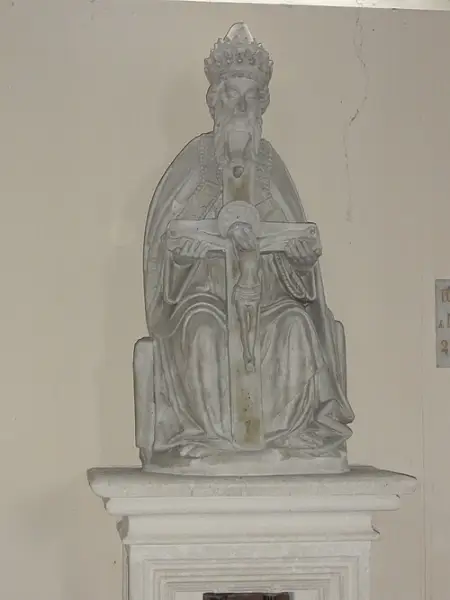
Hilarius was honored as a saint from antiquity, as the popes of the first centuries commonly were, without any formal process of canonization. His cult divides its calendar between the two lungs of Christendom: the Roman Catholic Church keeps his feast on 17 November, a date recorded in the medieval martyrologies and confirmed in the Catholic Encyclopedia, while the Eastern Orthodox Church, which numbers him among the holy popes of the undivided Church, celebrates him on 28 February. The double feast reflects the span of his life's work: a legate who risked everything at an ecumenical council in the Greek East, and a bishop of Rome who governed the churches of the Latin West. He is listed among the popes venerated as saints of the Catholic Church, and his memory is kept alongside his master Leo the Great, whose policy of Roman primacy and doctrinal firmness he carried forward. No medieval hagiographer supplied him with legends, and his saintliness rests on the sober record of the sources: the word spoken at Ephesus against a rigged council, the escape from Ephesus under the watch of his enemies, the discipline he imposed on wayward bishops, and the rebuke he delivered to an emperor at the tomb of the Prince of the Apostles. His statue stands in the Church of St. Hyginus at Carville-Pot-de-Fer in France.
§ Death
Discipline, Records, and Stone
Hilarius's legacy rests on three foundations. The first is institutional: he completed the system of Roman government over the Gallican and Spanish churches that Leo the Great had begun, confirming the primatial rights of Arles, regularizing the machinery of provincial synods, and insisting that important disputes be referred to the Apostolic See — practice that anticipated the medieval papacy's jurisdiction over the whole Latin Church. The second is documentary: the Roman synod of 19 November 465 at Santa Maria Maggiore is the earliest Roman synod whose acts survive in the original, and through those acts historians can watch the fifth-century papacy at work, judging elections, correcting ordinations, and balancing the rights of metropolitans against the rights of Rome. The third is architectural: the Liber Pontificalis praises his Roman works — the Holy Cross chapel of the baptistery, convents, a pair of public baths, and libraries beside St. Lawrence outside the Walls, plus the two Lateran oratories of the Baptist and the Evangelist, the latter of which settled the dedication of the ancient basilica. His confrontations also entered memory: the word Contradicitur became proverbial for papal protest, and his public rebuke of Anthemius stood as a precedent for bishops who faced emperors. After Leo the Great, few fifth-century popes left the Roman See so thoroughly organized as Hilarius handed it to Simplicius in 468.
§ Construction projects
Timeline
- 449
Served with Bishop Julius of Puteoli as papal legate to the Second Council of Ephesus and opposed the condemnation of Flavian of Constantinople.
§ Early career
- 11 Aug 449
Flavian of Constantinople, whose condemnation Hilarius had opposed, died from injuries suffered in an assault by the followers of Dioscorus.
§ Early career
- 19 Nov 461
Succeeded Leo I as bishop of Rome.
§ Papacy
- 19 Nov 462
Presided over a Roman synod judging the disputed bishopric of Hermes at Narbonne, leaving him titular bishop but withholding his episcopal faculties.
§ Ecclesiastical disputes
- 463
Confronted the irregular consecration of Marcel as bishop of Die by Mamertus of Vienne in territory belonging to the see of Arles.
§ Ecclesiastical disputes
- 25 Feb 464
Issued an edict warning Mamertus of Vienne against irregular ordinations and sanctioning the consecration of the Bishop of Die through Leontius of Arles.
§ Ecclesiastical disputes
- 19 Nov 465
Held a Roman synod at Santa Maria Maggiore that settled the disputed succession at Barcelona, the oldest Roman synod whose records survive.
§ Ecclesiastical disputes
- 467
Zealously opposed Emperor Anthemius's edict of toleration for schismatic sects and called the emperor to account during a visit to St. Peter's Basilica.
§ Papacy
- 29 Feb 468
Died in Rome and was buried in the Basilica of St. Lawrence outside the Walls.
§ Death
In Their Own Words
Contradicitur
The Record
- Major works
- Oratories of John the Baptist and John the Apostle in the Lateran baptistery·Chapel of the Holy Cross in the baptistery·Convents, two public baths, and libraries near St. Lawrence outside the Walls·Encyclicals regulating church discipline in Gaul and Spain
- Symbols
- Papal vestments·Statue depicted at Carville-Pot-de-Fer in France
- Canonization
- Pre-congregation; venerated as a saint in the Roman Catholic and Eastern Orthodox Churches
Prayer
Bibliography
Show 8 sources
- Butler, Alban; Burns, Paul (1995). Butler's Lives of the Saints: February. A&C Black. p. 266. ISBN 9780860122517.
- Kirsch, Johann Peter (1910). "Pope Saint Hilarus". In Herbermann, Charles (ed.). Catholic Encyclopedia. Vol. 7. New York: Robert Appleton Company.
- Chapman, John. "Dioscurus." The Catholic Encyclopedia, Vol. 5. New York: Robert Appleton Company, 1909.
- Liber Pontificalis [The book of the Popes] (in Latin). pp. 102–104.
- O'Malley, John W. (2010). A History of the Popes, From Peter to the Present. Sheed & Ward.
- Barmby, J., "Hilarius, bp. of Rome", A Dictionary of Early Christian Biography, (Henry Wace ed.), John Murray and Co., London, 1911.
- Onnis, Omar; Mureddu, Manuelle (2019). Illustres. Vita, morte e miracoli di quaranta personalità sarde (in Italian). Sestu: Domus de Janas. ISBN 978-88-97084-90-7.
- "CATHOLIC ENCYCLOPEDIA: Pope Saint Hilarus". www.newadvent.org.
Profile text adapted from the Wikipedia article, licensed CC BY-SA 4.0.
Pray with this saint every day
Save St. Hilarius to your favorites, read the full profile, and get feast-day reminders in the Saints app.
Get the Saints AppFree on the App Store for iPhone and iPad