
c. 450 – 523·Feast August 6
St. Hormisdas
Healer of the Acacian Schism
Overview
Hormisdas reigned as bishop of Rome from 20 July 514 until his death on 6 August 523, and his pontificate achieved what three previous popes had failed to do: it ended the Acacian schism that had severed Constantinople from Rome since 484. Born around 450 at Frusino in the closing age of the Western Empire, he bore a Persian name probably given in honor of the exiled noble Hormizd, celebrated in the Roman martyrology. Before his ordination he had been married and was the father of a son, Silverius, who would himself become pope — the only father in history preceded in that office by his son's era in both directions. A steadfast partisan of Pope Symmachus during the Laurentian schism, he acted as notary for the 502 synod at St. Peter's and rose to the papacy without controversy in 514. His first care was to heal Rome's own wounds, receiving back the remaining Laurentian adherents. The rest of his reign was given to reunion with the East: through patient embassies to Emperor Anastasius I, firm demands for the acceptance of Chalcedon and Leo's letters, and the formula that bears his name, he brought the negotiation to triumph under Justin I. On 28 March 519, before a great crowd in the cathedral of Constantinople, the churches were reunited.
The Complete Life
An Italian of Persian Name
Hormisdas was born around 450 at Frusino, the modern Frosinone, in the moribund years of the Western Roman Empire. His name puzzled and fascinated contemporaries, for it was Persian, and was probably given in honor of Hormizd, an exiled Persian noble celebrated in the Roman martyrology on 8 August, though not so honored in the East; the Encyclopaedia Iranica goes further and judges him probably related to that Hormizd. Whatever the eastern echo in his name, his family was otherwise of straightforward Italian pedigree, as the names of his father and his son suggest. His early life took a course unusual among the popes: before becoming a deacon he had been married, and he raised a son, Silverius, who in time would himself be raised to the chair of Peter as Pope Silverius — a family tie unique in the papal annals, a father and son each successively pope. The remainder of his known career was spent in the service of the Roman Church through its most bitter domestic crisis, the Laurentian schism, in which two rival claimants divided the Roman clergy and the city's factions. Two letters of Magnus Felix Ennodius, bishop of Pavia, addressed to Hormisdas survive, written when the bishop sought the return of horses and money he had advanced to the pope — small domestic evidence of the trust and familiarity the future pontiff already enjoyed among the episcopate of northern Italy.
§ Family and early career
Partisan of Symmachus
During the Laurentian schism, when the deacon Lawrence and Pope Symmachus contested the Roman see, Hormisdas stood among the most prominent clerical partisans of Symmachus, and in 502 he was notary of the St. Peter's synod called to weigh the charges brought against the pope. The experience marked him. The schism, as the historian Jeffrey Richards observed, had dragged on chiefly through personal animosity toward Symmachus, a poison from which Hormisdas appears to have been free, and that freedom from personal rancor shaped the statesman he became. When Symmachus died, Hormisdas was elected his successor on 20 July 514, and unlike his predecessor's troubled accession, his election lacked any notable controversy. His first act as pope displayed the lesson of the schism he had lived through: he swept away the final remnants of division at Rome, welcoming back into communion the Laurentian adherents still unreconciled, healing in his own city the wounds that a generation of faction had opened. A man who had watched a Christian community tear itself apart over persons, and who had kept his own hands clean of the hatred that fed it, now brought to the papacy precisely the temperament its quarrels required — firm in principle, unhindered by grudge, and tireless in the work of gathering back the separated.
§ Family and early career
The Long Road to Constantinople
The overwhelming bulk of Hormisdas's surviving correspondence, and the account of his reign in the Liber Pontificalis, is devoted to one enterprise: restoring communion between the sees of Rome and Constantinople, broken since 484 by the Acacian schism, which had arisen over the Henotikon of Emperor Zeno and been maintained by his Miaphysite successor Anastasius I. Pressure from the rebel general Vitalian brought a host of Huns and Bulgars up to the walls of Constantinople, and this pressure led Anastasius to write on 28 December 514 to the newly elected pope, summoning him to a Heraclea synod; a second, less courteous letter followed on 12 January 515. Hormisdas answered on 4 April, welcoming peace while defending his predecessors' position, and though he convened a Roman synod and dispatched a distinguished embassy under Ennodius of Pavia, the two hundred bishops who gathered on 1 July 515 separated without result. A second papal embassy fared no better, and Anastasius even tried to bribe the legates. When Vitalian was defeated and his supporters executed, the emperor announced on 11 July 517 that negotiations were ended. But within the year Anastasius was dead — the Liber Pontificalis says struck by a thunderbolt — and the Catholic Justin I at once reversed his policies, granting all the pope's demands: the names of Acacius, Anastasius, and Zeno were stricken from the diptychs, and the patriarch accepted the formula of Hormisdas. The schism's solemn close came on 28 March 519 in Constantinople's cathedral, before an immense gathering.
§ Pontificate
The Formula of Orthodoxy
Hormisdas's diplomacy was anchored in demands that admitted no compromise, drawn up according to the summary of the Reverend J. Barmby: public imperial adherence to the Council of Chalcedon together with the letters of Pope Leo; a like public declaration from the Eastern bishops, coupled with anathemas against Nestorius, Eutyches, Dioscorus and Aelurus, Peter Mongus, Peter the Fuller, and last of all Acacius, together with every member of their party; recall of the exiled, whose cases were reserved to the Apostolic See's judgment, with those of Roman communion recalled first; and referral to Rome of bishops accused of persecuting the Orthodox. In Barmby's summary, where the emperor offered free debate in a council, the pope demanded orthodoxy owned without qualification and submission to himself as Christendom's head before any negotiation could begin. That unbending standard, distilled into the short profession of faith known as the formula of Hormisdas, became the instrument of reunion: when Patriarch John II of Constantinople declared that the see of the apostle Peter and the see of the imperial city were one, he was assenting to the pope's formula, though some have argued he did so with qualifications. Hormisdas's conviction was ecclesiological as much as doctrinal: communion with the apostolic see and communion with the Orthodox faith were, for him, a single undivided act.
§ Pontificate
Reunion and Its Limits
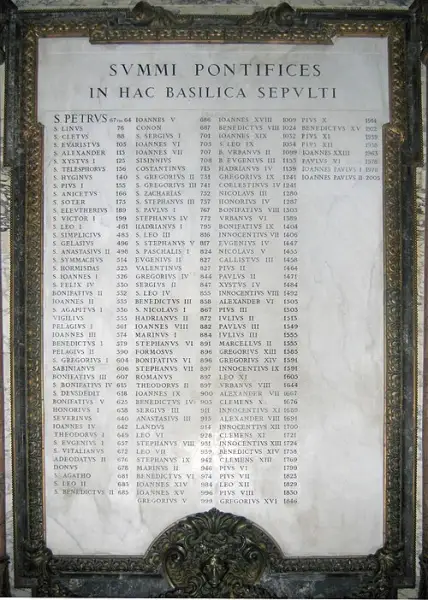
The triumph of 519 closed the Acacian schism but did not end the tensions it had exposed. The East continued to disregard papal demands by declining to condemn the memory of Acacius, and the reunion, solemnly ratified in the cathedral of Constantinople on 28 March 519 before a great throng, rested in practice on the goodwill of a Catholic emperor rather than on universal conviction among the eastern clergy. Hormisdas spent his remaining years consolidating what had been won, his correspondence carrying the Roman faith to bishops as distant as Avitus of Vienne, to whom he reported the good news that still more bishops of the Balkans had opened relations with Rome, and that the archbishop John of Nicopolis in Epirus had severed his communion with Constantinople to resume it with the apostolic see. He also stood secure at home, for when Anastasius's embassy of 516 had tried to turn the Roman Senate against the pope, both the Senate and King Theodoric had remained loyal to him — a rare moment of harmony among pope, senate, and Gothic king. Hormisdas died on 6 August 523, aged seventy-two or seventy-three, and was buried in Old St. Peter's Basilica, joining the long line of popes interred near the apostle's grave, though his tomb perished centuries later during the construction of the new basilica. His successor was John I, whom the new Ostrogothic regime would send on the fateful embassy to Constantinople.
§ Pontificate
Honored Among the Holy Popes
Hormisdas has been venerated as a saint since antiquity, numbered among the early bishops of Rome whose holiness the Church recognized without formal process. His feast is kept on 6 August, the anniversary of his death, recorded in the Patron Saints Index and the older martyrologies alike. He appears in the catalogue of popes who are saints of the Catholic Church, in the company of his predecessors Symmachus and his successors of the early sixth century, and his cult has always been strongest in Rome itself, where he governed and where he was buried beside the Prince of the Apostles in the old Constantinian basilica. The destruction of his tomb during the building of the new St. Peter's deprived the Church of a material memorial, but his true monument was never stone: it was the rite of 28 March 519 in Constantinople's cathedral, when the apostolic see's name the apostolic see was restored to the diptychs of the East and the tear in Christendom's garment, thirty-five years old, was sewn shut. Liturgical commemoration has preserved what archaeology lost, and the annual feast on 6 August keeps before the Church the memory of a pope who proved that firmness of faith and patience in negotiation could serve the same end. His son Silverius, also a saint, stands beside him in the Roman Martyrology.
§ Pontificate
The Pope Who Rejoined the Sees
Hormisdas bequeathed to the papacy two enduring possessions. The first was the formula of Hormisdas itself, the concise profession of Chalcedonian faith and Roman primacy that the East accepted in 519 and that later generations would invoke whenever communion between the sees was renegotiated; its famous assertion that the see of Peter and the see of the imperial city are one became a foundational text in the theology of Roman primacy, debated by theologians ever since. The second was the demonstration, unique in the early sixth century, that the pope could conduct a successful foreign policy of his own — refusing the emperor's invitation to a synod he judged unnecessary, dispatching embassies of bishops and notaries across the Adriatic, withstanding an attempt to divide him from his Senate, and winning every demand without sacrificing a point of doctrine. Richards's judgment that Hormisdas was untainted by the personal hatreds that had prolonged the Laurentian schism points to his deeper legacy: a style of ecclesiastical leadership in which principle never curdled into vendetta. His family line gave the Church a further singularity — his son Silverius would reign as pope a decade after his death, the only son of a pope to follow his father into the see of Peter, albeit by tragic paths. The reunion he achieved lasted, imperfectly, for a generation, a breathing space before the longer estrangements of the seventh century.
§ Pontificate
Timeline
- 450
Born at Frusino in the moribund era of the Western Roman Empire.
§ Family and early career
- 502
Acted as notary for the synod convened at St. Peter's amid the Laurentian schism, as a prominent clerical partisan of Pope Symmachus.
§ Family and early career
- 20 Jul 514
Elected bishop of Rome in succession to Symmachus, an election without notable controversy.
§ Pontificate
- 28 Dec 514
Emperor Anastasius I wrote inviting him to a synod to be held the following July.
§ Pontificate
- 4 Apr 515
Answered the emperor, welcoming peace but defending the position of his predecessors and calling a synod unnecessary.
§ Pontificate
- 1 Jul 515
The two hundred bishops assembled at Heraclea separated without accomplishing anything.
§ Pontificate
- 8 Jul 515
Convened a synod at Rome and announced to the emperor the departure of his embassy to Constantinople.
§ Pontificate
- 16 Jul 516
Received an imperial embassy carrying letters meant to turn the Roman Senate against him; the Senate and King Theodoric stayed loyal.
§ Pontificate
- 11 Jul 517
Anastasius, secure after defeating Vitalian, announced that he was breaking off the negotiations.
§ Pontificate
- 28 Mar 519
Emperor Justin I presided over the solemn ratification of communion between Rome and Constantinople in the imperial capital's cathedral, amid a vast assembly.
§ Pontificate
- 6 Aug 523
Died in Rome at about seventy-two and was buried in Old St. Peter's Basilica, where his tomb was later destroyed.
§ Pontificate
In Their Own Words
I declare that the see of apostle Peter and the see of this imperial city are one.
The Record
- Major works
- The formula of Hormisdas, the profession of faith accepted by the patriarch of Constantinople in 519·Surviving correspondence dominated by the restoration of communion with Constantinople
- Symbols
- Papal vestments
- Canonization
- Pre-congregation; venerated as a saint in the Catholic Church
Prayer
Bibliography
Show 10 sources
- "Saint Hormisdas". Patron Saints Index. Archived from the original on 2010-05-30.
- "Hormisdas, St." in William Darrach Halsey, Collier's Encyclopedia Volume 12, Macmillan Educational Company, 1984, p. 244.
- Kirsch, Johann Peter (1913). "Pope St. Hormisdas". In Herbermann, Charles (ed.). Catholic Encyclopedia. New York: Robert Appleton Company.
- Richards, Jeffrey (1979). The Popes and the Papacy in the Early Middle Ages. London: Routledge and Kegan Paul.
- Hormozod, A. Shapur Shahbazi, Encyclopaedia Iranica (March 23, 2012).
- Moorhead, John. "The Laurentian Schism: East and West in the Roman Church," Church History 47 (1978).
- Davis, Raymond (translator), The Book of Pontiffs (Liber Pontificalis), first edition. Liverpool: University Press, 1989.
- "Hormisdas, bp. of Rome", Dictionary of Christian Biography and Literature to the End of the Sixth Century A.D., edited by Henry Wace. London, 1911.
- Meyendorff, John (1989). Imperial unity and Christian divisions: The Church 450–680 A.D. Crestwood, NY: St. Vladimir's Seminary Press. ISBN 978-0-88-141056-3.
- Reardon, Wendy J. (2004). The Deaths of the Popes. Macfarland & Company, Inc. ISBN 978-0-7864-1527-4.
Profile text adapted from the Wikipedia article, licensed CC BY-SA 4.0.
Pray with this saint every day
Save St. Hormisdas to your favorites, read the full profile, and get feast-day reminders in the Saints app.
Get the Saints AppFree on the App Store for iPhone and iPad