
c. 138 – c. 142·Feast January 11
St. Hyginus
Organizer of the Early Roman Hierarchy
Overview
Hyginus served as bishop of Rome from about 138 until his death around 142, the fourth bishop after the apostles in a line whose early chronology cannot be fixed with exactitude. According to the Liber Pontificalis he was a Greek by birth, a native of Athens in Achaia, and his succession to Pope Telesphorus fell, as Eusebius notes, in the opening year of Emperor Antoninus Pius's rule. Tradition holds that during his papacy he settled what prerogatives belonged to the clergy and marked out the ranks within the ecclesiastical hierarchy — the Liber Pontificalis says that he composed the clergy and distributed the grades, an achievement the chronicler probably understood, in Louis Duchesne's judgment, as referring to the lower orders of the clergy. He instituted the baptismal parents, sponsors entrusted with assisting the baptized through their Christian life, and decreed that all churches be consecrated. His pontificate was troubled from within by gnosticism: the teacher Valentinus came to Rome in his time, and Cerdo, predecessor of Marcion of Sinope, obtained readmission to the Church by recanting before falling back into heresy and being expelled. Martyrdom is attributed to him, yet the ancient record offers no confirmation, and he was buried on the Vatican Hill near the tomb of St. Peter, with his feast kept on 11 January.
The Complete Life
A Greek on the Throne of Peter
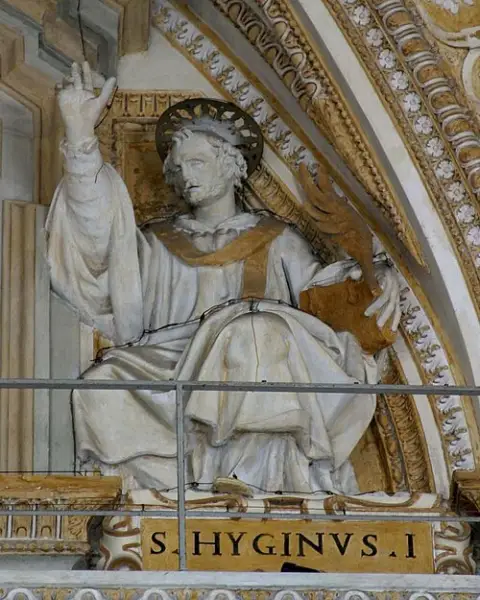
The Liber Pontificalis records that Hyginus was a Greek by birth, and tradition places his origin in Athens, the ancient capital of Achaia, a city that had already given the Church its first great philosophical convert in Paul's Areopagus sermon. Nothing is known of his family, his education, or the road that carried him from the schools of Greece to the Christian community of Rome, though the journey was a well-worn one in the middle of the second century, when Greek-speaking believers from the East were numerous in the imperial capital. What can be said with confidence is the date of his elevation: Eusebius, in the fifteenth chapter of the fourth book of his Church History, has it that Telesphorus's successor Hyginus took office in the opening year of Emperor Antoninus Pius — 138 or 139 — and the same historian, in the sixteenth chapter, fixes the length of his pontificate at about four years. The chronology of the earliest bishops of Rome, the sources themselves admit, cannot be determined today with any degree of exactitude, and Hyginus stands squarely in that twilight: a real bishop of a real community, remembered by name and by a handful of acts, whose features time has otherwise dissolved. His statue nonetheless stands among the pontiffs in St. Peter's Basilica, near the apostle whose tomb he would rest beside.
§ History
Gnostics at the Gates of Rome
The one drama the sources record from Hyginus's pontificate was the arrival in Rome of the gnostic teachers whose speculations would trouble the Church for a generation. Irenaeus relates that Valentinus, the most brilliant of the gnostic minds, came to the city in the time of Hyginus and remained there until Anicetus had become pontiff, planting his school in the very shadow of the apostolic see. With him, or near him, lived Cerdo, another gnostic and the predecessor in error of Marcion of Sinope. Cerdo's story took a different shape: through confession of his errors and recantation he won his way back into the Church's communion, an early testimony to the Roman community's willingness to receive the penitent; in time, however, he lapsed again into heresy and suffered expulsion from the community. Whatever decisions Hyginus himself took in these matters have not survived, but his reign forms part of the long second-century struggle in which the Roman Church learned to distinguish the apostolic faith from the esoteric systems that claimed to complete it — a discernment his successors would carry through to the exclusion of Marcion himself. That the confrontation happened under a Greek pope, facing Greek-speaking teachers in a Latin city, measures how international the Christian community of Rome had already become.
§ History
Order in the Household of God
Tradition credits Hyginus with quiet, structural achievements whose influence long outlasted him. The Liber Pontificalis says of him, in the words Hic clerum composuit et distribuit gradus, that he composed the clergy and distributed the grades: he settled what prerogatives belonged to the clergy and marked out the ranks within the ecclesiastical hierarchy. The chronicler's general observation recurs, curiously, in the biography of Pope Hormisdas four centuries later, and the great editor Louis Duchesne judged that the writer probably had in view the lower orders of the clergy — the ranks of doorkeeper, lector, exorcist, and acolyte through which a Christian ascended toward the diaconate and priesthood. Two further institutions bear his name. He instituted the baptismal parents — the sponsors who stood surety for the baptized and assisted them during their Christian life, an office that bound the community's mature believers to its newest members in an enduring spiritual kinship. And he decreed that all churches be consecrated, giving sacramental form to the distinction between every building and the place set apart for the altar of God. Each act belongs to the same instinct: that the Church, still young and persecuted, required visible order — ordered ministry, ordered initiation, ordered worship space — to carry the faith intact to the generations to come.
§ History
Martyrdom Claimed, Veneration Certain
Hyginus is said to have died a martyr, and the title of martyr stands beside his name in the traditional catalogues; but the ancient sources contain no information verifying a violent death, and sober historians leave the question open. The age itself supplies no difficulty: Antoninus Pius was remembered as a mild emperor, yet the Roman Church he governed lived under the standing menace of the law, and the bishops of that community — Telesphorus before Hyginus had been honored as a martyr — would have needed no extraordinary provocation to suffer. What is certain is the veneration. At his death, around 142, Hyginus was buried on the Vatican Hill, near the tomb of Saint Peter, in the hallowed ground where the earliest popes were laid, a place of honor that itself testifies to the esteem in which the community held him. His feast is celebrated on 11 January in the Roman Catholic Church, and the Eastern Orthodox Church, which numbers him among the holy pontiffs of the undivided early Church, keeps the same date, 11 January, on its calendar. His memory has been kept alive in art as in liturgy: his statue stands in St. Peter's Basilica among the long line of the successors of the apostle beside whose grave he was laid seventeen centuries ago.
§ History
Timeline
- 138
Succeeded Telesphorus as bishop of Rome during the first year of Emperor Antoninus Pius's reign.
§ History
- 142
Died at Rome after a pontificate of about four years and was buried on the Vatican Hill near St. Peter's tomb.
§ History
The Record
- Major works
- Organization of the clergy and definition of the grades of the ecclesiastical hierarchy·Institution of baptismal parents (sponsors) at baptism·Decree that all churches be consecrated
- Symbols
- Papal vestments·Pallium
- Canonization
- Pre-congregation; venerated as a saint in the Catholic and Eastern Orthodox Churches, said to have died a martyr though no records verify it
Prayer
Bibliography
Show 8 sources
- Kirsch, Johann Peter. "Pope St. Hyginus." The Catholic Encyclopedia. Vol. 7. New York: Robert Appleton Company, 1910.
- Butler, Alban. "St. Hyginus, Pope and Martyr", The Lives of the Saints, vol. 1, 1866.
- Irenaeus, On the Detection and Overthrow of the So-Called Gnosis, III, iii.
- Eusebius, Church History, IV, xv; IV, xvi.
- Liber pontificalis (in Latin).
- New Catholic encyclopedia, Volume 7.
- Encyclopaedia Perthensis; Or Universal Dictionary of the Arts, Sciences, Literature, &c., Volume 5.
- The Object, Importance, and Antiquity of the Rite of Consecration of Churches. With Notes and an Appendix.
Profile text adapted from the Wikipedia article, licensed CC BY-SA 4.0.
Pray with this saint every day
Save St. Hyginus to your favorites, read the full profile, and get feast-day reminders in the Saints app.
Get the Saints AppFree on the App Store for iPhone and iPad