
died 417·Feast March 12
St. Innocent I
Bishop of Rome and Arbiter of the Early Church
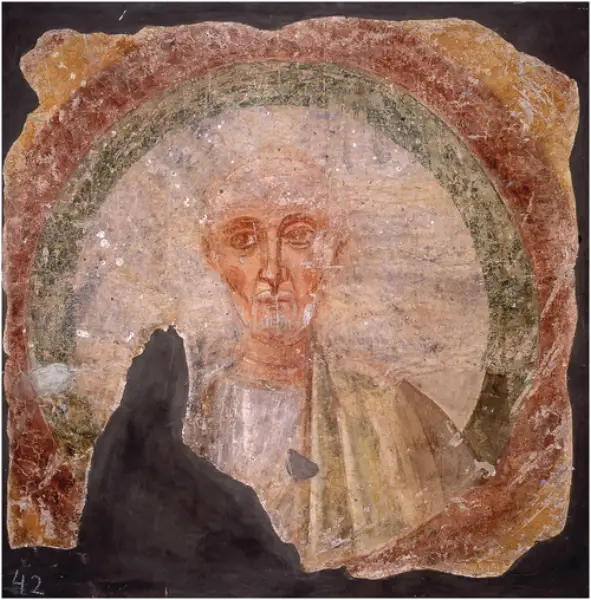
Overview
Innocent I served as bishop of Rome from 22 December 401 until his death on 12 March 417, an era that spanned the sack of Rome and the great doctrinal struggles of the early fifth century. From the outset of his pontificate, churches of East and West alike looked to him for judgment when their quarrels needed an arbiter, and he let no chance slip to uphold the primacy of the Roman See. He issued decretals on disciplinary questions referred to him by bishops such as Victricius of Rouen, corresponded with Exuperius of Toulouse and Alexander of Antioch, and in 405 sent a Gallic bishop a list of the sacred books that matched the canon later defined at Trent. He championed the exiled John Chrysostom against Theophilus of Alexandria and consulted the African bishops on the Pelagian controversy, confirming the condemnations pronounced by their synods at Carthage and Mileve, whose leaders included Augustine. A native of Albano according to the Liber Pontificalis, he died in Rome and was succeeded by Zosimus. In 846 his relics were translated to Gandersheim in Saxony, where most remain, and his memory has been kept on 12 March since the revision of the Roman calendar.
The Complete Life
A Son of Albano
The origins of Innocent are preserved in two slightly conflicting traditions. His biographer in the Liber Pontificalis records that he was a native of Albano, the ancient town in the Alban Hills south of Rome, and that his father was a man named Innocentius. Jerome, writing to the noblewoman Demetrias during Innocent's own lifetime, described him instead as the son of his predecessor on the papal throne, Anastasius I. Modern scholars have suggested that Jerome may have been describing a hierarchical rather than a biological relationship — a spiritual lineage of office rather than blood — since the evidence for an actual filial bond is slender. A later tradition, reported by Urbano Cerri, even claimed that Innocent came from Albania in the Balkans, though this rests on far weaker foundations. What is certain is that he emerged from the ecclesiastical world of Latium at the close of the fourth century, a time when the Roman see was consolidating its authority over the bishops of Italy and the wider Latin West. By 401 he was judged worthy to succeed Anastasius, and he inherited both the prestige and the burdens of an office whose influence was growing even as the empire that housed it grew weaker.
§ Family background
Assuming the See of Peter
Innocent entered upon the bishopric of Rome on 22 December 401, at a moment when the Western Roman Empire stood under mounting pressure and the Church faced disputes that crossed every provincial boundary. From the beginning of his pontificate he was recognized as the general arbitrator of ecclesiastical controversies in both the East and the West, and the supremacy of the Roman apostolic See — the court of last resort — was upheld by him at every opening. His correspondence reveals the breadth of that jurisdiction: he ruled on disciplinary questions raised by Victricius of Rouen, answered the queries of Exuperius of Toulouse, wrote to Alexander of Antioch, and shepherded the bishops of Italia Suburbicaria as their metropolitan, that band of provinces ringing Rome. When John Chrysostom, the exiled patriarch of Constantinople, appealed to him against Theophilus of Alexandria, Innocent took up the persecuted preacher's cause. His letters also reached the Holy Land, including one to John II, bishop of Jerusalem, on behalf of Jerome, who had been harassed by Pelagians at Bethlehem. In an age of collapsing imperial structures, the bishop of Rome became, through Innocent's energy, a working center of judgment and order.
§ Pontificate
Arbiter of Doctrine in a Divided Church
The defining labor of Innocent's pontificate was the Pelagian controversy, the dispute over grace and free will that had convulsed the African churches. Innocent did not hesitate. The rulings of the proconsular African synod that convened at Carthage in 416 received his full endorsement, as did the sentence passed in 411 upon Caelestius, the disciple of Pelagius. That same year brought his letter to the Numidian bishops gathered at Mileve, who had asked for his ruling. Soon afterward five African bishops, among them Augustine himself, sent Innocent a personal letter explaining their position on Pelagianism — a striking acknowledgment that the African church looked to Rome for confirmation of its own rulings. Innocent's intervention mattered far beyond North Africa: by endorsing the African verdicts he wove the distant synods into a single disciplinary framework under Roman approval. The same period saw the city of Rome itself sacked by Alaric in 410, a catastrophe so profound that the historian Zosimus later claimed Innocent had tolerated private pagan worship as a temporary measure, an attempt that failed, he says, because the Romans of his day had already been won permanently to Christianity. Whether or not the story is exact, it testifies to a pontiff governing a traumatized capital.
§ Pontificate
Guardian of the Scriptures and Image of the Church
Innocent's most enduring pastoral act came in 405, when he answered a request from Exuperius of Toulouse by sending the Gallic bishop an authoritative list of the sacred books. The catalogue he transmitted is identical with the canon later defined by the Council of Trent more than a thousand years afterward, apart from a lingering uncertainty in the manuscript tradition over whether the letters ascribed to Paul numbered fourteen or only thirteen — the latter case possibly implying the omission of the Epistle to the Hebrews. The letter stands in the lineage of earlier attempts to fix the canon, such as the thirty-ninth Easter letter of Athanasius of Alexandria, circulated in 367, which had listed the Scriptures of the Old and New Testaments as canonized. Beneath this administrative clarity lay a deeply ecclesial imagination. Innocent pictured the Church as a shelter giving refuge to all comers, a secure harbor standing fast against the waves, a storehouse of boundless riches. The image proved so compelling that Pope Gregory XVI quoted it, more than fourteen centuries later, in his 1833 correspondence with the French cleric Félicité de La Mennais — a quiet testament to how Innocent's vision of a harboring, secure Church continued to speak to later ages.
§ Pontificate
Death in a Wounded City
Innocent closed his pontificate in a Rome that had already known the unthinkable. The sack of 410 by Alaric's Goths had stripped the imperial capital of its aura of invincibility, and the bishop who governed the city in those years carried responsibilities that reached far past its ruined walls. His last recorded interventions belong to the Pelagian crisis: the confirmation of the Carthaginian decrees of 416, the letters to the Numidian bishops, and the correspondence with Augustine's circle, through which the Roman see gave its weight to the African defense of grace. The historian Zosimus preserved a tradition, of doubtful piety but great interest, that during the crisis of 410 Innocent had been prepared to tolerate private pagan worship for a season as an emergency measure, and that the pagans' hope of restoring public worship foundered on the indifference of a city already Christian at heart. Innocent died on 12 March 417 and was laid to rest in Rome, in the Western Empire he had served. His successor was Zosimus. The feast of 12 March, fixed by the modern Roman calendar, recalls the day of his death; from the thirteenth to the twentieth century his commemoration had been kept instead on 28 July.
§ Pontificate
Relics and Remembrance
Innocent's cult outlived the empire he served. In 846, with the blessing of Pope Sergius II, Count Liudolf of Saxony and his wife Oda carried the relics of St. Innocent — along with those of Anastasius, his father and predecessor in the papacy — into the crypt of what had been the collegiate church of Gandersheim — today's Gandersheim Abbey, in Lower Saxony — and most remain there still. Relics of the pope were also brought to the Church of Our Lady St Mary of Glastonbury upon its consecration, binding his memory to one of the great sanctuaries of English Christianity. Scholarly remembrance has kept pace with liturgical honor. Johann Peter Kirsch, the Catholic priest-scholar writing fifteen hundred years after Innocent's death, judged him a man of extraordinary energy and gifts who discharged every duty of his office with distinction — a verdict that captures the judgment of historians on a pontificate spent arbitrating disputes from Gaul to Jerusalem. Modern scholarship continues to examine his family origins, his letters, and his role in the canon of Scripture, and the Catholic Church and the Eastern Orthodox Church both number him among the saints. His name stands in the ancient line of popes who are venerated as saints, bridging the apostolic past and the medieval future.
§ Relics
Timeline
- 22 Dec 401
Innocent began his pontificate as bishop of Rome, succeeding Anastasius I.
§ Pontificate
- 405
Sent Exsuperius of Toulouse a list of the sacred books identical with the later canon of Trent.
§ Pontificate
- 410
Rome was sacked by Alaric I while Innocent held the Roman see.
§ Pontificate
- 416
Reinforced the decisions of the African synod held at Carthage against the Pelagians and wrote to the fathers of Mileve.
§ Pontificate
- 12 Mar 417
Died in Rome after roughly fifteen years as bishop, and was succeeded by Zosimus.
§ Pontificate
- 846
Pope Sergius II approved the translation of his relics, with those of Anastasius, to the church of Gandersheim in Saxony.
§ Relics
In Their Own Words
Where there is protection for all, ... where there is security, where there is a port that resists the waves, where there is a treasure of infinite goods
The Record
- Major works
- Decretal to Victricius of Rouen on disciplinary matters·Letter to Exsuperius of Toulouse listing the canonical books of Scripture (405)·Letters to Jerome and to John II of Jerusalem concerning the Pelagian disturbances at Bethlehem·Rulings confirming the African synods against Pelagianism
- Canonization
- Pre-congregation canonization; venerated as a saint since antiquity by the Catholic and Eastern Orthodox Churches.
Prayer
Bibliography
Show 7 sources
- Kirsch, Johann Peter (1910). "Pope Innocent I". In Herbermann, Charles (ed.). Catholic Encyclopedia. Vol. 8. New York: Robert Appleton Company.
- Dunn, Geoffrey (2007). "Anastasius I and Innocent I: Reconsidering the Evidence of Jerome". Vigiliae Christianae. 61 (1): 30–41.
- Dunn, Geoffrey (March 2013). "Innocent I's Letter to the Bishops of Apulia". Journal of Early Christian Studies. 21 (1). Johns Hopkins University Press: 27–41.
- Cerri, Urbano; Steel, Richard (1715). An Account of the State of the Roman-Catholick Religion Throughout the World. Oxford University.
- Calendarium Romanum. Libreria Editrice Vaticana, 1969, p. 132; Martyrologium Romanum. Libreria Editrice Vaticana, 2001.
- Heilmann, Birgit (2009). Aus Heiltum wird Geschichte. Der Gandersheimer Reliquienschatz in nachreformatorischer Zeit. Regensburg.
- Ramage, Matthew J. (2013). Dark Passages of the Bible. CUA Press.
Profile text adapted from the Wikipedia article, licensed CC BY-SA 4.0.
Pray with this saint every day
Save St. Innocent I to your favorites, read the full profile, and get feast-day reminders in the Saints app.
Get the Saints AppFree on the App Store for iPhone and iPad