
died 526·Feast May 18
St. John I
Pope and Martyr of Ostrogothic Persecution
Overview
John I was bishop of Rome from 13 August 523 until his death on 18 May 526, a pontificate spent under the Arian rule of Theoderic the Great and ended in an Ostrogothic prison. A native of Siena — or, by another tradition, of the Castello di Serena near Chiusdino — he served the Roman church as a deacon for decades before his election, appearing as a signer of the acta of the Roman synods of 499 and 502 and as a partisan of the Antipope Laurentius whose error he publicly confessed to Pope Symmachus in 506. As pope he repaired the cemeteries of the Roman martyrs and presided over a decisive step in the Church's reckoning of time, encouraging the monk Dionysius Exiguus in the work of 525 that standardized the calculation of Easter in the West. His final charge came from the king himself: Theoderic sent the frail pontiff to Constantinople to persuade Emperor Justin I to moderate his persecution of Arians, threatening reprisals against orthodox Christians if the embassy failed. John succeeded, but suspicion followed him home; arrested at Ravenna for allegedly conspiring with Constantinople, he died in prison of neglect and ill-treatment, and his body was carried back to Rome for burial in the Basilica of St. Peter.
The Complete Life
A Deacon of the Roman Church
John came from Tuscany, born at Sena Iulia — the ancient name of Siena — or, in a second tradition, at the Castello di Serena near Chiusdino. He rose in the service of the Roman church through the order of deacons, being created a cardinal in the rank of priest by Pope Gelasius I around 495. His early career unfolded amid the Laurentian schism, the bitter contest for the Roman see that divided the clergy at the turn of the sixth century. John had thrown in his lot with the Antipope Laurentius during that struggle, and the evidence of his own hand survives: in a libellus addressed to Pope Symmachus in 506 he confessed his error in opposing the lawful pope, condemned Peter of Altinum and Laurentius, and begged pardon. Scholars identify him very probably with the Deacon John who signed the acta, the ecclesiastical publications, of the Roman synods of 499 and 502, since the Roman church counted only seven deacons at the time. Some have gone further and seen in him the Deacon John to whom Boethius, the philosopher of the sixth century, dedicated three of his five religious tractates written between 512 and 520 — an identification first proposed in 1928 and defended since.
§ Early life
Election in the Shadow of Theoderic
John was elected bishop of Rome on 13 August 523, succeeding Hormisdas, and he assumed the papacy as an old and very frail man. The Italy he now governed spiritually was the kingdom of the Ostrogoths, ruled by Theoderic the Great, an Arian king who nonetheless generally protected the Catholic Church — until imperial policy in the East shattered that balance. In 523 the Eastern Roman Emperor Justin I issued a decree against the Arians, and Theoderic, himself an Arian, demanded that the pope intervene. Against John's protests, the king ordered him to travel to Constantinople to secure the moderation of the decree, warning that failure would bring punishment down upon the orthodox Christians of the West. The frail pope set out with a considerable entourage, befitting the gravity of the embassy: his fellow bishops Ecclesius of Ravenna, Eusebius of Fanum Fortunae, and Sabinus of Campania accompanied him, together with the Roman senators Flavius Theodorus and Inportunus and the Patrician Agapitus. Never before had a bishop of Rome traveled to Constantinople on such a mission, and never had a pope sailed under so naked a threat from a Christian ruler.
§ Pontificate
Embassy to Constantinople
The embassy reached the Eastern capital and was received with extraordinary honor. Emperor Justin is recorded as welcoming John ceremonially — the sources describe him approaching the pope as if to crown him — and as promising to do everything the embassy asked, with a single reservation: those coming over from Arianism into Orthodoxy were not to be reinstated — that is, they could not keep their old rank as deacons, priests, or bishops within the Orthodox hierarchy. On the substance of his mission John was relatively successful; the persecution of the Arians was moderated, and the orthodox Christians of the West were spared the reprisals Theoderic had threatened. Yet success did him no service. When the pope returned to Ravenna, Theoderic's capital in Italy, the king's suspicion had hardened into fury, fed by the report that the aged pontiff had conspired with Emperor Justin during his stay in Constantinople. John was arrested on that suspicion and cast into prison at Ravenna. The Arian king had obtained from the Catholic pope everything he demanded, and repaid the service with chains — a reversal that contemporary Christians read as martyrdom in everything but formal sentence.
§ Pontificate
Ordering the Church's Time and Honoring Her Dead
Between the burdens of politics, John's pontificate left marks on the liturgy and the landscape of Rome that endured for centuries. His influence proved decisive in fixing how the Western Church would reckon the date of Easter; behind the labors of the monk Dionysius Exiguus stood his sanction, who in 525 produced the new reckoning that replaced the Alexandrian cycle then in use — the same Dionysian tables that would later give the Christian world the Anno Domini era. The pastoral care of the dead likewise claimed his attention. The Liber Pontificalis records his restoration work at the martyr-cemetery of Nereus and Achilleus along the Via Ardeatina, at that of Felix and Adauctus, and at Priscilla's burial ground, the underground burial grounds where the Roman faithful gathered at the tombs of the witnesses to Christ. These acts of restoration, recorded alongside his embassy and his suffering, portray a shepherd who understood the papacy as stewardship in every dimension: the orderly praise of God in time, the dignified rest of the martyrs in the earth, and the defense of Christians threatened by the power of the state, whether that power ruled from Constantinople or from Ravenna.
§ Pontificate
Prisoner of Ravenna
John's imprisonment at Ravenna was short and merciless. An old man whose frailty had been remarked even at his election, he received from his captors neither the care his age demanded nor the dignity his office commanded, and on 18 May 526 he died in confinement of neglect and ill-treatment. The Church numbered him at once among the martyrs, for he had suffered precisely because he was Rome's bishop and Constantinople's guest — suspected of a conspiracy of which the record shows no proof, destroyed by a king whose demands he had in fact satisfied. His remains were carried back from Ravenna to Rome and interred in the Basilica of St. Peter — the pope who had restored the burial places of the martyrs was laid among the confessors of the apostolic see. His successor, Felix IV, inherited a church still living under the Ostrogothic regime whose tensions had claimed his predecessor. Theoderic himself survived John by only a few months, and the story of the pope who died in his chains became one of the fixed narratives of the Ostrogothic papacy, told wherever the memory of Theoderic's last years was recounted.
§ Pontificate
Veneration of the Martyr Pope
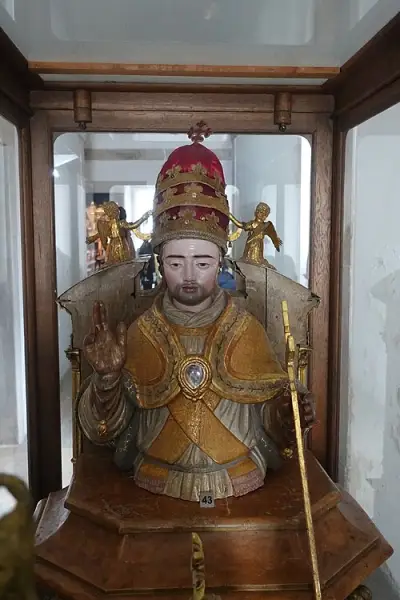
The memory of John I took liturgical form swiftly and has never lapsed. He is honored as a saint and martyr of the Catholic Church, venerated in a special way at Ravenna, the city of his imprisonment, and in Tuscany, the land of his birth. Christian art fixed his image from his suffering: artists show him peering out through prison bars, or confined alongside a deacon and a subdeacon — the companions of his captivity fixed forever in iconography. His feast falls on 18 May, the day he died; an earlier custom had assigned 27 May before the present date prevailed. A celebrated head reliquary of the saint is preserved in the New Cathedral of Coimbra, in Portugal, testimony to how widely his cult traveled from its Italian roots. He stands in the ancient line of popes whom the Church honors as saints, a roster that runs from Peter himself through the bishops of the imperial and barbarian ages, and his case is among the clearest of the early papal martyrs: a pope who shed no blood, yet whom the Church judged to have laid down his life under persecution for the sake of his flock.
§ Veneration
Timeline
- 495
Created a cardinal, in the rank of priest, by Pope Gelasius I.
§ Early life
- 499
Signed the acta of the Roman synod as Deacon John, one of only seven deacons of the Roman church.
§ Early life
- 506
Wrote a libellus to Pope Symmachus confessing his error in supporting the Antipope Laurentius and begging pardon.
§ Early life
- 13 Aug 523
Began his pontificate as bishop of Rome, succeeding Hormisdas.
§ Pontificate
- 525
Promoted the Easter reckoning of the monk Dionysius Exiguus, which standardized the date of Easter in the Western Church.
§ Pontificate
- 18 May 526
Died in prison at Ravenna of neglect and ill-treatment after arrest on suspicion of conspiring with Emperor Justin.
§ Pontificate
The Record
- Major works
- Libellus to Pope Symmachus confessing his error (506)·Repairs to the cemeteries of the martyrs Nereus and Achilleus, Felix and Adauctus, and Priscilla·Sponsorship of Dionysius Exiguus' new Easter computation (525)
- Symbols
- looking through the bars of a prison·imprisoned with a deacon and a subdeacon
- Canonization
- Pre-congregation canonization; venerated as a martyr-saint from antiquity, especially at Ravenna and in Tuscany.
Prayer
Bibliography
Show 5 sources
- Herbermann, Charles, ed. (1913). "Pope St. John I". Catholic Encyclopedia. New York: Robert Appleton Company.
- Moorhead, John (1983). "The Last Years of Theoderic". Historia: Zeitschrift für Alte Geschichte. 32: 113.
- Anonymus Valesianus, 15.90–15.91; translated by J. C. Rolfe, Ammianus Marcellinus. Harvard: Loeb Classical Library, 1972, vol. 3, p. 565.
- Davis, Raymond (translator). The Book of Pontiffs (Liber Pontificalis). First edition. Liverpool: University of Liverpool Press, 1989, pp. 49–50.
- Rand, E. K. (1928), first proposing the identification of Deacon John with the dedicatee of Boethius' theological tractates.
Profile text adapted from the Wikipedia article, licensed CC BY-SA 4.0.
Pray with this saint every day
Save St. John I to your favorites, read the full profile, and get feast-day reminders in the Saints app.
Get the Saints AppFree on the App Store for iPhone and iPad