
1920-2005·Feast October 22
St. John Paul II
Pope
Overview
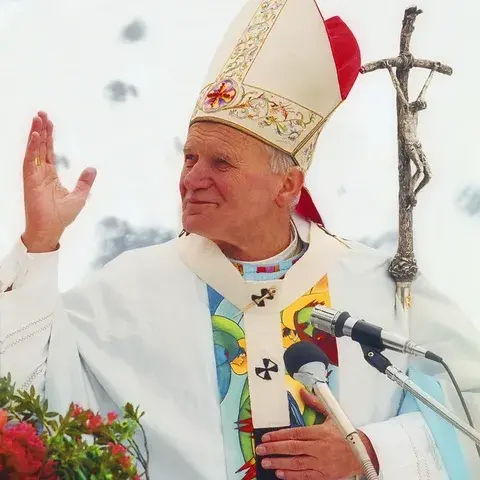
Karol Józef Wojtyła was born in Wadowice in 1920, the youngest of three children; by the age of twenty he had lost his mother, his brother, and his father, later saying that at that age he had already lost all the people he loved. The German occupation closed the Jagiellonian University and put him to work in a quarry and a chemical plant, but in 1942 he knocked on the door of the Archbishop's palace in Kraków and entered the clandestine seminary of Cardinal Sapieha. Ordained on All Saints' Day 1946, he took a doctorate in Rome on the faith of St. John of the Cross, served student parishes, taught ethics, and wrote Love and Responsibility in 1960, becoming auxiliary bishop of Kraków at thirty-eight and archbishop in 1964. He contributed to Vatican II's documents on religious liberty and on the Church in the modern world. Elected pope on 16 October 1978, the first non-Italian in 455 years, he opened with the words 'Be not afraid.' He traveled to 129 countries, convened nine World Youth Days, survived an assassin's bullets in St. Peter's Square on 13 May 1981 and forgave his attacker in prison, and his 1979 homecoming helped ignite Solidarity's nonviolent defeat of Polish communism. Weakened by Parkinson's disease, he died on 2 April 2005, asking to be allowed to depart to the Father's house.
The Complete Life
Early Life
Karol Józef Wojtyła was born on 18 May 1920 at Wadowice in southern Poland, the youngest of three children. His childhood was emptied out early: his mother Emilia died in 1929 when he was eight; his elder brother Edmund, a physician, died of scarlet fever contracted from a patient in 1932; and his father, a retired non-commissioned officer, died in 1941. By twenty he had, as he later said, lost all the people he loved. The Poland of his youth was newly independent, intensely patriotic and Catholic; he grew up an athlete, an actor in amateur theater, and a student of Polish literature at the Jagiellonian University in Kraków. The German occupation of 1939 closed the university and put the young man to work — first as a quarryman, then in the Solvay chemical plant — while he kept underground theater and study alive.
§ Early life
Conversion and Vocation
The decisive turn came in 1942, when Wojtyła knocked at the door of the Archbishop's palace in Kraków and was received into the clandestine seminary that Cardinal Adam Stefan Sapieha was running in defiance of the occupation. He was ordained on All Saints' Day, 1 November 1946, and sent immediately to Rome, where he took a doctorate at the Angelicum with a thesis on the faith of St John of the Cross. Parish work among students, a second doctorate on the ethics of Max Scheler, a chair of ethics at the Catholic University of Lublin, and the pastoral care of young people through hiking, kayaking, and discussion filled the next decade — out of which came his book Love and Responsibility (1960) and the poetic and dramatic work he never entirely abandoned.
§ Priesthood
Mission and Ministry
Consecrated auxiliary bishop of Kraków in 1958 at thirty-eight, he became archbishop in 1964 and cardinal in 1967, and sat in the Second Vatican Council from its first session, contributing to the declaration on religious freedom, Dignitatis humanae, and to the council's pastoral constitution Gaudium et spes. Elected pope on 16 October 1978 — the first non-Italian in 455 years, the first Slav, at fifty-eight — he began with the words that became his program: 'Be not afraid.' His pontificate of nearly twenty-seven years was the most traveled in history: he visited 129 countries, and his pilgrimages were deliberately political instruments. The homecoming of June 1979, before a million Poles in Warsaw's Victory Square, is credited with helping ignite the nonviolent movement that became Solidarity and, in 1989, the collapse of Polish communism. He survived an assassin's bullets in St Peter's Square on 13 May 1981, attributed his survival to Our Lady of Fatima, and later visited Mehmet Ali Ağca in prison to forgive him. He convened nine World Youth Days, made more saints than all his predecessors of the century combined, and issued the great cyclically-read catecheses of his Wednesday audiences on the theology of the body, plus the encyclicals from Redemptor hominis to Ecclesia de Eucharistia.
§ Introduction
Spirituality and Teaching
The constant themes of Wojtyła's teaching were already in his philosophy: the person as a subject who may never be used as a means, the splendor of truth in moral life, work as participation in creation, and the dignity of the human body. As pope these became the defense of life against what he called the culture of death, the insistence on religious freedom, and a Marian devotion expressed in his motto Totus tuus — entirely yours — borrowed from Louis de Montfort. His personal prayer life was famously disciplined: hours before the tabernacle, a discipline of rising early, and a practice of praying the liturgy of the hours even while being driven through crowds. To his interior formation he counted the triple bereavement of his youth, the factory and quarry years, and the Carmelite mystics on whom he wrote his first thesis.
§ Introduction
Trial and Final Years
The last years were a public lesson in suffering. Parkinson's disease progressively disabled him — the trembling hand, the slurred speech, the inability to walk — and he refused to hide it, insisting that the pope must be seen to carry the Cross as any aged person does. He remained in office, delegating more and more, until the final illness of early 2005: he was taken to the Gemelli hospital twice, received a tracheotomy in February, and died in the Vatican on 2 April 2005, having said that he was content and asking to be allowed to depart to the Father's house. The crowd at his funeral — several hundred thousand in St Peter's Square and the streets around, with many more in Kraków and Warsaw — chanted 'Santo subito,' a canonization demand made on the spot.
§ Citations
Canonization
The demand was met at unusual speed. Benedict XVI waived the five-year waiting period for his cause in May 2005; the first miracle — the healing of a French nun, Sister Marie Simon-Pierre, of Parkinson's disease — was recognized in 2011, and Benedict XVI beatified him on 1 May 2011 in the presence of some million people. A second miracle, the healing of a Costa Rican woman with a brain aneurysm on the night of his beatification, was recognized in 2013, and Pope Francis canonized him, together with John XXIII, on 27 April 2014 — Divine Mercy Sunday. His feast is kept on 22 October, the anniversary of the inauguration of his pontificate.
§ Posthumous recognition
Legacy
John Paul II is difficult to summarize because he operated on so many fronts at once. To most of the world his legacy is geopolitical — the pope whose pilgrimages and defense of Solidarity helped end communist rule in Europe without a war. To the Church he is the pope of the new evangelization, of World Youth Day, of the Catechism of the Catholic Church, and of a vast body of teaching on the person; his critics fault the centralization of the last years and his handling of the clerical abuse crisis. In Poland he remains a national figure alongside the poets and the martyrs. His writings — Love and Responsibility, the theology of the body, the encyclicals, the poetry and plays — are the textual monument, and the crowds of 2005 the human one.
§ Introduction
Timeline
- 18 May 1920
Born Karol Józef Wojtyła at Wadowice, youngest of three children
§ Introduction
- 1929
His mother Emilia, a schoolteacher, died of heart and kidney failure
§ Early life
- 1938
Finished school at Wadowice and moved with his father to Kraków, enrolling at the Jagiellonian University
§ Early life
- 1939
Nazi occupation authorities shut the university after invading Poland
§ Early life
- 1941
His father, a retired army officer, died of a heart attack, leaving him alone
§ Early life
- Oct 1942
Presented himself at the bishop's palace to begin training for the priesthood
§ Early life
- 6 Aug 1944
Avoided capture when the Gestapo rounded up young men in Kraków on Black Sunday
§ Early life
- 1 Nov 1946
Ordained a priest by Cardinal Adam Stefan Sapieha
§ Priesthood
- 26 Nov 1946
Began doctoral studies in Rome at the Angelicum under Reginald Garrigou-Lagrange
§ Priesthood
- 19 Jun 1948
Defended his doctoral thesis on faith in John of the Cross
§ Priesthood
- Mar 1949
Transferred to the parish of Saint Florian in Kraków
§ Priesthood
- 1953
Habilitation thesis accepted by the Jagiellonian University's theology faculty
§ Priesthood
- 1954
Received the Doctorate in Sacred Theology with a dissertation on a Catholic ethic grounded in Max Scheler
§ Priesthood
- 4 Jul 1958
Pius XII named him auxiliary bishop of Kraków while he was on a kayaking holiday
§ Episcopate and cardinalate
- 28 Sep 1958
Consecrated a bishop as titular bishop of Ombi, with Archbishop Baziak as principal consecrator
§ Episcopate and cardinalate
- 1960
Published Love and Responsibility, a philosophical defence of the church's teaching on marriage
§ Priesthood
- Oct 1962
Began taking part in the Second Vatican Council, contributing to Dignitatis humanae and Gaudium et spes
§ Participation in Vatican II and subsequent events
- 13 Jan 1964
Appointed Archbishop of Kraków by Pope Paul VI
§ Participation in Vatican II and subsequent events
- 26 Jun 1967
Elevated to the College of Cardinals by Paul VI
§ Participation in Vatican II and subsequent events
- 16 Oct 1978
Elected pope on the conclave's third day, the first non-Italian pontiff in 455 years
§ Election
- 22 Oct 1978
Invested with office in a simplified inauguration instead of a coronation
§ Election
- Jan 1979
Paid his earliest papal visits, to the Dominican Republic and Mexico
§ Pastoral journeys
- Jun 1979
Returned to Poland, where the crowds' response helped ignite Solidarity
§ Pastoral journeys
- Oct 1979
Became the first pope to visit the White House, welcomed by President Carter
§ Pastoral journeys
- 13 May 1981
Shot and gravely wounded by Mehmet Ali Ağca in St Peter's Square
§ Assassination attempts
- 1982
First reigning pontiff to set foot in Britain, received by Queen Elizabeth II
§ Pastoral journeys
- 12 May 1982
Survived a bayonet attack by a would-be assailant at Fátima, Portugal
§ Assassination attempts
- 25 Jan 1983
Promulgated the revised Code of Canon Law for the Latin Church with Sacrae disciplinae leges
§ 1983 Code of Canon Law
- Dec 1983
Visited Ağca in his prison cell two days after Christmas
§ Assassination attempts
- 28 Jun 1988
Issued the apostolic constitution Pastor bonus on Roman Curia reform
§ Pastor bonus
- 18 Oct 1990
Promulgated the Code of Canons of the Eastern Churches through Sacri Canones
§ Code of Canons of the Eastern Churches
- 11 Oct 1992
Ordered publication of the Catechism of the Catholic Church in Fidei depositum
§ Catechism of the Catholic Church
- 15 Jan 1995
Offered Mass at Manila's Luneta Park for five to seven million people, the largest gathering in Christian history
§ Pastoral journeys
- Mar 2000
While visiting Jerusalem, became the first pope to pray at the Western Wall
§ Pastoral journeys
- 6 May 2001
Became the first pope to enter and pray inside a mosque, the Umayyad Mosque in Damascus
§ Pastoral journeys
- 1 Feb 2005
Hospitalised with breathing trouble brought on by influenza
§ Death and funeral
- 2 Apr 2005
Died in the Apostolic Palace after developing septic shock
§ Death and funeral
- 8 Apr 2005
His Requiem Mass drew a record assembly of heads of state
§ Death and funeral
- 19 Dec 2009
Benedict XVI signed the decree proclaiming him Venerable
§ Beatification
- 1 May 2011
Beatified by Benedict XVI on Divine Mercy Sunday after approval of the Marie Simon-Pierre miracle
§ Beatification
- 27 Apr 2014
Canonized by Pope Francis alongside Pope John XXIII
§ Canonization
In Their Own Words
Be not afraid!
I was not at my mother's death, I was not at my brother's death, I was not at my father's death. At twenty, I had already lost all the people I loved.
Freedom consists not in doing what we like, but in having the right to do what we ought.
Pozwólcie mi odejść do domu Ojca
The Record
- Major works
- Love and Responsibility (1960)·Person and Act·Fourteen papal encyclicals, including Redemptor Hominis, Dives in Misericordia, Laborem Exercens, Veritatis Splendor, Evangelium Vitae, Fides et Ratio, and Ut Unum Sint·Theology of the Body (audiences)·Memory and Identity (2005)
- Patron of
- Youth (founder of World Youth Days)·Families
- Symbols
- White cassock and papal ferula·Marian cross with the letter M
- Canonization
- Proclaimed venerable by Pope Benedict XVI on 19 December 2009; beatified on 1 May 2011 (Divine Mercy Sunday); canonized by Pope Francis on 27 April 2014 alongside Pope John XXIII
Prayer
Bibliography
Show 5 sources
- ↑ The luminous mysteries seem to have their origin (although in a slightly different form) in the writings of Saint George Preca
- ↑ Latin : Ioannes Paulus II ; Italian : Giovanni Paolo II ; Polish : Jan Paweł II
- ↑ Polish pronunciation: [ ˈkarɔl ˈjuzɛv‿vɔjˈtɨwa ] ; in isolation, Józef is pronounced [ ˈjuzɛf ] .
- ↑ John Paul II is also the only pope since 1523 to have no documented Italian ancestry, as his successors Benedict XVI , Francis , and Leo XIV all have Italian ancestors, though none have been Italian citizens. [ 7 ] [ 8 ] [ 9 ]
- ↑ In his speech, John Paul deliberately chose to mispronounce the Italian word for 'correct'.
Profile text adapted from the Wikipedia article, licensed CC BY-SA 4.0.
Pray with this saint every day
Save St. John Paul II to your favorites, read the full profile, and get feast-day reminders in the Saints app.
Get the Saints AppFree on the App Store for iPhone and iPad