
1881-1963·Feast October 11
St. Pope John XXIII
Pope
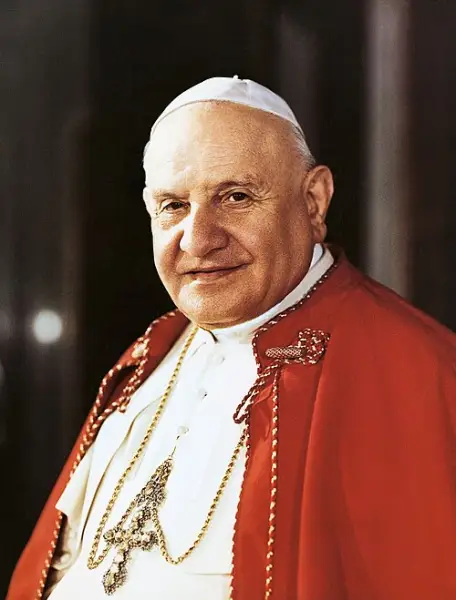
Overview
Angelo Giuseppe Roncalli was born on 25 November 1881 at Sotto il Monte near Bergamo, fourth of thirteen children of sharecroppers who worked vineyard, cornfields and cattle. Ordained a priest on 10 August 1904, he served as secretary to the bishop of Bergamo, carried stretchers as a medical sergeant in the First World War, and then entered the Vatican's diplomatic service. As apostolic visitor in Bulgaria, delegate in Turkey and Greece, he became known as a friend of the East; once the Second World War had begun, his office was placed at the service of the Jewish underground, and he supplied 'immigration certificates' for Palestine together with baptismal documents that carried thousands to safety, work that later earned a Righteous among the Nations petition to Yad Vashem. Named nuncio to France in 1944, cardinal and Patriarch of Venice in 1953, he was elected pope on 28 October 1958 at seventy-six, expected to be a caretaker. Within three months he had announced a council. The Second Vatican Council opened on 11 October 1962 with his Gaudet Mater Ecclesia address; during the Cuban Missile Crisis that same month he offered to mediate between Kennedy and Khrushchev, and his final encyclical Pacem in terris pleaded for peace and human rights. Diagnosed with stomach cancer, he died on 3 June 1963, mourned worldwide as il papa buono, the Good Pope.
The Complete Life
Early Life
Angelo Giuseppe Roncalli was born on 25 November 1881 at Sotto il Monte near Bergamo, in Lombardy, the fourth of thirteen children of sharecroppers who worked vineyard, cornfields and cattle. It was a large, poor, deeply religious household of the northern Italian peasantry — the social origin almost never represented in the papacy, and never forgotten in it. He was ordained a priest on 10 August 1904 and served as secretary to the bishop of Bergamo, the first rung of a church career that would be spent almost entirely away from Rome.
§ Introduction
Diplomat and Pastor
Roncalli's middle years belong to the Vatican's diplomatic service and to war. He carried stretchers as a medical sergeant in the First World War, then served as apostolic visitor in Bulgaria and delegate in Turkey and Greece, where he became known as a friend of the East and its churches. When the Second World War came, Istanbul became his posting, and from that city he lent the Jewish underground the help of his office, providing immigration certificates for Palestine along with baptismal documents that carried thousands to safety — work that later supported a Righteous among the Nations petition to Yad Vashem. Named nuncio to France in 1944, he managed the delicate politics of the postwar episcopate; in 1953 he was made cardinal and Patriarch of Venice, at last a pastor with a diocese of his own.
§ External links
Election and the Council
Elected pope on 28 October 1958 at seventy-six, taking the name John XXIII, Roncalli was expected to be a caretaker. Within three months he had announced a council. The Second Vatican Council, the first in nearly a century, opened on 11 October 1962 with his Gaudet Mater Ecclesia address, in which he rejected the prophets of doom and proposed that the Church use the medicine of mercy rather than severity. In the same month, during the Cuban Missile Crisis, he offered publicly to mediate between Kennedy and Khrushchev — a gesture historians count among the pressures that pulled the crisis back from the edge. His major writings include the encyclicals Mater et Magistra and, at the end of his life, Pacem in terris, the first encyclical addressed to all people of good will, pleading for peace and grounding human rights in the dignity of the person.
§ Introduction
Spirituality and Teaching
The inner register of John XXIII is preserved in his Journal of a Soul, the spiritual diary kept from seminary days to the papacy, which shows a man of simple, disciplined piety — daily mental prayer, devotion to his saints, the habit of self-examination without morbidity — under a manner of cheerful openness to persons and events. His governing idea was pastoral rather than curial: the Church's teaching was a deposit to be presented afresh, not a fortress to be defended with anathemas. The 'aggiornamento' he named — updating — was less a program than an attitude of trust in the world's honest questions.
§ Legacy
Trial and Final Years
John XXIII did not live to see the Council he called. Diagnosed with stomach cancer in 1963, he bore his illness publicly and with serenity, and the daily bulletins of his last weeks were followed worldwide. He died on 3 June 1963, mourned as il papa buono, the Good Pope — a title no other modern pope has carried so naturally. The Council continued under Paul VI and concluded in 1965.
§ Introduction
Canonization
His cause moved quickly by modern standards: he was beatified by John Paul II on 3 September 2000, and canonized by Pope Francis on 27 April 2014 alongside John Paul II, in the ceremony that paired the two popes of the Council's beginning and its long aftermath. His feast is kept on 11 October, the anniversary of the Council's opening.
§ Introduction
Legacy
John XXIII changed the Church's relation to the modern world more decisively than any pope of the twentieth century, and he did it in four and a half years, mostly by convening a council and setting its tone. Vatican II's documents on revelation, liturgy, religious freedom and the Church in the modern world descend from his decision; his Pacem in terris remains a reference point of Catholic social teaching on peace. For the popular imagination he is the peasant pope of the balcony jokes and the transparent goodness — and among historians, the diplomat who spent a lifetime being underestimated.
§ Introduction
Timeline
- 25 Nov 1881
Born Angelo Giuseppe Roncalli at Sotto il Monte in the province of Bergamo
§ Introduction
- 1889
Made his First Communion and Confirmation when he was eight
§ Early life
- 1 Mar 1896
Was enrolled in the Secular Franciscan Order by Luigi Isacchi
§ Early life
- 23 May 1897
Professed his vows as a Secular Franciscan
§ Early life
- 10 Aug 1904
Ordained a priest in the church of Santa Maria in Montesanto in Rome
§ Introduction
- 1905
Became secretary to Giacomo Radini-Tedeschi, the new Bishop of Bergamo
§ Priesthood
- 1915
Conscripted into the Royal Italian Army as a sergeant, serving as stretcher-bearer and chaplain
§ Priesthood
- 1919
Left the army with an honourable discharge and became spiritual director of the seminary
§ Priesthood
- 7 May 1921
Appointed a Domestic Prelate of His Holiness, taking the title Monsignor
§ Priesthood
- 19 Mar 1925
Consecrated a bishop by Giovanni Tacci Porcelli at San Carlo al Corso in Rome
§ Episcopate
- 30 Nov 1934
Appointed delegate for Turkey and Greece, with the titular see of Mesembria
§ Episcopate
- 22 Dec 1944
Pius XII chose him as Apostolic Nuncio to newly liberated France
§ Introduction
- 12 Jan 1953
Created Cardinal-Priest of Santa Prisca and appointed Patriarch of Venice by Pius XII
§ Introduction
- 28 Oct 1958
Elected pope at seventy-six, taking the name John
§ Introduction
- 4 Nov 1958
Crowned in the central loggia of the Vatican with the 1877 Palatine Tiara
§ Papal election
- 25 Dec 1958
First pontiff since 1870 to go on pastoral rounds inside the Rome diocese
§ Visits around Rome
- 25 Jan 1959
Surprised the church by announcing an ecumenical council at the Basilica of Saint Paul Outside the Walls
§ Calling the Council
- 23 Sep 1962
Diagnosed with stomach cancer
§ Final months and death
- 4 Oct 1962
Prayed at Assisi and Loreto on the feast of St Francis, ahead of the council's opening
§ Calling the Council
- 11 Oct 1962
Opened the first session of the Second Vatican Council in St Peter's
§ Vatican II: The first session
- 8 Dec 1962
Closed the council's first session with a solemn ceremony
§ Vatican II: The first session
- 1963
Signed the encyclical Pacem in terris on universal peace and human rights
§ Human rights
- 3 Jun 1963
Died of peritonitis from a perforated stomach at 19:49, aged eighty-one
§ Final months and death
- 18 Nov 1965
Paul VI opened his canonization cause during the council's final session, declaring him a Servant of God
§ Canonization
- 3 Sep 2000
Beatified by Pope John Paul II in St Peter's Square
§ Canonization
- 27 Apr 2014
Canonized by Pope Francis alongside Pope John Paul II
§ Canonization
In Their Own Words
I will be called John. A name sweet to me because it is the name of my father, dear to me because it is the name of the humble parish church where I received baptism.
We were all made in God's image, and thus, we are all Godly alike.
Man has the right to live. He has the right to bodily integrity and to the means necessary for the proper development of life.
From the saints I must take the substance, not the accidents of their virtues.
If St. Aloysius had been as I am, he would have become holy in a different way.
We are not on earth as museum keepers, but to cultivate a flourishing garden of life and to prepare a glorious future.
[Peace must be] founded on truth, built according to justice, vivified and integrated by charity, and put into practice in freedom.
The Record
- Major works
- Pacem in terris (encyclical, 1963)·Gaudet Mater Ecclesia (opening address of Vatican II, 1962)
- Patron of
- Christian unity and ecumenism·The Second Vatican Council
- Symbols
- White papal cassock and zucchetto·Crozier and the Gospel book·Round spectacles and warm smile of 'the Good Pope'
- Canonization
- Beatified 3 September 2000 by Pope John Paul II; canonized 27 April 2014 by Pope Francis alongside Pope John Paul II
Prayer
Bibliography
Show 6 sources
- ↑ Latin : Ioannes XXIII ; Italian : Giovanni XXIII ; in his native Bergamasque dialect : Gioàn XXIII [ dʒoˈaɱ ˌʋintɛˈtri, - ˌʋen- ] .
- ↑ Italian: [ ˈandʒelo dʒuˈzɛppe roŋˈkalli ] ; Bergamasque: Àngel Giózep Roncàli [ ˈandʒɛl ˈdʒozɛp roŋˈkali ] .
- ↑ William Doino is one of the commentators who claim that Roncalli was papabile and argue that "[b]y the time of Pius XII’s death, in 1958, Cardinal Roncalli 'contrary to the idea he came out of nowhere to become pope' was actually one of t
- ↑ At the 1958 conclave, the two Eastern Catholic cardinal-electors were Gregorio Pietro Agagianian , Patriarch of Cilicia of the Armenian Catholic Church and Ignatius Gabriel I Tappouni , Patriarch of Antioch of the Syriac Catholic Church
- ↑ At the 1958 conclave, Nicola Canali the Cardinal protodeacon was only an ordained priest and Alfredo Ottaviani , the Cardinal-Deacon of Santa Maria in Domnica had not yet been consecrated as a bishop.
- ↑ '...that all may be one.'
Profile text adapted from the Wikipedia article, licensed CC BY-SA 4.0.
Pray with this saint every day
Save St. Pope John XXIII to your favorites, read the full profile, and get feast-day reminders in the Saints app.
Get the Saints AppFree on the App Store for iPhone and iPad