
c. 280 – 352·Feast April 12
St. Julius I
Defender of Athanasius and champion of Roman primacy
Overview
Julius was a native of Rome who served as bishop of the city from 6 February 337 until his death on 12 April 352, succeeding Mark after an interlude of four months in which the Roman see stood vacant. His pontificate was dominated by the Arian controversy that convulsed the church after the Council of Nicaea. When the followers of Eusebius of Nicomedia renewed the deposition of Athanasius of Alexandria at a synod in Antioch in 341, the case came to Julius, who judged in favor of the deposed patriarch and invited both sides to submit the matter to a synod under his presidency — an invitation the Arian Eastern bishops refused. When Athanasius fled to Rome, Julius received him, and a Roman synod in 342 recognized him as a lawful bishop; the letter Julius then addressed to the Eastern bishops ranks among the earliest documents asserting the primacy of the Roman see. At his urging, the council of Sardica was later convened, where the Western bishops confirmed his rulings and granted rights of revision that strengthened the Roman see. Tradition further credits him with fixing the date of December 25 for the feast of Christmas, a claim resting on a spurious letter. He built several basilicas and churches, died at Rome, and was succeeded by Liberius.
The Complete Life
A Roman Raised to the Apostolic See
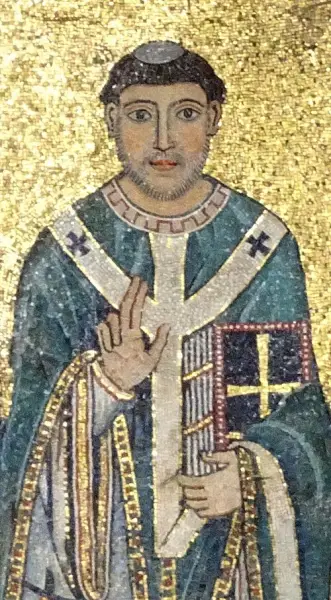
Julius was born at Rome around the year 280, into the city that would be the scene of his whole life's work. By the time he reached manhood the church there had emerged from the great persecutions into the era of Constantine, and a Roman deacon or priest of that generation witnessed the transformation of a hunted community into an imperial favorite. When Pope Mark died, the Roman see stood vacant for four months, an unusual interval, before Julius was chosen as his successor; he entered upon the office on 6 February 337, in the last months of Constantine's reign. He inherited at once both the dignity and the burden of a position that the council of Nicaea had recently elevated in the church's ordering, for the bishop of Rome was now acknowledged among the great sees of the empire while the theological settlement of Nicaea was already beginning to unravel in the East. Julius proved to be a builder as well as a governor: during his pontificate he raised several basilicas and churches in the city, adding to the fabric of Christian Rome, and a twelfth-century apse mosaic in the church of Santa Maria in Trastevere preserves his likeness for later generations.
§ Pontificate
The Arian Controversy and the Case of Athanasius
The theater of Julius's chief work was the Arian controversy. In 341 a synod at Antioch, dominated by the party of Eusebius of Nicomedia — by then patriarch of Constantinople — repeated its deposition of Athanasius of Alexandria and dispatched envoys both to Constans, emperor of the West, and to Julius, to set out the reasons for what it had done. Julius declared his judgment favorable to Athanasius and then shrewdly invited both parties to submit the whole case to a synod over which he himself would preside. The Arian Eastern bishops refused the proposal outright. In the meantime Athanasius, driven from his see a second time, came to Rome, and the synod that Julius presided over in 342 recognized him as a bishop in good standing. To the Eastern bishops Julius then sent a letter that is among the earliest documents asserting the primacy of the Roman see: even allowing that Athanasius and those with him had some fault to answer for, the Alexandrian church ought first to have written to the pope, so that justice might be defined from Rome. The Easterners, meeting in council at Sardica in Illyria through Julius's influence, withdrew instead to Philippopolis and there deposed Julius himself, together with Athanasius and their other adversaries; the three hundred Western bishops who stayed on ratified the rulings of the Roman synod and issued disciplinary canons, several of which strengthened the rights of revision claimed by the Roman see.
§ Arianism
The Date of Christmas
Julius's name has been attached for centuries to one of the most familiar facts of the Christian calendar: the fixing of Christmas on 25 December. According to accounts repeated since the Middle Ages, around the year 350 he fixed that day as the official feast of Christ's nativity, answering an inquiry said to have come from Cyril of Jerusalem, who sought the date recorded in Roman archives. Modern scholarship has dismantled the story: the letter on which it rests is quoted only in a ninth-century source and is spurious, and the claim that Cyril requested the information is likewise false. Yet the association is not wholly groundless, for 25 December was already one of the commonly held dates for Christ's birth when Julius reigned — Hippolytus of Rome had used it in his Commentary on Daniel around the year 200 — and various explanations have been offered for the choice of the day: a Christian counter-feast to the Roman Saturnalia, which ended two days before; a challenge to the feast of Sol Invictus, said to have been established on 25 December by Aurelian in 274; or a reckoning from the belief that Jesus died on the anniversary of his conception, which in the third century was kept on 25 March, nine months before the December date. The actual date of the Nativity remains unknown, but the legend of Julius's decree shows how his pontificate became woven into the church's memory of its own feasts.
§ Christmas
Death at Rome and the Succession of Liberius
Julius died at Rome on 12 April 352, after fifteen years as bishop of the city, and the succession passed without disturbance to Liberius. He had lived to see the controversy that defined his pontificate outlast him: the Arian dispute would consume the church for generations more, and the conciliar politics of East and West that he had navigated would grow only more bitter under his successor. But the precedents he set did not die with him. The claim he had staked — that cases touching the great sees should come first to Rome for judgment — passed from his letter into the conciliar legislation of Sardica, whose canons gave practical form to the rights of revision the Roman bishops would claim in the centuries ahead. The church of Rome buried him within the city he had adorned with new basilicas, and his memory settled into its calendar: his feast is kept on 12 April, the day of his death. He is venerated as a saint not only by the Catholic Church but by the Eastern Orthodox and Oriental Orthodox Churches as well, a rare breadth of commemoration for a pope whose chief battles had been fought against Eastern bishops, and a measure of the respect his defense of Athanasius earned even among the churches of Alexandria.
§ Death and veneration
A Saint of the Undivided Church
Julius ranks among the popes whom the church honored as saints before any formal machinery of canonization existed, his cult arising from the testimony of his life and the judgment of the communities he served. The Catholic Church keeps his feast on 12 April; the Eastern Orthodox and Oriental Orthodox Churches likewise number him among the saints, and the Coptic tradition that claims Athanasius as its own great father has never forgotten the Roman bishop who sheltered him. In Christian art he survives in the apse mosaic of Santa Maria in Trastevere, a work of about the twelfth century that depicts him as bishop of Rome, so that pilgrims who enter that basilica still meet the face that Roman Christians gave him centuries after his death. His shrine is honored at the Basilica of Saint Praxedes in Rome. The grounds of his sanctity were never miracles recounted at a tomb but the character of his governance: a bishop who refused to let a deposition stand unjust, who insisted on hearing the accused before condemning him, and who spent the authority of his see on behalf of a persecuted patriarch rather than against him. In that record the churches of East and West alike have recognized the faithfulness of a chief shepherd.
§ Death and veneration
Timeline
- 280
Born at Rome.
§ Introduction
- 6 Feb 337
Chosen bishop of Rome in succession to Pope Mark, after the see had stood vacant for four months.
§ Pontificate
- 341
Followers of Eusebius of Nicomedia renewed the deposition of Athanasius at a synod in Antioch and sent delegates to set their case before Julius.
§ Arianism
- 342
Presided over a Roman synod that recognized the exiled Athanasius as a lawful bishop, and sent the Eastern bishops a letter asserting the primacy of the Roman see.
§ Arianism
- 350
By later, spurious report he was said to have declared 25 December the official date of Christ's birth.
§ Christmas
- 12 Apr 352
Died at Rome and was succeeded by Liberius.
§ Death and veneration
In Their Own Words
Can you be ignorant that this is the custom, that we should be written to first, so that from here what is just may be defined
The Record
- Major works
- Epistle of Julius to the Eastern (Antiochene) bishops·Several basilicas and churches built in Rome
- Symbols
- Papal vestments·Twelfth-century apse mosaic in Santa Maria in Trastevere
- Canonization
- Pre-congregation; venerated as a saint by the Catholic, Eastern Orthodox, and Oriental Orthodox Churches
Prayer
Bibliography
Show 7 sources
- "Saint Julius I". Encyclopædia Britannica (Online ed.). Chicago: Encyclopædia Britannica, Inc. ISSN 1085-9721. OCLC 33663660. Retrieved 2026-06-25.
- Kirsch, Johann Peter. "Pope St. Julius I." The Catholic Encyclopedia Vol. 8. New York: Robert Appleton Company, 1910.
- The Ecclesiastical History of Socrates, Surnamed Scholasticus, or The Advocate. Comprising a History of the Church, in Seven Books, from the Accession of Constantine, A.D. 305 to the 38th Year of Theodosius II. Book II, Chapter 23. London: Henry G. Bohn, York Street, Covent Garden, 1853.
- Butler, Alban. "Saint Julius, Pope and Confessor". Lives of the Fathers, Martyrs, and Principal Saints, 1866. CatholicSaints.Info. 15 April 2013.
- Crump, William D. (2013). The Christmas encyclopedia (3rd ed.). Jefferson, North Carolina: McFarland & Company, Inc., Publishers. p. 96. ISBN 9781476605739. OCLC 858762699.
- Martindale, Cyril (1908). "Christmas". The Catholic Encyclopedia. New York: Robert Appleton Company.
- Duffy, Eamon. Saints and Sinners: A History of the Popes, Yale University Press, 2001, pp. 30–32. ISBN 0-300-09165-6.
Profile text adapted from the Wikipedia article, licensed CC BY-SA 4.0.
Pray with this saint every day
Save St. Julius I to your favorites, read the full profile, and get feast-day reminders in the Saints app.
Get the Saints AppFree on the App Store for iPhone and iPad