
c. 391-461·Feast November 10
St. Pope Leo I (Leo the Great)
Pope and Doctor of the Church
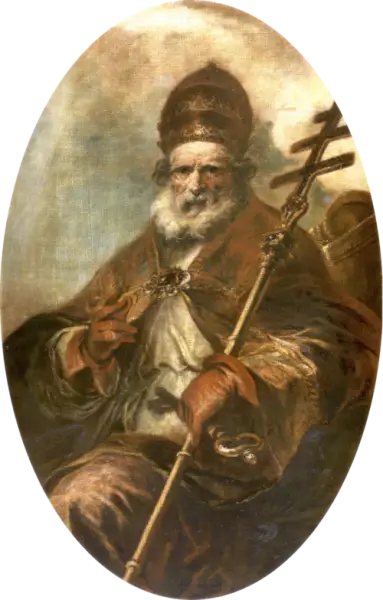
Overview
Leo, a Roman aristocrat said by the Liber Pontificalis to be a native of Tuscany, was already a deacon of wide reputation by 431, when John Cassian dedicated a treatise to him. While he was away in Gaul settling a dispute for Emperor Valentinian III, Pope Sixtus III died, and on 29 September 440 Leo was unanimously elected Bishop of Rome. Over twenty-one years he built the medieval understanding of papal authority on the succession of Peter's see, obtained from Valentinian in 445 a decree recognizing the primacy of the bishop of Rome, and energetized charity in a Rome stricken by famine and refugees. His Tome to Flavian of Constantinople, rejected at the rigged council of 449, was acclaimed at the Council of Chalcedon in 451, which confessed the union without confusion of Christ's divine and human natures. In 452 he led the embassy that met Attila near Lake Garda and turned the Hun back from Italy; three years later his intercession could not stop the Vandal sack of Rome, but it spared the city's burning and the great basilicas sheltering its people. He died on 10 November 461 and was the first pope buried within St Peter's.
The Complete Life
Early Life
Leo was born around 391, a Roman of the aristocratic and administrative class; the Liber Pontificalis makes him a native of Tuscany, and Etruria rather than Rome itself is the usual reading of the evidence. Nothing certain is known of his family or early career, but his formation was the standard one of the late Roman educated elite — law and rhetoric, the tools of administration — and by 431 he was an archdeacon of the Roman church of such reputation that John Cassian dedicated to him his treatise against Nestorius, and such standing that he was trusted with imperial business. His Letters, the largest corpus to survive from any ancient pope, show a mind formed in the Latin rhetorical tradition and a prose that made that tradition serve doctrine: lucid, balanced, and unhesitating.
§ Early life
Vocation
The moment of Leo's calling was as dramatic as the papacy has known. While he was away in Gaul, on a mission to settle a dispute between the imperial generals Aetius and Albinus for Emperor Valentinian III, Pope Sixtus III died at Rome; and on 29 September 440 Leo was elected bishop of Rome — unanimously, in his absence, while absent on the emperor's service. He was consecrated and took possession in circumstances that suited his whole program: a bishop chosen in the exercise of public trust, in the year that would see the Theodosian Code's final promulgation, for a see he would spend twenty-one years teaching the Church and the emperors to understand.
§ Early life
Mission and Ministry
Leo's pontificate (440-461) built the medieval papacy. In his letters and sermons — ninety-six of the latter survive, on the liturgical year as he largely fixed it — he articulated the doctrine of the Petrine succession: that Peter lives on in his successors, and that the bishop of Rome's authority is Peter's, exercised in the whole Church. He enforced this in practice — deposing a bishop of Illyricum who had appealed over his head, converting the Illyrian churches to vicariate status, and correspondingly managing relations with Constantinople, whose see's ambitions he respected and contained. In 445 he obtained from Valentinian III an imperial decree recognizing the primacy of the bishop of Rome and compelling attendance at Roman appeals — the legal foundation of papal jurisdiction in the West. And his was a real pastoral government: in a Rome stricken by famine and swollen with refugees, he reorganized the charities, insisted on the care of the poor as the bishop's personal charge, and repaired the city's liturgical and practical life.
§ Various regional matters
Spirituality and Teaching
Leo's doctrinal monument is the Tome to Flavian, written in 449 to the patriarch of Constantinople on the two natures of Christ. Against the monophysite position of Eutyches — that Christ's humanity was absorbed into his divinity — Leo argued, in a letter that is also a sermon, that the two natures subsist in one person without confusion or change: each nature doing what is proper to it, in communion with the other, so that the Word's majesty and the flesh's weakness are both truly Christ's. The letter was read out at the robber council of 449 and ignored; at Chalcedon in 451 it was read again, and the council fathers acclaimed that Peter had spoken through Leo. It remains, with the Chalcedonian definition it shaped, the standing confession of the Greek as well as the Latin Church — the one doctrinal text of the Latin West that the East formally received.
§ Tome
Trial and Final Years
The final years were the years of the empire's undoing, in which Leo's public role became legendary. In 452, with the imperial government unable to act, he led the embassy — with the senators Gennadius Avienus and Trigetius — that met Attila on the Mincio near Mantua and persuaded the Hun to withdraw from Italy; the contemporaries offered explanations (a tribute, a superstition about Leo's person, the state of Attila's army), and Leo himself said only that the embassy was granted because of his faith. In 455 the Vandal Genseric came; Leo met him at the gates and could not prevent the sack of fourteen days, but by his intercession the city was not burned, and the basilicas — where the population had taken refuge, with the pope moving among them — were spared. He died on 10 November 461, and was the first pope buried within St Peter's.
§ Leo and Attila
Canonization
Leo belongs to the ancient cult, pre-congregation: venerated as a saint within a generation of his death, and among the first popes so honored for teaching rather than martyrdom. Benedict XIV counted him among the Doctors of the Church, with the title Doctor unitatis caritatisque — the church's earliest doctor, its earliest Latin theological mind of the first rank. His feast in the Roman calendar was long kept on 11 April and, after the reform, on 10 November, the day of his death.
§ Introduction
Legacy
Leo is one of the three popes called 'the Great' — with Gregory I and Nicholas I — and the reason is visible in every subsequent claim of the papacy: the doctrinal and jurisdictional architecture he built in twenty-one years carried the see of Rome from one honor among patriarchates into the center of Western Christianity. Chalcedon's definition, which he authored in substance, remains the confessed faith of Catholic, Orthodox, and the greater part of Protestantism alike. And the two embassies — Attila turned back, Genseric's fires contained — fixed in the Western imagination the figure of the pope as the city's and civilization's last defender, an image that outlived the empire it was drawn against by fifteen centuries.
§ Introduction
Timeline
- 391
Born around this year, a Tuscan by origin according to the Liber Pontificalis
§ Introduction
- 431
Already a deacon of wide renown; John Cassian dedicates to him his treatise against Nestorius
§ Early life
- 11 Aug 440
Pope Sixtus III dies at Rome while Leo is away in Gaul on an imperial commission
§ Papacy
- 29 Sep 440
Chosen unanimously by the people to succeed Sixtus III as Bishop of Rome
§ Papacy
- 443
In late 443 he preaches against the Manichaeans hiding in Rome, leading to their exposure
§ Papacy
- 6 Jun 445
Obtains from Valentinian III a decree upholding the primacy of the bishop of Rome
§ Various regional matters
- 21 Jul 447
Writes an extended treatise against the Priscillianist sect spreading in Spain
§ Papacy
- 449
His Tome, delivered to the Second Council of Ephesus, is neither read nor heeded there
§ Tome
- 451
The Council of Chalcedon accepts his Tome, acclaiming that Peter has spoken through Leo
§ Council of Chalcedon
- 452
Meets Attila the Hun as an imperial envoy near Lake Garda; the invaders turn back from Italy
§ Leo and Attila
- 455
Pleads with the Vandal Genseric during the sack of Rome, sparing the city from burning and saving the basilicas
§ Leo and Attila
- 10 Nov 461
Dies at Rome aged about seventy and is entombed near the apostle's shrine, the first pope so buried
§ Death and burial
- 688
Pope Sergius I transfers his remains into the south transept of Saint Peter's
§ Death and burial
- 1754
Proclaimed a Doctor of the Church by Pope Benedict XIV
§ Significance
In Their Own Words
The care of the universal Church should converge towards Peter's one seat, and nothing anywhere should be separated from its Head.
[The dignity of Peter the Apostle] does not fail in the person of an unworthy heir.
Christian, acknowledge thy dignity, and becoming a partner in the Divine nature, refuse to return to the old baseness by degenerate conduct.
The Record
- Major works
- The Tome of Leo (letter to Flavian of Constantinople, 449)·Sermones (nearly one hundred surviving sermons)·Some 150 surviving letters
- Symbols
- Papal vestments·The Tome presented at Chalcedon·Meeting Attila outside Rome
- Canonization
- Pre-congregation (ancient cult); declared a Doctor of the Church with the title Doctor unitatis Ecclesiae ('Doctor of the Church's Unity')
Prayer
Bibliography
Show 12 sources
- ↑ Neil 2009 , p. 50.
- ↑ "Martyrologium Romanum - November" . www.liturgialatina.org . Retrieved 2021-04-10 .
- ↑ Kaiser, Denis (2015-08-01). "Leo the Great on the Supremacy of the Bishop of Rome" . Andrews University Seminary Student Journal . 1 (2). ISSN 2376-063X .
- ↑ Annuario Pontificio . Holy See.
- 1 2 3 "St. Leo the Great, Pope" . Collection at Bartleby.com . January 12, 2023.
- 1 2 3 4 5 Kirsch, Johann Peter (1910). "Pope St. Leo I (the Great)" . In Herbermann, Charles (ed.). Catholic Encyclopedia . Vol. 9. New York: Robert Appleton Company.
- ↑ Cohen 2020 , p. 156.
- ↑ Cohen 2020 , p. 139.
- ↑ Cohen 2020 , p. 152.
- ↑ Cohen 2020 , p. 153.
- ↑ Cohen 2020 , p. 140.
- 1 2 "Saint Leo the Great | EWTN" . EWTN Global Catholic Television Network .
Profile text adapted from the Wikipedia article, licensed CC BY-SA 4.0.
Pray with this saint every day
Save St. Pope Leo I (Leo the Great) to your favorites, read the full profile, and get feast-day reminders in the Saints app.
Get the Saints AppFree on the App Store for iPhone and iPad