
c. 750 – 816·Feast June 12
St. Leo III
The pope who crowned Charlemagne emperor of the Romans
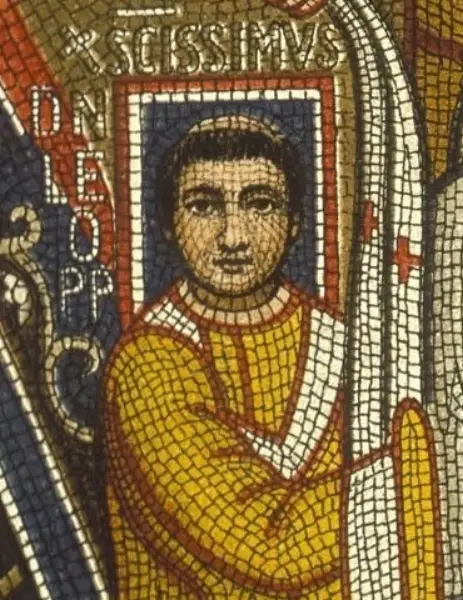
Overview
Leo III was bishop of Rome and ruler of the Papal States from 26 December 795 until his death on 12 June 816, a pontificate of more than twenty years that altered the shape of European history. A Roman by birth, son of Atzuppius and Elizabeth and usually thought to be of Greek origin, he had served Pope Adrian I as cardinal-priest of Santa Susanna and as vestiarius, chief of the pontifical wardrobe and treasury, before being elected on the very day Adrian was buried. When the relatives of his predecessor plotted against him and left him maimed in the streets of Rome on 25 April 799, he was rescued by Charlemagne's envoys, sheltered in Spoleto, and received with honor at the Frankish court in Paderborn. After clearing himself of his enemies' charges by an oath of purgation in December 800, he crowned Charlemagne emperor on Christmas Day of that year, reviving the imperial office in the West and binding the Frankish monarchy to the protection of the Holy See. Constantinople resented the coronation but could do nothing about it. Leo restored a Northumbrian king, settled English disputes, reversed Adrian's grant of the pallium to Lichfield, upheld the Filioque while refusing to alter the creed, and hung silver shields bearing the creed in Greek and Latin above the entrance of St Peter's. Canonized by Clement X, he is commemorated on 12 June.
The Complete Life
A Roman of Greek Stock
Leo came into the world around 750, in the city of Rome, which then belonged administratively to the Byzantine Exarchate of Ravenna though it lived increasingly under the authority of its bishops. The Liber Pontificalis calls him of the Roman nation, the son of a man named Atzuppius; a later chronicle names his parents more precisely as Asupius and Elizabeth. His family's background was debated even among medieval writers: he is usually considered to have been of Greek origin, though the name of his father has suggested to some scholars an Arab background, and an earlier figure bearing the same name or nickname, Atzypios, had been an iconoclast adversary of John of Damascus. Whatever the truth of his ancestry, the young Leo apparently knew Greek, a valuable accomplishment in a Rome that still kept close ties with the Greek East and welcomed Greek-speaking monks and clergy. He entered the service of the Roman church and rose within it under Pope Adrian I, one of the longest-reigning and most consequential pontiffs of the eighth century, becoming a familiar figure in the papal administration long before he was thought of as Adrian's successor.
§ Rise
Cardinal and Keeper of the Treasury
Under Adrian I, Leo was made cardinal-priest of the title of Santa Susanna, one of the ancient station churches of Rome, and he seems also to have held the office of vestiarius, the official who stood at the head of the pontifical treasury and wardrobe. The posts made him a man of both liturgy and administration, acquainted with the property, the vestments, and the money of the Roman church as well as its worship. When Adrian died, Leo was elected to succeed him on 26 December 795 — the very day of Adrian's burial — and was consecrated the next day. The haste of the transition was striking, and it may well have been deliberate: the Romans seem to have wished to complete the election before any interference could arrive from the Franks, whose king now loomed over Italian affairs. Leo's first act toward the Frankish court was itself a message. With the letter announcing his unanimous election he sent Charlemagne the keys of the confession of St Peter and the standard of the city, requesting an envoy in return; the meaning of the gesture was plain: he looked upon the Frankish king as guardian of the Holy See. Charlemagne replied with congratulatory letters and a great share of the treasure captured from the Avars, a gift that made the new pope at once one of the richest men in Rome.
§ Rise
Blood in the Streets and a Crown at Christmas
The generosity of Leo's first years — Charlemagne's treasure flowed out to Rome's churches and works of mercy — stirred the envy that nearly destroyed him. Relatives of Adrian I, prompted by jealousy, ambition, or the conviction that the papal office should belong only to a noble, formed a plot to render him unfit for his see. On 25 April 799, as the pope made his way toward the Flaminian Gate in the procession of the Greater Litanies, armed men fell upon him: he was thrown to the ground; his assailants tried to cut out his tongue and gouge out his eyes, and left him lying wounded and insensible. Two envoys of Charlemagne rescued him with a considerable force, and Duke Winiges of Spoleto gave the fugitive pope shelter before he traveled to Paderborn, where Charlemagne's camp stood; the Frankish king received him with the greatest honor, in a meeting later celebrated in the epic poem Karolus Magnus et Leo Papa. His enemies charged him with adultery and perjury, but no verdict could be reached at Paderborn; Charlemagne escorted him back to Rome, came to the city himself in November 800, and assembled a council of both parties on 1 December. On 23 December the pope swore a formal oath clearing himself of the accusations, the plotters were sent into exile, and two days later, on Christmas Day 800, Leo set a crown on Charlemagne's head and proclaimed him emperor. By his own biographer's account Charlemagne had not expected the coronation; by the judgment of history, Leo had revived the imperial office in the West and made the Frankish monarchy the sworn protector of the Roman church.
§ Coronation of Charlemagne
The Creed Guarded in Silver
Leo's theology was the theology of a guardian. In the great doctrinal quarrel of his age, the question of the procession of the Holy Spirit, he supported without ambiguity the Western teaching that the Spirit proceeds from the Father and the Son, and he declared that it is forbidden not to believe so great a mystery of the faith. Yet when the same teaching was being inserted into the text of the Nicene Creed in some churches of the Frankish world, Leo refused to alter the creed itself, which he regarded as the work of the council fathers under divine illumination, teaching that the symbol did not contain everything necessary for salvation and that its wording belonged to the whole church rather than to one party. To make his position visible to every pilgrim he placed two silver shields above the entrance of St Peter's, carrying the creed, unaltered, in Greek and in Latin alike; the Liber Pontificalis says he set them there out of love for the orthodox, catholic, apostolic faith and to keep it safe. The gesture summarized his spirituality: firm in doctrine, tender toward the received words of the church, and public in his confession. It is a spirituality that valued the bond between the churches of East and West — the creed displayed in both tongues — even while defending the faith of the undivided councils against every innovation.
§ Theological policy
Twenty Years and a Quiet End
Leo lived more than fifteen years beyond the Christmas coronation, governing the Roman church and the Papal States until 12 June 816, his death coming after a reign of more than twenty years. The last years of the pontificate carried the cares of a Mediterranean world under pressure: in 808, as Muslim raiders out of Al-Andalus attacked the island, Leo committed Corsica to Charlemagne's safekeeping, and within two years Corsica and Sardinia alike had passed under Muslim occupation. In the English church he exercised a quiet arbitration, restoring King Eardwulf of Northumbria to his throne and settling disputes between the archbishops of York and Canterbury. He died at Rome at the age of sixty-five or sixty-six and was buried in a monument of his own; some years afterward his remains were placed in a tomb that held the first four popes named Leo, and not until the eighteenth century were the relics of Leo the Great separated from his namesakes and given a chapel of their own. The succession passed smoothly to Stephen IV. He had outlived Charlemagne by two years, and the empire he had crowned would be quarreled over by the dead emperor's sons; but the union of Frankish arms and Roman altars, forged in the violence of 799 and sealed at Christmas 800, proved permanent.
§ Death and legacy
Canonized by Clement X
Leo III was canonized by Pope Clement X, who in 1673 had the name of the eighth-century pontiff entered in the Roman Martyrology. The canonization came almost nine centuries after his death and set the final seal on a reputation that had always rested on the judgment of tradition rather than on a formal process. The men of his own century had seen him beaten in the streets and had watched him swear his purgation before theFranks; yet the Liber Pontificalis and the medieval chroniclers handed him down as the pope whom God had vindicated, the bishop who crowned the Christian emperor and guarded the creed in Greek and Latin above the door of the apostle. His feast is kept on 12 June, the anniversary of his death. In the calendar of the saints he stands among the few popes raised to the altars between the age of the early martyrs and the reform era, a confessor-bishop whose sufferings of 799 — the attempt to tear out his eyes and tongue — were remembered as a kind of white martyrdom. The Roman Martyrology that bears his name entry commemorates him not for a single deed but for the whole shape of his pontificate: courage under assault, fidelity to the received faith, and the statesmanship that joined the see of Peter to the new Christian empire of the West.
§ Death and legacy
The Empire Reborn and the Balance of Powers
No pope of the early Middle Ages left a deeper mark on the political order of Europe. By crowning Charlemagne emperor on Christmas Day 800, Leo III revived the imperial title in the Latin West after an interruption of more than three centuries and created the precedent on which later popes would base their claims to confer and legitimize royal crowns. The act offended Constantinople, which regarded itself as the rightful defender of Rome, but the empress Irene, like many rulers since Justinian, was too weak to protect the city or its diminished population, and the Byzantines, occupied with their own defense, could offer little opposition. Within the church, Leo's decisions shaped ecclesiastical geography for generations: his reversal of Adrian's grant of the pallium to Hygeberht of Lichfield restored the ancient ordering of the English episcopate, Lichfield becoming a regular diocese again in 803, and his arbitration between York and Canterbury and his restoration of Eardwulf of Northumbria bound the English church more closely to Rome. His silver shields at St Peter's kept before every pilgrim the ideal of a creed common to Greeks and Latins, even as the Filioque controversy he managed with such delicacy grew in later centuries into a chief cause of division. The meeting at Paderborn, the oath of December 800, and the coronation itself passed into epic, fresco, and canvas, from the Karolus Magnus et Leo Papa to Raphael's Coronation of Charlemagne.
§ Death and legacy
Timeline
- 750
Born in Rome, in the Byzantine Exarchate of Ravenna, son of Atzuppius and Elizabeth.
§ Rise
- 26 Dec 795
Elected pope unanimously on the day Pope Adrian I was buried, and consecrated the following day.
§ Rise
- 25 Apr 799
Attacked by armed men during the procession of the Greater Litanies near the Flaminian Gate and rescued by Charlemagne's envoys, then sheltered by Duke Winiges of Spoleto.
§ Attack on Leo in 799
- 799
Received by Charlemagne with the greatest honor at Paderborn, a meeting later celebrated in the epic Karolus Magnus et Leo Papa.
§ Attack on Leo in 799
- 23 Dec 800
Took an oath of purgation before the council Charlemagne convened at Rome, clearing himself of charges of adultery and perjury; his opponents were exiled.
§ Attack on Leo in 799
- 25 Dec 800
Crowned Charlemagne as emperor on Christmas Day in St Peter's, reviving the imperial title in the West.
§ Coronation of Charlemagne
- 803
Reversed Adrian I's grant of the pallium to Bishop Hygeberht of Lichfield, restoring Lichfield to the rank of a regular diocese.
§ Episcopal policy
- 808
Committed Corsica to Charlemagne's safekeeping on account of Muslim raids launched from Al-Andalus against the island.
§ Pontificate
- 12 Jun 816
Died in Rome after a reign of more than twenty years and was buried in his own monument.
§ Death and legacy
In Their Own Words
it is forbidden not to believe such a great mystery of the faith
The Record
- Major works
- Two silver shields bearing the creed in Greek and Latin, placed above the entrance of St Peter's
- Symbols
- Papal tiara and vestments·Imperial crown held in the hand
- Canonization
- Canonized by Pope Clement X, who entered his name in the Roman Martyrology in 1673
Prayer
Bibliography
Show 12 sources
- Winterhager, Philipp. Migranten und Stadtgesellschaft im frühmittelalterlichen Rom: Griechischsprachige Einwanderer und ihre Nachkommen im diachronen Vergleich (De Gruyter, 2020), p. 261.
- Noble, T. F. X. (1985), "The Declining Knowledge of Greek in Eighth- and Ninth-Century Papal Rome", Byzantinische Zeitschrift, 78 (1): 59.
- Beck, Hans-Georg, "Die Herkunft des Papstes Leo III", Frühmittelalterliche Studien, 3 (1969): 131–137.
- Mann, Horace Kinder (1910). "Pope St. Leo III". In Herbermann, Charles (ed.). Catholic Encyclopedia. Vol. 9. New York: Robert Appleton Company.
- Miranda, Salvador. "Leone (?–816)". The Cardinals of the Holy Roman Church – Biographical Dictionary. Florida International University.
- Shahan, Thomas; Macpherson, Ewan (1908). "Charlemagne". In Herbermann, Charles (ed.). Catholic Encyclopedia. Vol. 3. New York: Robert Appleton Company.
- Einhard (1880). "Charlemagne Crowned Emperor". The Life of Charlemagne. Translated by Turner, Samuel Epes. New York: Harper & Brothers.
- Noble, Thomas F. X. (2011). The Republic of St. Peter: The Birth of the Papal State, 680–825. University of Pennsylvania Press. p. 173. ISBN 9780812200911.
- Siecienski, A. Edward (2010). The filioque: history of a doctrinal controversy. New York: Oxford University Press. pp. 96–100. ISBN 978-0-19-537204-5.
- Davis, Raymond (2007). "Leo III". The lives of the eighth-century popes (Liber pontificalis). Liverpool University Press. p. 216. ISBN 978-1-84631-154-3.
- Reardon, Wendy (2012). The deaths of the Popes. McFarland. p. 41. ISBN 9781476602318.
- Baring-Gould, Sabine (1874). The Lives of the Saints. J. Hodges. p. 156.
Profile text adapted from the Wikipedia article, licensed CC BY-SA 4.0.
Pray with this saint every day
Save St. Leo III to your favorites, read the full profile, and get feast-day reminders in the Saints app.
Get the Saints AppFree on the App Store for iPhone and iPad