
died 17 July 855·Feast July 17
St. Leo IV
Builder of the Leonine Wall and victor of Ostia
Overview
Leo IV was bishop of Rome and ruler of the Papal States from 10 April 847 until his death on 17 July 855, a pontificate devoted almost entirely to defending and rebuilding a city still shaken by the Arab raid on Rome of 846. A Roman by birth, educated in the monastery of St Martin near St Peter's and promoted by Gregory IV to the subdiaconate, he had been made cardinal-priest of Santi Quattro Coronati by Sergius II before the Roman people chose him unanimously in April 847 and consecrated him at once, without waiting for imperial consent, for fear the Saracens might strike again. He restored the basilicas of St Peter and St Paul Outside the Walls, rebuilt fifteen of the city's towers, and became the first pope to enclose the Vatican Hill, surrounding the undefended basilica of St Peter with a new line of walls that gave its name to the Leonine City. In 849 he summoned the maritime republics of Naples, Gaeta, and Amalfi into a league whose fleet, aided by a storm, destroyed the Saracen armada off Ostia in one of the most celebrated naval victories of medieval papal history. He held three synods, traveled to Ravenna to dispute with its archbishop, and welcomed the West Saxon royal family, including the boy Alfred, as pilgrims to Rome. He died in 855 and was succeeded by Benedict III.
The Complete Life
Raised Near the Apostle's Tomb
Leo was born a Roman, in the Papal States his later office would do so much to defend, and his whole formation belonged to the precincts of the apostle he would one day serve. As a boy he received his early education in Rome at the monastery of St Martin, near St Peter's, in the cluster of monastic houses that kept learning alive in the shadow of the great basilica. His abilities attracted the notice of Pope Gregory IV, who advanced him to the subdiaconate, and in the course of time Pope Sergius II created him cardinal-priest of the title of Santi Quattro Coronati, one of the ancient station churches of the city with its memories of the crowned martyrs. Thus he passed his early manhood in the two worlds of the eighth- and ninth-century Roman church: the monastery that schooled him in prayer and letters, and the college of cardinal-priests through which the popes governed the city. He held the title of Santi Quattro Coronati when the blow fell that would define the age. In 846 a Saracen fleet raided Rome itself, and though the attackers could not take the walls of the city, they sacked the basilicas of St Peter and St Paul Outside the Walls, which stood outside the defenses, stripping the very altar of the apostle.
§ Early career
Consecrated Without Waiting for the Emperor
When Sergius II died, the cardinals and people of Rome chose Leo unanimously to succeed him in April 847. Ordinarily a newly elected pope waited for the emperor's consent before consecration, a remnant of imperial control over the Roman see; but the memory of the Saracen assault of 846 was too fresh, and the fear for the safety of the city too urgent, for delay. Leo received consecration on 10 April 847 without awaiting the emperor's approval, his prerogative set aside in the face of the city's danger. The new pope inherited a task that matched the emergency. The raid had left the great shrines of the apostles looted and damaged, the confidence of Christendom shaken, and the coastline of Italy open to the fleets of the raiders. Leo's response was immediate: he set the repair of the churches first, and then turned to the defenses of the city itself. From the first day of his reign to the last, his pontificate would be a single work of restoration and protection — stone upon stone for the walls, gold upon the altar of the apostle, and ships gathered from the maritime cities for the defense of the sea — pursued with the urgency of a man consecrated in wartime.
§ Pontificate
Walls for Peter and Victory at Ostia
Leo began at once to repair what the Arab raid had broken. The Basilica of Saint Paul Outside the Walls, damaged in the sack, was restored and embellished, and St Peter's Basilica rose renewed, its altar again covered with gold — a covering weighing 206 pounds, studded with precious gems, to replace the one the raiders had stolen. Once the shrines stood mended, Leo called on the Christian realms to take up the struggle against the Arab raiders, and then turned to fortifying the city against their return. The walls of Rome were put into a thorough state of repair, with fifteen of the great towers entirely rebuilt. More daring still, Leo became the first bishop of Rome to ring the Vatican hill with defenses: he had a new wall line thrown up about the suburb on the Tiber's right bank, bringing St Peter's Basilica at last within cover after its long exposure. The money came from the emperor and the labor and support from all the cities and agricultural colonies of the Duchy of Rome, and the work took four years; the district it enclosed still bears his name as the Leonine City. His defense reached out to sea as well. In 849, as a Saracen fleet out of Sardinia bore down on Portus, Leo called the maritime republics of Naples, Gaeta, and Amalfi into a league, gave the unified fleet to Cesarius, son of the duke of Naples, and watched the league destroy the Saracen armada off Ostia, aided by a fierce storm — a victory celebrated ever after among the most famous of the medieval papacy and painted by Raphael and his pupils in the Vatican Palace.
§ Battle of Ostia
The Sign of the Cross over the Borgo
The age told one story of Leo that no chronicler of walls and fleets could match. According to a legend cherished in Rome, a fire broke out in the pilgrims' district at the foot of the Vatican hill, the Borgo that Leo's own walls had enclosed, and the pope made the sign of the cross toward the flames and stopped them. The story captured the imagination of the Renaissance as fully as the battle at sea: Raphael's fresco The Fire in the Borgo, painted in the rooms of the Vatican Palace, celebrates the miracle, showing the pope from afar blessing the crowd while the fire dies at his word. Whatever the fact of the tale, the piety it records was characteristic: a pope who defended the city with masonry believed just as firmly that the city stood under the protection of the cross and the apostle. The same instinct appears in the lasting emblem he gave to Western Christendom. Leo placed the figure of a rooster on the old Constantinian basilica of St Peter's, a reminder of Peter's denial of his Lord, and the image has served since his time as a religious icon, crowning church steeples into the present day. A pope who remembered the apostle's tears above the apostle's tomb built his defense of Rome on humility as much as on stone.
§ Iconography
Synods, Ravenna, and a Royal Pilgrim
In the later years of his reign Leo governed the church through three synods, of which the one held in 850 was distinguished by the presence of Emperor Louis II, though the other two were of little consequence. His dealings with the great prelates of Italy met with less success: in 853 he traveled to Ravenna to settle a dispute with its archbishop, but the prelate stood on good terms with Emperor Lothair I, and the pope gained little from the journey. The quarrel with Hincmar of Reims that would occupy his successors had its beginnings under Leo, though its history belongs properly to the pontificate of Nicholas I, the deacon whom Leo himself had made. In those same years England came to him. In 853 the five-year-old Alfred, later the Great, had been received by the pope in Rome; before his death in 855 Leo welcomed the boy's father, King Aethelwulf of Wessex, and his sons as pilgrims to the apostles' city, a royal visit that bound the distant Saxon kingdom to the see of Peter. Leo passed away on 17 July 855, and Benedict III took his place, though a later legend pretended that a woman, Pope Joan, had reigned in his place for two years — a tale modern scholars dismiss as fiction. He was buried in his own monument in St Peter's; some years afterward his remains were moved to a tomb holding the first four popes named Leo, until the eighteenth century separated the relics of Leo the Great and gave them a chapel of their own.
§ Death and burial
The Leonine City and the Rooster on the Steeple
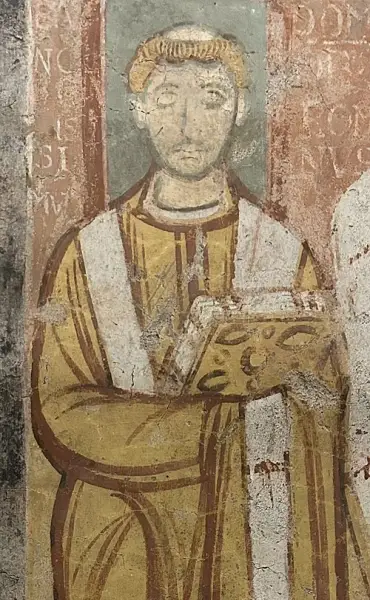
Leo's works outlasted him in stone, in paint, and in the daily sight of every Christian town. The walls he drew around the Vatican hill gave the district its permanent name, the Leonine City, corresponding to the later rione of Borgo, and for centuries they defined the defensive shape of Rome, standing between the apostle's basilica and any raider who came up the Tiber. The Battle of Ostia entered the treasury of papal memory, painted by Raphael and his workshop in the halls where popes would govern for five hundred years, beside the same master's vision of Leo halting the fire of the Borgo with the sign of the cross. His choice of a rooster for the old basilica of St Peter proved the most imitated act of his reign: after him, Nicholas I — the deacon Leo had raised — decreed that the figure of the cock should be placed on every church, and the bird that recalls Peter's repentance still turns on steeples across the world, an emblem Gregory the Great was reputed to have called the most suitable of Christianity. Venerated as a saint by the Catholic Church, Leo is remembered in art in his papal vestments with his rooster beside him. He left Rome safer than any pope had in a century, the apostle's altar regilded, the Saracens beaten at sea, and a young Saxon pilgrim named Alfred carrying the memory of his welcome home to become the scholar-king of England.
§ Iconography
Timeline
- 844
Created cardinal-priest of Santi Quattro Coronati by Pope Sergius II.
§ Early career
- 10 Apr 847
Chosen unanimously to succeed Sergius II and consecrated at once, without waiting for the emperor's consent, after the Saracen raid of 846 had terrified the city.
§ Pontificate
- 849
Summoned Naples, Gaeta, and Amalfi into a league whose fleet, aided by a storm, destroyed the Saracen fleet off Ostia.
§ Battle of Ostia
- 850
Held a Roman synod distinguished by the presence of Emperor Louis II, the first of three councils of his pontificate.
§ Pontificate
- 853
Traveled to Ravenna to settle a dispute with its archbishop, but achieved little against a prelate allied with Emperor Lothair I.
§ Pontificate
- 855
Received at Rome the West Saxon king Aethelwulf and his children, among them seven-year-old Alfred, who had first met the pope as a boy of five in 853.
§ Pontificate
- 17 Jul 855
Died at Rome and was succeeded by Benedict III; buried first in his own monument in St Peter's Basilica.
§ Death and burial
The Record
- Major works
- Leonine Wall around Vatican Hill·Restoration of St Peter's Basilica and the Basilica of Saint Paul Outside the Walls
- Symbols
- Papal vestments·Rooster
- Canonization
- Pre-congregation; venerated as a saint by the Catholic Church
Prayer
Bibliography
Show 9 sources
- Mann, Horace (1910). "Pope St. Leo IV". In Herbermann, Charles (ed.). Catholic Encyclopedia. Vol. 9. New York: Robert Appleton Company.
- Riche, Pierre. The Carolingians: A Family who forged Europe, transl. Michael Idomir Allen. University of Pennsylvania Press, 1993, p. 175.
- Gregorovius, Ferdinand. History of the City of Rome in the Middle Ages, vol. 3, (Annie Hamilton, tr.), 1903, ch. III "The Leonine City", pp. 95ff.
- Partner, Peter. The Lands of St. Peter: The Papal State in the Middle Ages and the Early Renaissance. University of California Press, 1972, p. 62. ISBN 9780520021815.
- Chisholm, Hugh, ed. (1911). "Leo IV." Encyclopædia Britannica. Vol. 16 (11th ed.). Cambridge University Press. p. 433.
- Asser, Life of Alfred the Great.
- Boureau, Alain (2001). The Myth of Pope Joan. Translated by Lydia G. Cochrane. University of Chicago Press. p. 8. ISBN 0-226-06745-9.
- Reardon, Wendy (2004). The deaths of the Popes. McFarland, Incorporated, Publishers. ISBN 9780786415274.
- Cheetham, Nicolas, Keepers of the Keys. New York: Charles Scribner's Sons, 1983. ISBN 0-684-17863-X.
Profile text adapted from the Wikipedia article, licensed CC BY-SA 4.0.
Pray with this saint every day
Save St. Leo IV to your favorites, read the full profile, and get feast-day reminders in the Saints app.
Get the Saints AppFree on the App Store for iPhone and iPad