
21 June 1002 – 19 April 1054·Feast April 19
St. Leo IX
Reforming pope of the eleventh-century renewal
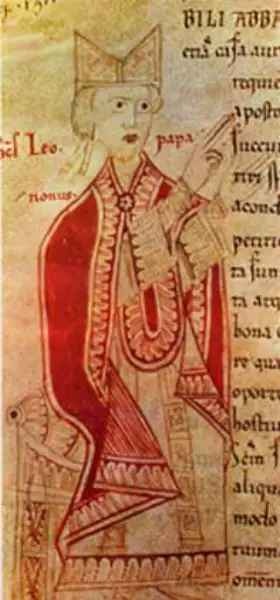
Overview
Born Bruno von Egisheim-Dagsburg in Alsace, the future Leo IX belonged to a noble family related to the imperial house. Placed as a child in the care of the Bishop of Toul, he became a canon there, served in the imperial chapel, and in 1027 was consecrated Bishop of Toul, a frontier see he governed for over two decades through famine and war. His zeal for the Cluniac reform made his reputation, and when Damasus II died in 1048 an assembly at Worms chose him as pope. He insisted on traveling to Rome to be freely elected by clergy and people before accepting, and took the name Leo IX. His pontificate was marked by constant travel and a series of synods that attacked simony and demanded clerical celibacy. He sought to settle the growing dispute with the Patriarchate of Constantinople, though his appeal to the Donation of Constantine sharpened the conflict. In 1053 he personally led an army against the Normans in southern Italy and suffered a crushing defeat at Civitate, spending nearly a year afterward in honorable captivity at Benevento. He died in Rome on 19 April 1054, shortly before the final rupture between East and West that his negotiations had failed to prevent. Gregory VII canonized him in 1082.
The Complete Life
A Noble Child of Alsace
Bruno von Egisheim-Dagsburg was born on 21 June 1002 at Egisheim in Upper Alsace, the youngest son of Count Hugh IV of Nordgau and Hedwig of Dagsburg. His family stood close to the summit of imperial politics, for his father stood as a first cousin to Conrad II, who would become Holy Roman Emperor. Piety surrounded his birth in the memory of later writers, who claimed the infant's skin was marked with small red crosses, a sign some came to regard as a form of the stigmata. At the age of five the boy was entrusted to Berthold, Bishop of Toul, whose school served the sons of the nobility. There he received the formation that shaped his life. In 1017 he became a canon at St. Stephen's in Toul, and seven years later, when his cousin Conrad succeeded to the throne, his relatives sent him to court to serve in the royal chapel. His father and mother, together with two of his brothers, died while he was still a young bishop, and he found consolation in music, in which he showed himself highly proficient.
§ Early life
Bishop of a Troubled Frontier
In 1026, still a deacon, Bruno was drawn from the chapel into affairs of state. When Conrad II marched into Italy to assert his authority, the aged Bishop Herimann of Toul was too infirm to lead the diocese's contingent, and the command fell to Bruno. While he was on campaign, Herimann died and Bruno was elected his successor. Conrad, who had larger plans for the young man, at first hesitated to let him accept so modest a see, but Bruno persuaded the emperor to consent, and he was consecrated in 1027. For more than twenty years he governed Toul through hardship, contending with famine and with the frequent wars that beset a frontier town. He rendered important political service to Conrad II and afterward to Henry III, negotiating between France and the imperial throne a peace of such durability that it outlasted both reigns. He also held his walled episcopal city in resistance to Count Odo II of Blois, who had risen in rebellion against the emperor. His reputation as an earnest reformer grew from his zeal in advancing the Cluniac observance across his region.
§ Early life
A Pontificate of Reform on the Move
When Pope Damasus II died in 1048, an assembly at Worms selected Bruno as his successor that December, and both the emperor and the Roman delegates agreed. Bruno, however, insisted on a canonical election: he would first travel to Rome and accept the papacy only from the free voice of the Roman clergy and people. Setting out after Christmas, he met Abbot Hugh of Cluny at Besançon, where the young monk Hildebrand, the future Gregory VII, joined him. Rome received him warmly in February 1049, and at his consecration he took the name Leo IX. One of his first public acts was the Easter synod of 1049, where celibacy was required anew for clergy of every rank down to subdeacons, and his convictions against simony were made unmistakably clear. He then undertook one of the remarkable journeys of the age, presiding over synods at Pavia, joining Henry III in Saxony, and traveling to Cologne and Aachen. At Reims he gathered the higher clergy and secured important reforming decrees, and at Mainz he held a council attended by Italian, French, and German clergy together with Byzantine ambassadors, again confronting simony and clerical marriage.
§ Papacy
Teaching, Doctrine, and the Eastern Question
Leo IX's reforming energy rested on a vision of a purified clergy. He favored celibacy for those in holy orders and pressed the requirement through repeated councils across Italy, Germany, and France. In April 1050 he held another Easter synod in Rome, occupied chiefly with the teaching of Berengar of Tours on the Eucharist, and that same year chaired provincial synods in Salerno, Siponto, and Vercelli. A third Easter synod considered whether those ordained by simonists needed reordination. The most consequential doctrinal dispute of his reign, however, lay with Constantinople. Patriarch Michael I Cerularius, through Leo of Ohrid, denounced Latin practices concerning unleavened bread and fasting. Leo answered in 1054 with a letter in which he cited the Donation of Constantine at length, believing it genuine, and assured Michael that only the apostolic successor of Peter possessed primacy and rightful headship over the whole Church. Before his death he dispatched Cardinal Humbert of Silva Candida to negotiate with the patriarch; Humbert instead excommunicated him, an act answered in kind, and the breach that followed became the Great East–West Schism. In all of this he treated doctrine and discipline as one work: a clergy cleansed of greed would teach the faith whole, and a faith taught whole would hold East and West together.
§ Relations with Constantinople
Defeat, Captivity, and Death
The Normans pressing through southern Italy threatened both the Byzantines and the papacy, and Leo IX was pressed to intervene. After a fourth Easter synod in 1053 he marched south at the head of Italian troops and Swabian paid soldiers, taking personal command. The Normans, reluctant to raise arms against their spiritual leader, sought peace, but the Swabians mocked the overture and battle followed. On 15 June 1053 the papal forces were utterly defeated at the Battle of Civitate. Yet when Leo went out from the city to meet the victors, they received him with every token of submission, begging forgiveness and swearing fidelity and homage. Even so, from June 1053 to March 1054 the pope was held at Benevento in honorable captivity, released only once he recognized the Norman takeover of Calabria and Apulia. He lived only weeks beyond his homecoming to Rome. Exhausted by hardship and failing health, he died there on 19 April 1054, at the age of fifty-one, within weeks of the excommunications that would cement the schism he had worked to avert. The soldier-pope who had taken the field in person ended his life as a prisoner of the men he had marched against, a paradox his biographers never let fade.
§ Conflict with the Normans
Raised to the Altars
The Church lost no time in honoring Leo IX as a saint. In 1082, less than three decades after his death, Pope Gregory VII canonized him — a fitting tribute from the very Hildebrand who had once walked beside him into Rome, for it was the young monk from Cluny who had joined Bruno's company at Besançon and accompanied him in pilgrim garb to his consecration. The reforming ideals the two men shared had transformed the medieval papacy, and Gregory's own pontificate would carry the program of clerical purity and papal primacy to its dramatic height. Leo's feast is kept on 19 April, the anniversary of his death in Rome. Devotion to him took root both in his native Alsace and in the city of his See, and the memory of the crosses said to have marked his body from birth gave his cult a distinctive popular character. Among the reforming popes of the eleventh century he stands as the one who set the renewal in motion through travel, preaching, and councils, and his canonization confirmed the holiness that his contemporaries had already recognized in his tireless pastoral labor.
§ Pope Leo IX
A Turning Point in the Church's History
Historians rank Leo IX among the most significant popes of the Middle Ages. His restless progress through Italy, Germany, and France made the Roman See a visible, active reality for the first time in generations, and his councils gave the reform movement a doctrinal shape that outlasted him. The tragedy of his reign lies in the East. His reliance on the Donation of Constantine, a document later exposed as a forgery, hardened the dispute with Patriarch Michael Cerularius, and the legatine mission he entrusted to Humbert of Silva Candida ended in mutual excommunication. Though Leo died before the final rupture, and though the act against the patriarch was legally invalid because the pope had already died, the event is popularly reckoned the formal split between the Catholic and Eastern Orthodox Churches, the Great Schism of 1054. Voices of moderation, such as Patriarch Peter III of Antioch, urged compromise and rejected many of Michael's charges against Rome, but the break proved enduring. Leo's defeat at Civitate also marked the beginning of a new chapter, for the Normans whose conquests he acknowledged would soon become papal allies.
§ Relations with Constantinople
Timeline
- 21 Jun 1002
Born at Egisheim in Alsace as Bruno von Egisheim-Dagsburg, son of Count Hugh IV of Nordgau.
§ Early life
- 1017
Became a canon at St. Stephen's in Toul, entering the household of the bishop who had educated him.
§ Early life
- 1026
As a deacon, commanded the Toul contingent on Emperor Conrad II's Italian expedition and was elected Bishop of Toul.
§ Early life
- 1027
Consecrated Bishop of Toul, beginning more than twenty years of leadership in a troubled frontier diocese.
§ Early life
- Dec 1048
Chosen pope by an assembly at Worms after the death of Damasus II, with emperor and Roman delegates concurring.
§ Papacy
- 12 Feb 1049
Arrived in Rome in pilgrim garb and was consecrated as pope, taking the name Leo IX.
§ Papacy
- 1049
Held the Easter synod at which clerical celibacy was required anew and every form of simony was condemned.
§ Theology
- 29 Apr 1050
Presided over an Easter synod in Rome largely occupied with the Eucharistic teaching of Berengar of Tours.
§ Theology
- 1052
Joined Emperor Henry III at Pressburg in an unsuccessful attempt to secure the submission of the Hungarians.
§ Theology
- 15 Jun 1053
Personally led papal forces against the Normans and suffered total defeat at the Battle of Civitate.
§ Conflict with the Normans
- 19 Apr 1054
Died in Rome, not long after returning from honorable captivity at Benevento.
§ Conflict with the Normans
- 1082
Canonized by Pope Gregory VII.
§ Pope Leo IX
In Their Own Words
to liberate Italy that now lacks its freedom and to force that wicked people, who are pressing Apulia under their yoke, to leave
his body [was] marked all over with little red crosses
The Record
- Major works
- 1051 charter·Letter to Patriarch Michael I Cerularius citing the Donation of Constantine
- Patron of
- against schism·musicians
- Symbols
- papal tiara·crosses marked on the body·sword
- Canonization
- Canonized in 1082 by Pope Gregory VII.
Prayer
Bibliography
Show 6 sources
- Coulombe, Charles A., Vicars of Christ: A History of the Popes, (Citadel Press, 2003), 204.
- Butler, Alban, Butler's Lives of the Saints, (Liturgical Press, 2003), 176.
- Ian Robinson, The papal reform of the eleventh century: Lives of Pope Leo IX and Pope Gregory VII (Manchester University Press, 2004), 99.
- Mann, Horace. "Pope St. Leo IX." The Catholic Encyclopedia Vol. 9. New York: Robert Appleton Company, 1910.
- James R. Ginther, Humbert of Silva Candida, The Westminster Handbook to Medieval Theology (Westminster John Knox Press, 2009), 89–91.
- Brett Edward Whalen, Dominion of God: Christendom and Apocalypse in the Middle Ages (Harvard University Press, 2009), p. 24.
Profile text adapted from the Wikipedia article, licensed CC BY-SA 4.0.
Pray with this saint every day
Save St. Leo IX to your favorites, read the full profile, and get feast-day reminders in the Saints app.
Get the Saints AppFree on the App Store for iPhone and iPad