
c. 10 – c. 80·Feast September 23
St. Linus
Second bishop of Rome after Peter
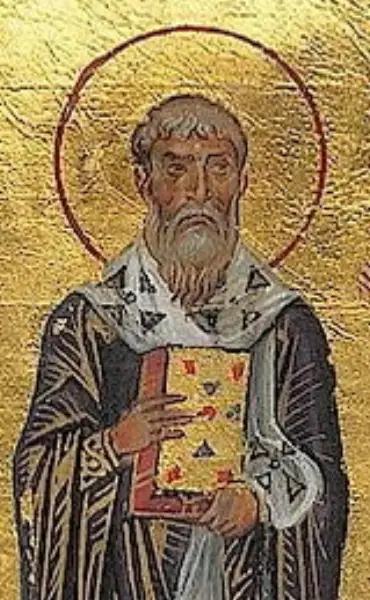
Overview
Linus stands at the very beginning of the Roman Church's institutional life. Ancient tradition records that he was an Italian born at Volterra in Tuscany, the son of Herculanus, and that a Claudia — possibly his mother — appears beside his name in the closing greetings of the Second Epistle to Timothy, where Linus is mentioned as a companion of Paul the Apostle in Rome near the end of Paul's life. According to the succession lists preserved by Irenaeus and Hegesippus and attested by Eusebius, the apostles Peter and Paul entrusted him with the office of the episcopate after they had established the Christian community at Rome. Most later tradition counts him the second bishop of Rome, serving from around 68 until his death around 80, though some ancient writers placed him first. The Liber Pontificalis credits him with ordering that women cover their heads in church and with creating the first fifteen bishops, and it records that he died a martyr, a claim modern scholars consider unproven. His burial was dated to 23 September, the day on which the Church still commemorates him, and his name stands within the Roman Canon, the Mass's oldest Eucharistic prayer. A tomb inscribed LINVS found in Saint Peter's Basilica in 1615 probably belonged to someone else.
The Complete Life
Origins in Tuscany and a Place in Scripture
Later tradition preserved by the Liber Pontificalis makes Linus an Italian, born at Volterra in Etruscan Tuscany around the year 10, his father named Herculanus. The Apostolic Constitutions add the name of his mother, Claudia, and an intriguing detail of the New Testament gives the claim some color: immediately after Linus in the valediction of 2 Timothy, a Claudia is mentioned among those greeting Timothy. Scripture itself never identifies the two, but the epistle does place Linus in Rome at Paul's side near the end of the apostle's life, and Irenaeus, writing around 180, declared this companion to be the same man who would govern the Roman Church. If the identification holds, Linus belongs to that small circle of believers whose names passed from the pages of the New Testament into the living memory of the community they served. Everything else about his origins is fragmentary, yet the convergence of Scripture and patristic testimony gave the second bishop of Rome a pedigree no other early pope could claim: he appears both in the apostolic record and in the earliest succession lists of the Roman Church.
§ Episcopate
Entrusted with the Episcopal Office
The sources agree on the essentials of Linus's vocation even while they differ on its ordering. Irenaeus, Hegesippus, and Eusebius all transmit succession lists in which Peter and Paul, having founded the church at Rome, entrusted the episcopate to Linus. Jerome called him the first after Peter to have charge of the Roman Church, and Eusebius portrayed him as the first to hold the episcopate once the two apostles had been martyred. Optatus and Augustine likewise place him immediately after Peter, while Epiphanius sets him after both apostles, and John Chrysostom reported the common view that he was second bishop of Rome. The Apostolic Constitutions alone claim that Paul himself consecrated Linus as first bishop. Chronology is disputed: Eusebius and Jerome date his episcopate from about 68 to about 80, while the Liberian Catalogue and the Liber Pontificalis put it under Nero. Most scholars judge the earlier dating a mistake, since the same sources allot Peter twenty-five years in Rome and place his death around 67 or 68. Whatever the precise years, Linus led the Roman community through the aftermath of the Neronian terror.
§ Episcopate
Venerated from the Beginning
Linus belongs to the company of saints honored before any formal process of canonization existed. The earliest Christian communities kept the memory of their bishops as a matter of course, and as with nearly all the early popes, his sanctity was received rather than decreed. His commemoration was fixed on 23 September, the date the Liber Pontificalis records for his burial, and it has remained on that day ever since. The current Roman Martyrology describes him with careful precision, recounting that the apostles handed him oversight of the church they had planted in the City, and that blessed Paul names him a companion. The Martyrology notably declines to call him a martyr, whereas the Liber Pontificalis asserts that he died for the faith; scholars such as J.P. Kirsch have judged the martyrdom improbable, since no persecution of the Roman Church is recorded between Nero and Domitian, and Irenaeus singled out only Telesphorus among the early bishops as a glorious martyr. Linus's name nonetheless found its way into the Roman Canon, the Church's most ancient Eucharistic prayer, where he is still invoked among the first witnesses of the Roman faith.
§ Episcopate
A Name That Endured
The memory of Linus gathered both honor and legend across the centuries. The Liber Pontificalis credited him with a decree that women cover their heads in church and with creating the first fifteen bishops for the service of the community, though modern scholars regard the decree as apocryphal, borrowed from Paul's First Corinthian correspondence and attached to Peter's first successor. A letter telling of the martyrdom of the two apostles circulated under his name until scholars determined it was written in the sixth century. In 1615 the antiquarian Torrigio discovered a tomb in Saint Peter's Basilica inscribed with the letters LINVS and assumed it marked the pope's grave, but his own notes reveal that the inscription was merely the ending of a longer, unknown name such as Aquilinus or Anullinus. The Liber Pontificalis nonetheless maintains that Linus found burial on the Vatican Hill beside the Apostle Peter, in the area now known as the Vatican Necropolis beneath the basilica. His fame even crossed the ocean: the city of Saint-Lin–Laurentides in Canada bears his name, a small modern echo of the man who shepherded Rome's Christians in the generation after the apostles.
§ Legacy
Timeline
- 10
Born at Volterra in Tuscany, according to the Liber Pontificalis, which records his father's name as Herculanus.
§ Episcopate
- 67
Ordained by Paul the Apostle, according to the tradition preserved in his early biographical notices.
§ Pope Linus
- 68
Began his episcopate as bishop of Rome, the date given by Eusebius and Jerome.
§ Episcopate
- 23 Sep 80
Died in Rome after about twelve years of episcopal service; the Liber Pontificalis dated his burial to 23 September.
§ Episcopate
- 180
Irenaeus wrote that the blessed apostles committed the office of the episcopate into Linus's hands, the earliest reference to his role.
§ Background
In Their Own Words
the blessed apostles, then, having founded and built up the Church, committed into the hands of Linus the office of the episcopate
without doubt this decree is apocryphal, and copied by the author of the Liber Pontificalis from Paul's First Epistle to the Corinthians (11:5)
The Record
- Major works
- Decree that women cover their heads in church, recorded in the Liber Pontificalis·Creation of the first fifteen bishops, per the Liber Pontificalis
- Patron of
- patron of Volterra
- Symbols
- papal vestments·pallium
- Canonization
- Pre-congregation; venerated as a saint from the earliest Christian era.
Prayer
Bibliography
Show 5 sources
- Kirsch, Johann Peter (1910). "Pope St. Linus". Catholic Encyclopedia. Vol. 9. New York, New York, USA: Robert Appleton Company.
- Irenaeus, Against Heresies, 3: 3.3
- J. N. D. Kelly, Oxford Dictionary of Popes, 2005, pp. 6–7.
- Loomis, Louise Ropes (2006) [1917]. The Book of the Popes (Liber Pontificalis). Arx Publishing, LLC.
- Epiphanius, of Salamis (2009). "27.6.2". The Panarion of Epiphanius of Salamis, Book I (Sects 1–46). Brill.
Profile text adapted from the Wikipedia article, licensed CC BY-SA 4.0.
Pray with this saint every day
Save St. Linus to your favorites, read the full profile, and get feast-day reminders in the Saints app.
Get the Saints AppFree on the App Store for iPhone and iPad