
died 5 March 254·Feast March 5
St. Lucius I
Exiled confessor pope of the Decian aftermath
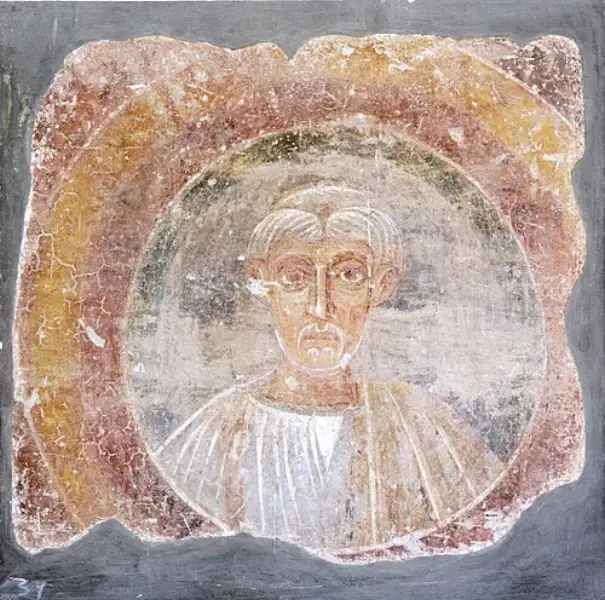
Overview
Lucius was a Roman, son of a man named Porphyrianus, who was elected bishop of Rome probably on 25 June 253, in the shadow of the persecution that had driven his predecessor Cornelius into exile. Soon after his own consecration Lucius too was driven from the city, though he won the right to come back to his flock. His pontificate lasted barely nine months, yet it left a mark on the Church's life: Cyprian of Carthage praised him in several letters for his condemnation of the Novatianists, the rigorists who refused communion to Christians who repented of having lapsed under persecution. Lucius stood firmly with Cornelius's policy of mercy toward the fallen. He died on 5 March 254 and was buried in the cemetery of Callistus on the Appian Way, where his tombstone survives. For centuries he was honored as a martyr, but the persecution of Valerian under which he was said to have died did not begin until after his death, and the 1969 calendar revision removed the mistaken title. The Roman Martyrology remembers him instead as an outstanding confessor of the faith, who endured exile and governed in difficult times with moderation and prudence.
The Complete Life
A Roman of Hidden Origins
Lucius was born in Rome, and the ancient records preserve almost nothing of his family beyond a single name: his father was called Porphyrianus. He emerges into history only at the moment of his election, which tells its own story about the man and his times. The Roman Church of the early 250s was reeling from the Decian persecution, the first empire-wide assault on Christianity, which had cost the Church many confessors and had filled it with the spiritually wounded. Christians who had sacrificed to the gods to save their lives, the lapsi, sought readmission to communion, and a fierce controversy divided the community between those who demanded lifelong penance and those who advocated mercy. In this charged atmosphere the Roman clergy and people chose Lucius, probably on 25 June 253, to succeed Cornelius, the pope who had championed reconciliation and died in exile for it. The son of an otherwise unknown Roman, Lucius inherited both the office and the crisis of his predecessor, and his brief pontificate would show that he had embraced Cornelius's policy as his own. That inheritance shaped every choice of his short reign, from his first breath as an exile to his last defense of mercy for the repentant.
§ Life
Exile, Return, and Mercy for the Fallen
The persecution that had banished Cornelius did not spare his successor. Soon after his consecration Lucius was himself sent into banishment, sharing the lot of the confessors he now led. Yet the blow was brief: he gained permission to return to Rome, and his homecoming made him a living sign that the Church could not be silenced by imperial decree. Back in the city he took up the unfinished argument over the lapsed. Cyprian, bishop of Carthage and the great voice of the reconciliationist party, praised Lucius in several of his letters for condemning the Novatianists, the rigorists who denied communion to any Christian who had repented of sacrificing under persecution. Lucius thus confirmed, at cost to himself, the discipline of mercy that Cornelius had defended against the antipope Novatian. His pontificate ended almost as soon as it had begun, on 5 March 254, after less than nine months. He was laid to rest in the cemetery of Callistus on the Appian Way, the papal burial ground, where his tombstone can still be seen among the oldest monuments of the Roman Church.
§ Life
A Confessor Rather than a Martyr
For centuries Lucius was venerated as a martyr, but the honor rested on an error of chronology. The persecution of Emperor Valerian, in which he was said to have shed his blood, did not begin until after March 254, when Lucius died peacefully as bishop of Rome. The 1969 revision of the Roman calendar dropped his feast from the General Roman Calendar, resting partly on these grounds, and transferred his commemoration in the Roman Martyrology to 5 March, the day he died. The Martyrology's entry does justice to the truth: it records his burial in the cemetery of Callistus, calls him successor of Saint Cornelius, and describes him as an outstanding confessor of the faith who endured exile for Christ and bore himself with a calm, prudent moderation through the troubled season that was his. His observance had its own winding history, absent from the Tridentine calendar of Pius V, inserted into the universal calendar on 4 March in 1602, reduced to a commemoration in 1621 when Casimir's feast took the same date, and finally suppressed in 1969. Veneration of him nonetheless continued, especially in the north.
§ Veneration
A Skull, a Fjord, and a Puzzle of Relics
Lucius's strangest afterlife unfolded far from Rome. His relics were brought to the church of Santa Cecilia in Trastevere together with those of Cecilia and others, but his head eventually traveled north. Around the year 1100 it was taken to Roskilde in Denmark after Lucius had been declared patron of the Danish region of Zealand. Legend told of demons infesting the Isefjord who feared nothing but Lucius's skull; once the relic was brought, peace returned to the waters. After the Reformation the skull passed into the collection of King Frederik III, displayed among the king's curiosities, and it stayed at Roskilde Cathedral until 1908, when it was transferred to Copenhagen's Saint Ansgar's Cathedral. It is among the few Catholic relics to survive the Reformation in Denmark. Yet modern science unsettled the story: researchers, prompted by the possibility that the skull had been confused with that of the Norwegian king Sigurd the Crusader, subjected it to carbon dating. The result dated the remains to a man who lived between 340 and 431, roughly a century after Lucius's death — too late for either the pope or Sigurd, leaving the relic's true identity an open question.
§ Tomb
Timeline
- 25 Jun 253
Elected bishop of Rome, probably on this date, during the persecution that had banished his predecessor Cornelius.
§ Life
- 253
Sent into exile straight after his consecration, he won leave to come back to Rome.
§ Life
- 5 Mar 254
Died in Rome after a pontificate of less than a year and was buried in the cemetery of Callistus.
§ Life
- 1100
His head relic was brought to Roskilde in Denmark, after he had been declared patron saint of Zealand.
§ Tomb
- 1602
His feast was inserted into the General Roman Calendar under the date of 4 March.
§ Veneration
- 1621
The insertion of the feast of Saint Casimir on the same date reduced his celebration to a commemoration within Casimir's Mass.
§ Veneration
- 1908
The skull kept at Roskilde Cathedral was moved to Saint Ansgar's Cathedral in Copenhagen.
§ Tomb
- 1969
His observance was dropped from the General Roman Calendar, in part because the title of martyr was baseless.
§ Veneration
In Their Own Words
In the cemetery of Callistus on the Via Appia, Rome, burial of Saint Lucius, Pope, successor of Saint Cornelius. For his faith in Christ he suffered exile and acted as an outstanding confessor of the faith, with moderation and prudence, in the difficult times that were his.
The Record
- Major works
- Letters condemning Novatianist rigorism, attested by Cyprian of Carthage
- Patron of
- patron of the Danish region of Zealand
- Symbols
- papal vestments·pallium
- Canonization
- Pre-congregation; venerated as a saint since antiquity, though the title of martyr was later judged mistaken.
Prayer
Bibliography
Show 5 sources
- Kirsch, Johann Peter (1910). "Pope St. Lucius I" in The Catholic Encyclopedia. Vol. 9. New York: Robert Appleton Company.
- Martyrologium Romanum (Libreria Editrice Vaticana, 2001), die 5 martii.
- Calendarium Romanum (Libreria Editrice Vaticana 1969), pp. 88 and 118.
- R. Broby-Johansen: Det gamle København (page 164), edited by Thanning and Appel, Copenhagen 1978.
- "Skull and cross wires". The Copenhagen Post. 15 December 2014.
Profile text adapted from the Wikipedia article, licensed CC BY-SA 4.0.
Pray with this saint every day
Save St. Lucius I to your favorites, read the full profile, and get feast-day reminders in the Saints app.
Get the Saints AppFree on the App Store for iPhone and iPad