
died 304·Feast April 26
St. Marcellinus
Pope in the storm of Diocletian's persecution
Overview
Marcellinus governed the Roman Church through the darkest hour of the ancient persecutions. A Roman, the son of Proiectus, he became bishop of Rome on 30 June 296, taking over from Caius, at a moment when the emperor Diocletian still tolerated the Christians and their numbers were growing. The peace collapsed in 302 when Caesar Galerius pressed Diocletian toward repression; Christian soldiers were expelled from the army, church property was seized, the scriptures were burned, and at last the faithful were commanded to apostatize on pain of death. Marcellinus himself stands at the center of the era's darkest controversy. Some sources allege that under the persecution he surrendered the sacred books and offered incense to the idols, repenting soon afterward; the Liber Pontificalis, drawing on his lost acts, says he re-confessed the faith and died a martyr with companions. Augustine of Hippo firmly rejected the charge, and the story of a council that refused to judge him rests on a sixth-century forgery. The martyrdom itself cannot be proven. His burial took place on 26 April 304 in the Priscilla cemetery along the Via Salaria, and after a considerable interregnum Marcellus I succeeded him. He is venerated as a saint in the Catholic and Serbian Orthodox Churches.
The Complete Life
A Roman Son of the Persecuted Church
The Liberian Catalogue preserves the little that is known of Marcellinus's origins: he was a Roman, son of a man called Proiectus or Projectus, born at a date history has not recorded. He belonged to that generation of Roman Christians who grew up in the long peace that followed the crises of the third century. When Caius, bishop of Rome, died in 296, Marcellinus was chosen to succeed him and took up the office on 30 June of that year. The empire he served in was then at the height of its restoration under Diocletian, who had reorganized the Roman world and had not yet turned his hand against the Church. Christian communities were expanding freely, their membership growing across the provinces. No one governing the Roman see in that hopeful season could have foreseen that within a few years the ancient Church would face the most systematic assault in its history. Marcellinus led the Roman Christians through the last years of this calm, keeping the ordinary structures of a growing community, until the storm that Galerius would raise broke over them all.
§ Pontificate
The Gathering Storm of Persecution
Marcellinus's years as bishop of Rome spanned the transformation of imperial policy from tolerance to annihilation. Diocletian himself at first left the Christians undisturbed, but Caesar Galerius, a convinced enemy of the faith, led the pagan movement against Christianity and in 302 won the emperor over to repression. The measures fell in escalating waves: first Christian soldiers were compelled to leave the army; next church property was seized and the scriptures burned. After two fires broke out in Diocletian's own palace, the emperor took still harsher steps, and Christians everywhere faced a stark choice — sacrifice to the gods or die. How the Roman community endured this cataclysm, and how its bishop fared within it, became one of the great unanswered questions of early Church history. The ancient liturgical calendars are silent about Marcellinus: he appears neither in the Martyrologium hieronymianum, nor in the Depositio episcoporum, nor in the Depositio martyrum, an absence that later writers found significant and troubling in nearly equal measure. Marcellinus, who had known only an expanding and confident community, now shepherded his people into an age when every act of worship could cost a life.
§ Pontificate
The Contested End of His Pontificate
Tradition offers two irreconcilable portraits of Marcellinus's final days. The Liber Pontificalis, drawing on the lost Acts of Saint Marcellinus, relates that during Diocletian's persecution the pope offered incense to the idols, but repented shortly afterward, professed Christ anew, and died a martyr alongside several companions. Other documents speak simply of his defection, and Petilianus, the Donatist bishop of Cirta writing early in the fifth century, charged that Marcellinus and his priests had handed over the holy books to the pagans and sacrificed to false gods. Augustine of Hippo firmly denied the whole affair. The records of the pseudo-Council of Sinuessa, fabricated in the early sixth century, describe a fallen pope presenting himself before a council that refused to try him, declaring that the first See is judged by none. What is certain is the date of his burial: 26 April 304, in the Priscilla cemetery along the Via Salaria, twenty-five days after the martyrdom the Liber Pontificalis reports, though the Liberian Catalogue places the burial on 25 October. After a considerable interregnum Marcellus succeeded him. Between the accusation and the denial, later generations have had to leave the question open, honoring the man without claiming to know his last hour.
§ Pontificate
Veneration Amid Uncertainty
Whatever the truth of his last days, the Church of Rome never erased Marcellinus from her memory. The Catholic Church and the Serbian Orthodox Church both honor him as a saint, his cult received from antiquity rather than conferred by process. In the thirteenth century a feast in his honor, kept jointly with that of Saint Cletus, was inserted into the General Roman Calendar under the date of 26 April. The uncertainties surrounding both saints, however, followed them into the modern liturgical reform: in 1969 the joint feast was removed from the calendar. Saint Cletus remains listed in the Roman Martyrology on 26 April, but Marcellinus is no longer named in that professedly incomplete register of recognized saints, a quiet acknowledgment of how much about him remains unresolved. The East preserves a different remembrance. Together with Pope Marcellus, the Serbian Prologue of Ohrid remembers Marcellinus on 7 June by the Julian calendar, a witness that the Churches of the Balkans kept his memory alive long after western calendars had grown uncertain. Even so, his place among the successors of Peter has never been in doubt, and his name remains in the ancient lists of the bishops of Rome.
§ Veneration
A Name Wrapped in Silence and Debate
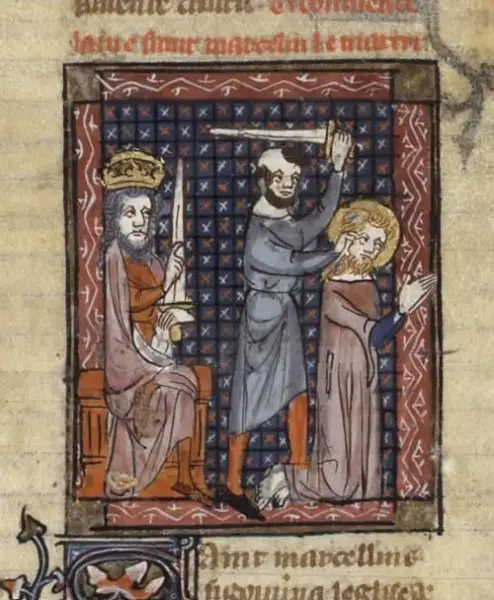
Few popes of the early centuries have provoked as much anxious discussion as Marcellinus, and the debate itself became part of his legacy. His absence from every ancient liturgical list of martyrs and bishops struck medieval and modern scholars alike as evidence of a suppressed scandal, and the charges of the Donatist Petilianus — a polemicist with every reason to blacken the Catholic past — were weighed against the denials of Augustine, the most formidable witness on the other side. The forged council records that made him the occasion for the maxim that the first See is judged by none entered the canon law tradition and shaped centuries of argument about papal accountability. After his death the Roman Church endured a considerable interregnum before Marcellus I took up the office, and the two names have sometimes been confused with one another in the lists. In art he is remembered by the medieval miniature that depicts his martyrdom, and a statue of him stands in the colonnade of Saint Peter's Square, where the Church presents him to the world as one of her own — a bishop tested beyond telling, remembered in hope rather than in judgment.
§ Veneration
Timeline
- 30 Jun 296
Succeeded Caius as bishop of Rome, beginning a pontificate in the final years of imperial toleration.
§ Pontificate
- 302
Caesar Galerius stirred Diocletian against the Christians; soldiers were forced from the army and church property and books seized.
§ Pontificate
- 26 Apr 304
Laid to rest in the Priscilla cemetery along the Via Salaria, twenty-five days after the reported martyrdom.
§ Pontificate
- 1969
The joint feast was removed from the General Roman Calendar amid continuing uncertainty about both saints.
§ Veneration
In Their Own Words
The first See is judged by none
The Record
- Symbols
- papal vestments·palm of martyrdom
- Canonization
- Pre-congregation; venerated as a saint in the Catholic Church and the Serbian Orthodox Church.
Prayer
Bibliography
Show 5 sources
- Kirsch, Johann Peter. "Pope Saint Marcellinus." The Catholic Encyclopedia Vol. 9. New York: Robert Appleton Company, 1910.
- Delehaye, Hippolyte (1911). "Marcellinus, St". Encyclopædia Britannica. Vol. 17 (11th ed.). p. 684.
- Calendarium Romanum (Libreria Editrice Vaticana 1969), p. 121.
- Martyrologium Romanum (Libreria Editrice Vaticana 2001).
- "Prologue from Ochrid".
Profile text adapted from the Wikipedia article, licensed CC BY-SA 4.0.
Pray with this saint every day
Save St. Marcellinus to your favorites, read the full profile, and get feast-day reminders in the Saints app.
Get the Saints AppFree on the App Store for iPhone and iPad