
died 7 October 336·Feast October 7
St. Mark
Brief-reigning pope of Constantine's Rome
Overview
Mark was a Roman, the son of a man named Priscus, who governed the Church of Rome for less than nine months at the height of the Constantinian peace. Succeeding Sylvester I on 18 January 336, he led a church now free from persecution and enjoying the favor of Emperor Constantine. His brief pontificate left lasting institutional marks. According to the Liber Pontificalis, he issued a constitution that clothed the bishop of Ostia with the pallium and ratified his authority to consecrate a newly elected pope, a prerogative the Ostian bishops exercised for centuries. He is also credited with founding the Basilica of San Marco in Rome and a cemetery church over the Catacomb of Balbina, built on land donated by Constantine, and some evidence suggests that the earliest lists of Roman bishops and martyrs were begun under him. Mark died a natural death on 7 October 336 and was laid in the Catacomb of Balbina, the ground he had developed. His body was carried to Velletri in 1048 and in 1145 was translated to Rome's Basilica of San Marco, where an urn beneath the altar holds it. His feast is kept on 7 October, and he is especially venerated at the Abbadia San Salvatore at Monte Amiata.
The Complete Life
A Roman of the Constantinian Age
Little is recorded of Mark's origins beyond what the Liber Pontificalis preserves: he was a Roman by birth, his father named Priscus. The dates and circumstances of his youth are unknown, but the shape of his life was determined by the revolution through which the Church passed in his lifetime. Born into a community that had survived the great persecution of Diocletian, Mark lived to see the Edict of Milan and the transformation of Christianity from a hunted sect into the favored religion of the empire. When Sylvester I, the pope of Constantine's conversion era, died after a pontificate of more than twenty years, the Roman church faced its first transition in the new age of imperial favor. The clergy and people of the city chose Mark, and on 18 January 336 he succeeded Sylvester as bishop of Rome. He inherited a community grown vast and confident, possessing new basilicas and imperial patronage, but still bearing the memory of the cemeteries where its martyrs lay — a memory that would define his own brief ministry. Whatever his family's standing, the choice of a native Roman with an old Roman name speaks of a community still conscious of its own continuity.
§ Pope Mark
Ordering the Papal Succession
The most consequential act of Mark's pontificate concerned not his own office but its future. According to the Liber Pontificalis, he issued a decree investing the bishop of Ostia with the pallium and confirming his power to consecrate the newly elected pope. The small harbor city of Ostia, at the mouth of the Tiber, thus received a permanent dignity in the Church's life, and its bishops stood thereafter among the foremost of the suburbicarian sees. The arrangement reflected the new circumstances of a Church that could now regulate its succession openly, in law and ceremony, instead of hurrying a bishop into office between arrests. In the same spirit of consolidation, some evidence suggests that the Depositio episcoporum and the Depositio martyrum, the early lists of Rome's bishops and martyrs, were begun during his pontificate — an act of historical memory that preserved for posterity the names of the confessors of the persecutions. Mark's months in office were devoted to such quiet structures: codifying rites, recording memories, and binding the young imperial Church to its own past. The paperwork of memory, no less than the parchment of law, became a form of piety in the Church's new freedom.
§ Pope Mark
Basilicas and a Cemetery Church
Mark continued the building program that the Constantinian peace had made possible. The Liber Pontificalis records his founding of the Basilica of San Marco, which still bears his name near the heart of the city, and of a cemetery church raised above the Catacomb of Balbina, just outside the walls. For this second foundation he received lands as a donation from Emperor Constantine, a sign of the favor the Christian communities now enjoyed at court. Building over the catacombs was an act of devotion as much as architecture: the martyrs of the persecutions, whose graves were fast becoming places of pilgrimage, received the dignity of churches above them. In Mark's own case the choice of Balbina proved providential, for it was there that he himself would be buried within the year. The dual foundations — one for the worship of the city, one for the memory of its dead — summed up the priorities of the post-persecution church: to build for the living a worthy house of God, and to honor the dead who had won its freedom with their blood.
§ Pope Mark
A Short Reign and a Peaceful Death
Mark's pontificate lasted less than nine months. He died in Rome on 7 October 336, and unlike so many of his predecessors he died of natural causes, in his bed, in a city where a bishop had recently been able to live and minister without fear. He was buried in the catacomb of Balbina, the burial ground whose church he had founded, laid to rest among the Christians whose memory his building had honored. After him the see of Rome passed to Julius I, who would shepherd the Church through the turbulence of the Arian controversy. Mark's own reign was too brief to touch that storm, but its peacefulness belongs to its era: 336 fell within the brief golden interval between Constantine's patronage and the doctrinal conflicts of the following decades, when the bishop of Rome could die an old man's death and be mourned in peace. In the long line of Peter's successors he stands among the quiet pontiffs, remembered less for crisis than for construction. Eusebius, his successor, inherited a well-ordered see and a city at peace, a rare inheritance in that century of the Church's history.
§ Pope Mark
Relics, Altars, and a Living Memory
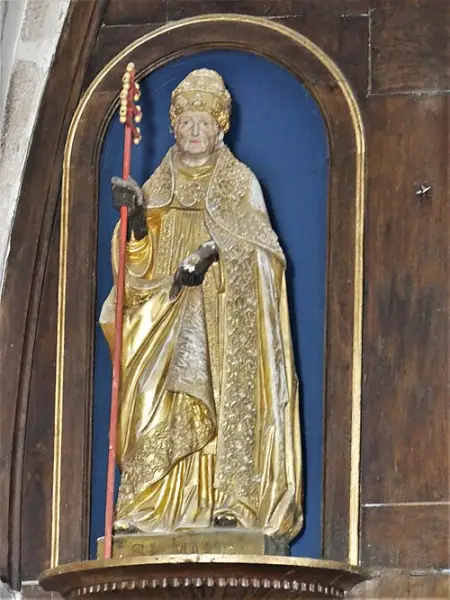
Mark's memory traveled with his relics. He was first honored at his tomb in the Catacomb of Balbina, but in 1048 his body was carried to Velletri, and in 1145 it was translated to Rome's Basilica of San Marco, the church he had founded, where an urn beneath the altar holds it. There the founder returned to his own foundation, his grave joining the city's medieval devotion to its Constantinian past. His feast is celebrated on 7 October, the anniversary of his death, and his cult has a particular home at the Abbadia San Salvatore at Monte Amiata, the ancient abbey in Tuscany where he is especially venerated. A statue of the saint stands in the church of Saint-Marc-à-Loubaud in France, evidence that his memory crossed the Alps. In the history of the papacy his brief reign endures through its institutions: the pallium of Ostia, the early Depositio lists, and the basilica that still carries his name all trace their origin to the few months in 336 when Mark held the chair of Peter. Few pontificates of barely nine months have left so firm a trace in stone, in law, and in the affection of the faithful.
§ Pope Mark
Timeline
- 18 Jan 336
Succeeded Sylvester I as bishop of Rome.
§ Pope Mark
- 336
By constitution he clothed the bishop of Ostia with the pallium and ratified his right to consecrate newly chosen popes, per the Liber Pontificalis.
§ Pope Mark
- 336
Founded the Basilica of San Marco in Rome and a cemetery church over the Catacomb of Balbina on land given by Constantine.
§ Pope Mark
- 7 Oct 336
Died a natural death in Rome after a pontificate of less than nine months and was laid in the Catacomb of Balbina.
§ Pope Mark
- 1048
His remains were carried off to Velletri.
§ Pope Mark
- 1145
His relics were translated to Rome's Basilica of San Marco, where an urn beneath the altar holds them.
§ Pope Mark
The Record
- Major works
- Constitution investing the bishop of Ostia with the pallium and the right to consecrate popes·Foundation of the Basilica of San Marco, Rome·Cemetery church over the Catacomb of Balbina
- Symbols
- papal vestments·pallium·model of a church
- Canonization
- Pre-congregation; venerated as a saint since antiquity.
Prayer
Bibliography
Show 2 sources
- Butler, Alban. "St. Mark, Pope", Lives of the Saints, Benziger Bros., 1894.
- Kirsch, Johann Peter. "Pope St. Mark." The Catholic Encyclopedia. Vol. 9. New York: Robert Appleton Company, 1910.
Profile text adapted from the Wikipedia article, licensed CC BY-SA 4.0.
Pray with this saint every day
Save St. Mark to your favorites, read the full profile, and get feast-day reminders in the Saints app.
Get the Saints AppFree on the App Store for iPhone and iPad