
c. 590 – 655·Feast 13 April
St. Martin I
Martyr Pope Who Defied an Emperor over Monothelitism
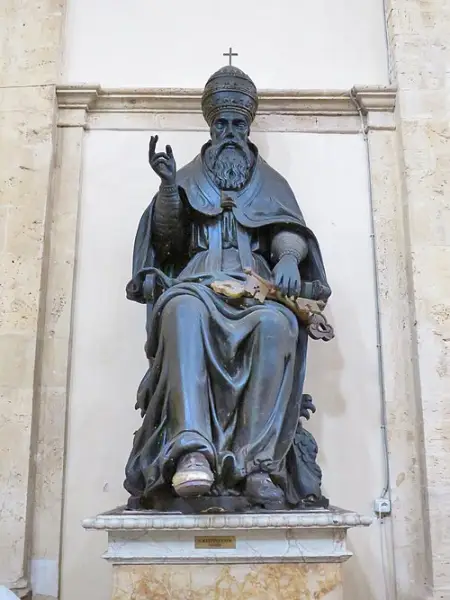
Overview
Martin I, honored as Martin the Confessor, was bishop of Rome from 649 until his arrest in 653, and stands as the last pope the Church has recognized as a martyr. Born between 590 and 600 near Todi in Umbria, on ground that still bears his name, he came of noble stock and showed an early gift for both intelligence and generosity to the poor. He entered the order of St. Basil, became an abbot by 641, and was dispatched by Pope John IV to Dalmatia and Istria bearing funds to relieve war-ravaged communities and ransom captives. His diplomatic skill next carried him to Constantinople, where he served as papal apocrisiarius through most of the pontificate of Theodore I. Elected pope as a deacon without waiting for the imperial mandate customarily required under Byzantine rule, he moved at once against the Monothelite teaching that Christ possessed no human will, summoning the Lateran Council of 649, which condemned the heresy and the imperial Typos that defended it. Emperor Constans II answered with force: after three years of frustrated arrest orders, imperial officers seized Martin in the Lateran on 17 June 653, took him by way of Naxos to Constantinople, and, sparing his life only at the plea of a dying patriarch, banished him to Cherson in the Crimea. He arrived there in May 655, broken in health, and died on 16 September of that year.
The Complete Life
A Noble Umbrian Formed for Service
Martin was born near Todi in Umbria, on ground that came to be called Pian di San Martino in his honor, at some point between 590 and 600. His biographer Theodore records that he was born to nobility, gifted with a commanding mind, and remarkably generous toward the poor — a combination of rank, mind, and mercy that would define his entire career. He belonged to the order of St. Basil, and by 641 he had risen to be an abbot. In that year Pope John IV entrusted him with a mission of mercy of unusual scale: Martin traveled to Dalmatia and Istria carrying large sums of money to relieve the distress of inhabitants whose lands had been ravaged in the invasion of the Sclaveni, and to redeem captives carried off in the fighting. Where the devastation had left churches beyond repair, the remains of distinguished Dalmatian saints were carried instead to Rome, and Pope John, himself a Dalmatian, enshrined them in the Chapel of St. Venantius at the Lateran Baptistery — an edifice still counted among the earliest and most significant martyria, shrines built expressly to house relics carried in from distant lands. The mission revealed the two threads of Martin's later greatness: practical administration on the Church's behalf and a devotion to the martyrs that would one day mark his own life.
§ Early life and career
Ambassador at the Court of Constantinople
From the earliest years of Pope Theodore I's pontificate, Martin served at Constantinople as apocrisiarius, the papal legate or resident ambassador to the imperial court. The posting was one of the most delicate in the Church's service. Rome had become, economically, militarily, and politically, second to Constantinople, the capital of the Eastern Roman Empire, where the Ecumenical Patriarch stood as the most influential churchman and the guardian of Christendom's holiest relics, among them the Crown of Thorns and the True Cross. The eastern half of the empire was meanwhile convulsed by its own crises: Arab expansion pressed upon its provinces, Jerusalem had fallen in 637, and theological disputes over the will of Christ had polarized the Christians of the empire. To hold the line of communication between the Lateran and the Byzantine court through so much of Theodore's papacy was a charge that spoke of Martin's preeminence among the Roman clergy. When Theodore died on 13 May 649, it was as a deacon that Martin was elected to the papal throne — a man tested in diplomacy, seasoned in charity, and acquainted at first hand with the theological politics of the East that he would soon be called to confront as pope.
§ Early life and career
The Lateran Council and the Defense of Christ's Two Wills
Martin's papacy began with an act of defiance. He neither sought nor waited for the consent of Emperor Constans II to his election, and it was without the customary imperial ratification that he had himself consecrated, beginning his pontificate on 5 July 649. The provocation was theological as much as political: the year before, the emperor had issued his Typos, a decree upholding the Monothelite claim — later condemned as heresy — that in Christ there was no human will. Barely three months into his pontificate, Martin called the bishops of the West to assemble in council at the basilica of St. John Lateran and came to be known as the Lateran Council. A gathering of 105 bishops — most of them from Italy, Sicily, and Sardinia, a few from Africa and beyond — sat through five sessions from 5 to 31 October 649 and issued twenty canons censuring Monothelitism, its authors, the writings by which it had spread rifts in the Western Church, the imperial Typos, and Patriarch Sergius's Ecthesis backed by Heraclius. Imperial interference in theological matters had been soundly rejected. Unperturbed by the angry reaction of the Byzantine court, Martin hastened to publish the decrees in an encyclical, and the emperor commanded his exarch in Italy to seize the pope if he would not desist.
§ Papacy (649 – 654)
Arrest, Trial, and the Exile of Cherson
For more than three years Constans II's men failed to lay hands on him, though imperial hostility and accusation never ceased; the emperor accused Martin of unauthorized dealings and cooperation with the Muslims of the Rashidun Caliphate — charges the pope proved powerless to persuade the furious imperial court to abandon. On 17 June 653 the order was finally executed: soldiers seized Martin in the Lateran beside Maximus the Confessor and rushed him out of Rome. He was conveyed first to Naxos and subsequently to Constantinople, reaching the imperial capital on 17 September 653. There his life was spared from execution only through the pleas of Patriarch Paul II of Constantinople, who was himself gravely ill. Martin cherished the hope that no successor would be chosen while he lived, but the imperial government compelled the Romans to elect one, and Eugene I was chosen on 10 August 654 — an election Martin apparently acquiesced in, and which fixed the formal end of his papacy. After exhausting imprisonment and reportedly many public indignities, he was banished to Cherson, arriving on 15 May 655. Sustained there only by the generosity of pious individuals, aged and ill to the point of being unable to walk, he died on 16 September 655, never surrendering the integrity his enemies had labored in vain to break.
§ Papacy (649 – 654)
Confessor and Martyr of East and West
The Church received Martin not as a deposed official but as a witness to the faith. Catholic and Eastern Orthodox Christians alike number him among the saints, and he stands as the final pope whom the Church has honored with the title of martyr. His cult took liturgical form in both traditions: the calendar reform of 1969 gave the Roman rite his memorial on 13 April, observed as the formal anniversary of his passing, whereas earlier editions had set it on 12 November; the Byzantine-rite Churches keep his feast on 14 April, corresponding to 27 April in the New Style reckoning. The Byzantine breviary sings of him as the glorious definer of the Orthodox Faith, unstained by error, the true reprover of heresy, the foundation of bishops and pillar of Orthodoxy who adorned the see of Peter and immovably defended the Church from that divine Rock. In the ninth century Anastasius Bibliothecarius translated into Latin in Rome a selection of the documents recording Martin's trial and exile, ensuring that the record of his endurance would circulate in the West. Pope Pius VII, in his 1800 encyclical Diu satis, held Martin up to the Church of his own day as an exemplar of faithfulness and fortitude, recalling how neither deceit, nor fear, nor promises, nor dangers could break him.
§ Legacy
The Pope Who Broke the Imperial Mandate
Martin's significance reaches far beyond the pathos of his death. He was the only pope of the era when Constantinople controlled the papacy whose election did not await the imperial mandate, and the consecration of 5 July 649 stands in the record as a deliberate assertion that the Roman see owed its authority to Christ rather than to the emperor. The Lateran Council of 649, though it never won ecumenical rank, marked the opening attempt by a pope to convoke a council of ecumenical ambition with no emperor presiding — a constitutional turning point in the relations of the papacy and the empire. The council's condemnation of Monothelitism set the Church's doctrine of Christ's two wills on the course it would ultimately take, and the pope's decision to publish its decrees in an encyclical announced that theological truth was not to be settled by imperial edict. The suffering that followed became part of the argument: the trial documents preserved by Anastasius Bibliothecarius, the liturgical texts of East and West, and Pius VII's testimony all present Martin's endurance of exile as proof that the faith he defended was worth the price of a throne. In the memory of the Church, the quiet scholar-diplomat from Umbria endures as the standard of episcopal courage.
§ Legacy
Timeline
- 641
Sent by Pope John IV to Dalmatia and Istria with money to relieve distress and redeem captives taken in the Sclaveni invasion.
§ Early life and career
- 13 May 649
Pope Theodore I died, and Martin, then a deacon, was elected to succeed him.
§ Early life and career
- 5 Jul 649
Consecrated bishop of Rome without seeking or awaiting the imperial ratification of Emperor Constans II.
§ Papacy (649 – 654)
- 5 Oct 649
Opened the Lateran Council with 105 bishops; over five sessions it condemned Monothelitism and Constans' Typos.
§ Papacy (649 – 654)
- 17 Jun 653
Arrested in the Lateran by imperial officers, together with Maximus the Confessor, and hurried out of Rome.
§ Papacy (649 – 654)
- 17 Sep 653
Arrived in Constantinople as a prisoner, conveyed by way of Naxos; execution was averted by the pleas of the gravely ill Patriarch Paul II.
§ Papacy (649 – 654)
- 10 Aug 654
Eugene I was elected pope under imperial pressure, ending Martin's pontificate; Martin apparently acquiesced.
§ Papacy (649 – 654)
- 15 May 655
Arrived at Cherson in exile after exhausting imprisonment and public indignities.
§ Papacy (649 – 654)
- 16 Sep 655
Died at Cherson, far from Rome, worn out by exile; remembered by the Church as a martyr.
§ Papacy (649 – 654)
In Their Own Words
Indeed, the famous Martin who long ago won great praise for this See, commends faithfulness and fortitude to Us by his strengthening and defense of the truth and by the endurance of labors and pains. He was driven from his See and from the City, stripped of his rule, his rank, and his entire fortune.
Glorious definer of the Orthodox Faith ... sacred chief of divine dogmas, unstained by error ... true reprover of heresy ... foundation of bishops, pillar of the Orthodox faith, teacher of religion.
The Record
- Major works
- Convening and decrees of the Lateran Council of 649, which issued twenty canons against Monothelitism·Encyclical publishing the decrees of the Lateran Council·Diplomatic missions to Dalmatia and Istria and the translation of Dalmatian saints' relics to Rome
- Symbols
- Papal tiara·Martyr's palm·Book of the canons
- Canonization
- Pre-congregation; venerated as a saint and martyr by the Catholic Church and the Eastern Orthodox Church
Prayer
Bibliography
Show 8 sources
- Attwater, Donald (1939). A dictionary of the popes : from Peter to Pius XII. London: Catholic Book Club. OCLC 5978402.
- Bury, John Bagnell (2005). History of the Later Roman Empire Vols. I & II. London: Macmillan & Co., Ltd. ISBN 978-1402183683.
- Kaegi, Walter E. (2006). "The Early Muslim Raids into Anatolia and Byzantine Reactions Under Emperor Constans II". In Grypeou, Emmanouela; Swanson, Mark N.; Thomas, David (eds.). The encounter of Eastern Christianity with early Islam. Leiden: Brill. pp. 73–93. ISBN 978-90-04-14938-0.
- Mackie, Gillian (1996). "The San Venanzio Chapel in Rome and the Martyr Shrine Sequence". RACAR: revue d'art canadienne / Canadian Art Review. 23 (1/2): 1–13. ISSN 0315-9906.
- Mershman, Francis (1913). "Pope St. Martin I". In Herbermann, Charles (ed.). Catholic Encyclopedia. New York: Robert Appleton Company.
- Richards, Jeffrey (1979). The Popes and the Papacy in the Early Middle Ages. Routledge & Kegan Paul.
- Siecienski, Anthony Edward (2010). The Filioque: History of a Doctrinal Controversy. Oxford University Press. ISBN 9780195372045.
- West, Charles (2019). "'And how, if you are a Christian, can you hate the emperor?' Reading a Seventh-Century Scandal in Carolingian Francia". In Kellermann, Karina; Plassmann, Alheydis; Schwermann, Christian (eds.). Criticising the ruler in pre-modern societies: possibilities, chances, and methods. Göttingen: V&R Unipress. pp. 411–430. ISBN 978-3-8471-1088-0.
Profile text adapted from the Wikipedia article, licensed CC BY-SA 4.0.
Pray with this saint every day
Save St. Martin I to your favorites, read the full profile, and get feast-day reminders in the Saints app.
Get the Saints AppFree on the App Store for iPhone and iPad