
died 10 or 11 January 314·Feast 10 January
St. Miltiades
First Pope under Constantine and Judge at the Lateran
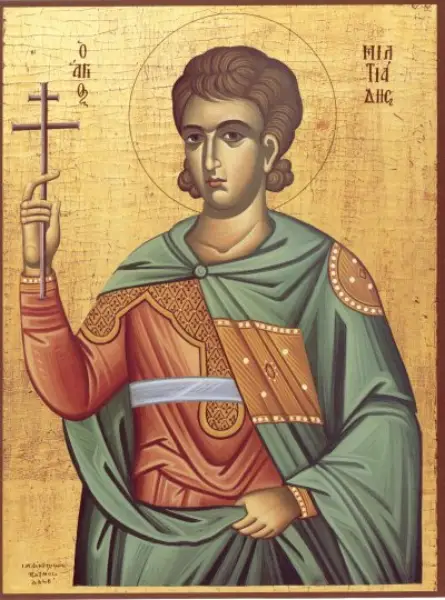
Overview
Miltiades, known in Greek also as Melchiades the African, occupied the Roman see from 311 until he died early in 314 — 10 or 11 January by the record — guiding the church at the moment when Christianity moved from persecution to legal standing across the empire — the opening pontificate of the Constantinian age. Of North African descent and, according to the Liber Pontificalis, a Roman citizen, he had served among the clergy of Pope Marcellinus before his election on 2 July 311 ended a year of papal vacancy following the exile and death of Eusebius. Under Maxentius the church property confiscated in the Diocletianic Persecution was restored to Roman Christians, and in October 312 Constantine's victory at the Milvian Bridge transformed the pope's world: the emperor presented Miltiades with the palace of Empress Fausta, on the site where the Lateran Palace would rise as the papal residence and seat of church administration. In February 313 the Edict of Milan gave Christianity full legal standing. Miltiades also presided over the Lateran Council of 313, the first adjudication of a church dispute commissioned by an emperor, retaining Caecilianus as bishop of Carthage and condemning Donatus's teaching on the rebaptism of apostatizing clergy. The Donatist schism nonetheless spread across North Africa, and Constantine summoned the Council of Arles in 314, after Miltiades had died. He was buried in the Catacomb of Callixtus on the Appian Way and venerated as a saint.
The Complete Life
An African in the Clergy of Rome
The year of Miltiades' birth is unknown, but his origins were clear enough to earn him the ancient byname Melchiades the African. He was of North African descent, born in what is now the region of North Africa that antiquity knew as the Roman province of Africa, and, according to the Liber Pontificalis, the papal register compiled from the fifth century onwards, he was a Roman citizen. His path into the Roman church ran through the clergy of Pope Marcellinus, among whom he served alongside Sylvester I, the man who would one day succeed him as bishop of Rome. The Liber Pontificalis also credits Miltiades with introducing several customs that later scholars believe long predated him, such as the practice of not fasting on Thursdays or Sundays — attributions that reveal how deeply his name became woven into the memory of Roman liturgical life. A darker thread in the tradition also touches his early career: in letters composed between 400 and 410, Donatist Bishop Petilianus of Constantine alleged that Marcellinus, Miltiades, and Sylvester alike had handed over the scriptures and burned incense before pagan gods amid the persecution. Augustine of Hippo repudiated that alleged apostasy, and the church that venerated Miltiades as a saint never received the accusation as fact.
§ Background
Elected at the Turn of the Age
The Liberian Catalogue dates Miltiades' election as pope to 2 July 311, the moment that brought a painful vacancy to its end. His predecessor Eusebius had been exiled to Sicily by the Emperor Maxentius and perished on 17 August in 310 or 309, so the Liber Pontificalis records, soon after his banishment — a death in exile that left the Roman church without a head through the last months of the persecution's aftermath. That the clergy and people of Rome dared to elect a bishop at all in 311 was itself a measure of the changing times: in April of that year the Emperor Galerius had proclaimed his Edict of Toleration at Serdica, formally closing the era of the Diocletianic Persecution in the eastern empire, and in Maxentius's own jurisdiction the new pope soon saw confiscated church property ordered back into Christian hands, though that order probably did not extend to all the territories under Maxentius' control. Miltiades thus began his pontificate exactly where the old age met the new: the scars of the great persecution still fresh, the first legal restorations under way, and a shepherd chosen from the persecuted clergy to lead the Roman church across the threshold into a world it had never yet inhabited — a world in which emperors sought its favor.
§ Pontificate
Constantine's Peace and the Gift of the Lateran
Miltiades was the first pope to serve under Constantine, and his pontificate coincided with what tradition calls Constantine's peace to the Church. In October 312 Constantine overcame Maxentius at the Milvian Bridge, and the new emperor shortly gave the pope the palace of Empress Fausta — the gift from which the Lateran Palace would grow into the papal residence and the seat of the central administration of the Church. February 313 brought the Edict of Milan, the agreement of Constantine with Licinius, master of the eastern empire, to carry toleration of Christianity into Licinius' domains; worship was now free, every place of Christian worship was to be given back, and confiscated property restored. Amid these transformations Miltiades also attended to the intimate bonds of Roman church life: he ordered that the fermentum — fragments of the bread the pope had consecrated — be carried out to every church of the city and its surroundings, a tangible sign that every congregation in the city shared in the one Eucharist of the bishop. Liber Pontificalis attributed further liturgical customs to him, though subsequent scholarship judges many to have predated his pontificate. In three short years the church of Rome had passed from hiding places to palaces, under a pope who had lived through both.
§ Pontificate
The Lateran Council and the Donatist Schism
The first great test of the church's new freedom arrived from Africa, where a schism over the election of Bishop Caecilianus had split the Church of Carthage. Donatus's party, drawn mostly from the North African clergy, insisted that anyone ordained amid schism or heresy must undergo baptism and ordination afresh before exercising office — the question at the heart of the quarrel between Donatists and Catholics — while Rome stood behind Caecilianus. When the Donatists appealed to Constantine and requested judges from Gaul, the emperor consented, entrusting the adjudication to Miltiades sitting with three bishops from Gaul — an unprecedented entry of imperial power into ecclesiastical affairs. Caught between the need to keep the emperor's confidence and the refusal to preside over a verdict left to chance, Miltiades recast the assembly as an ordinary church synod, adding fifteen Italian bishops to the panel. The Lateran Council sat for three days, from 2 to 4 October 313, its conduct borrowed from the courts of Roman civil law, the pope holding the parties to exacting standards of proof and debate. The Donatists, exasperated, withdrew without arguing their cause, and Miltiades ruled for Caecilianus by default, retaining him as bishop of Carthage and condemning Donatus' teaching on the rebaptism of bishops and priests. Miltiades did not live to see the sequel: the Donatists appealed again, Constantine convened the Council of Arles in 314, and it too ruled against them — but Miltiades was already dead by then, having passed away on 10 or 11 January; Sylvester I took his place.
§ Lateran Council
From the Catacombs to the Calendar
Miltiades was buried in the Catacomb of Callixtus on the Appian Way, the ancient burial ground of the Roman bishops, and venerated as a saint. His liturgical memory is among the oldest attached to any pope: according to the Martyrologium Hieronymianum, his feast was already celebrated on 10 January in the fourth century, within living memory of his own generation. The medieval church, however, remembered him under a double error. By the thirteenth century his feast, kept under the name Melchiades, had entered the General Roman Calendar with 10 December as its date, and with the mistaken qualification of martyr — a title his peaceful death under a favorable emperor did not earn, however much his predecessor's exile and his own African origins kept the age of persecution close to his name. The modern reform of the calendar corrected the record: in 1969 the celebration was removed from the calendar of obligatory liturgical celebrations in its December placement, and moved instead to 10 January, the day of his death, with his name given in its proper form Miltiades and without the indication of martyrdom. He remains venerated across the divided households of Christianity — by the Catholic Church, the Eastern Orthodox Church, the Oriental Orthodox Churches, the Anglican Communion, and Lutheranism alike.
§ Veneration
The Pope Who Bridged Two Worlds
Miltiades' legacy lies in the pivot he was chosen to embody: the passage of the church from a persecuted body to an institution courted by imperial power. The gift of Empress Fausta's palace made the Lateran the enduring center of papal administration, and every later century of papal history stands, architecturally and institutionally, on that Constantinian donation. His presidency of the Lateran Council fixed two precedents of lasting weight — that a Roman bishop could adjudicate a great dispute of the African church with the rigor of Roman procedure, and that the rebaptism of those who had lapsed was not to be the church's way, a ruling that the Council of Arles of 314 confirmed after his death. Yet his pontificate also foreshadowed the perils of the new age: Constantine's commission to Miltiades was the first instance of an emperor interfering in church affairs, and yet the judgments handed down in 313 and 314 could not halt Donatism's continued advance through North Africa, where the schism would burden the African church for generations. Miltiades governed through the turn without commanding either world entirely — too late for the catacombs' era, too early to shape the imperial church that followed. The saint of 10 January stands precisely at the hinge, holding fast to the unity of baptism while the ground shifted beneath the church of Rome.
§ Lateran Council
Timeline
- Apr 311
Emperor Galerius issued the Edict of Toleration at Serdica, officially ending the Diocletianic Persecution in the eastern empire.
§ Pontificate
- 2 Jul 311
Elected bishop of Rome according to the Liberian Catalogue, ending the vacancy that followed the death and exile of Pope Eusebius.
§ Pontificate
- 311
Maxentius ordered the return of property seized from the churches during the Diocletianic Persecution.
§ Pontificate
- Oct 312
Constantine overthrew Maxentius at the Milvian Bridge and afterward gave the pope Empress Fausta's palace, on ground where the Lateran Palace would later rise.
§ Pontificate
- Feb 313
Constantine and Licinius agreed to the Edict of Milan, extending tolerance of Christianity and restoring confiscated property and places of worship.
§ Pontificate
- 2 Oct 313
The Lateran Council opened, sitting for three days; Miltiades ruled for Caecilianus and condemned Donatus's teaching on rebaptism.
§ Lateran Council
- 10 Jan 314
Died in Rome on 10 or 11 January, before the Council of Arles convened; buried in the Catacomb of Callixtus on the Appian Way.
§ Lateran Council
The Record
- Major works
- Lateran Council (Synod of Rome, 313), ruling for Caecilianus and condemning the rebaptism of apostatised bishops and priests·Introduction of the fermentum, the distribution of portions of bread consecrated by the pope to all the churches of Rome as a sign of unity
- Symbols
- Papal tiara·Book of canons
- Canonization
- Pre-congregation; venerated as a saint by the Catholic, Eastern Orthodox, Oriental Orthodox, Anglican, and Lutheran churches
Prayer
Bibliography
Show 8 sources
- Burris, Ronald D. (2012). Where Is the Church?: Martyrdom, Persecution, and Baptism in North Africa from the Second to the Fifth Century. Eugene, OR: Wipf and Stock Publishers. ISBN 9781608998081.
- Gibbon, Edward (2008). The History of the Decline and Fall of the Roman Empire. New York City: Cosimo, Inc. ISBN 9781605201221.
- Green, Bernard (2010). Christianity in Ancient Rome: The First Three Centuries. London: T&T Clark International. ISBN 9780567032508.
- Kirsch, Johann Peter (1913). "Miltiades, Pope St.". In Herbermann, Charles G.; Pace, Edward A.; Pallen, Condé B.; Shahan, Thomas J.; Wyne, John J. (eds.). The Catholic Encyclopedia. Vol. 10. New York: Encyclopedia Press, Inc.
- Lenski, Noel Emmanuel (2012). The Cambridge Companion to the Age of Constantine. Cambridge: Cambridge University Press. ISBN 9781107013407.
- Levillain, Philippe, ed. (2002). The Papacy: an Encyclopedia. Vol. 2. New York City: Routledge.
- McBrien, Richard P. (2000). Lives of the Popes. New York, NY: HarperCollins. ISBN 9780060653040.
- O'Malley, John (2009). A History of the Popes: From Peter to the Present. Lanham, MD: Government Institutes. ISBN 9781580512299.
Profile text adapted from the Wikipedia article, licensed CC BY-SA 4.0.
Pray with this saint every day
Save St. Miltiades to your favorites, read the full profile, and get feast-day reminders in the Saints app.
Get the Saints AppFree on the App Store for iPhone and iPad